

Africa News
Kenya digital superhighway takes shape
Kenya plans to expand its national network to bring affordable fibre broadband to millions, writes ARTHUR GOLDSTUCK.

What is it?
Kenya plans to add 100,000 kilometres of fibre-optic cable to its national network, connect six million households and install 25,000 public Wi-Fi hotspots by 2032. It is a national infrastructure programme with a very familiar goal in Africa: An Internet connection that people can afford and use.
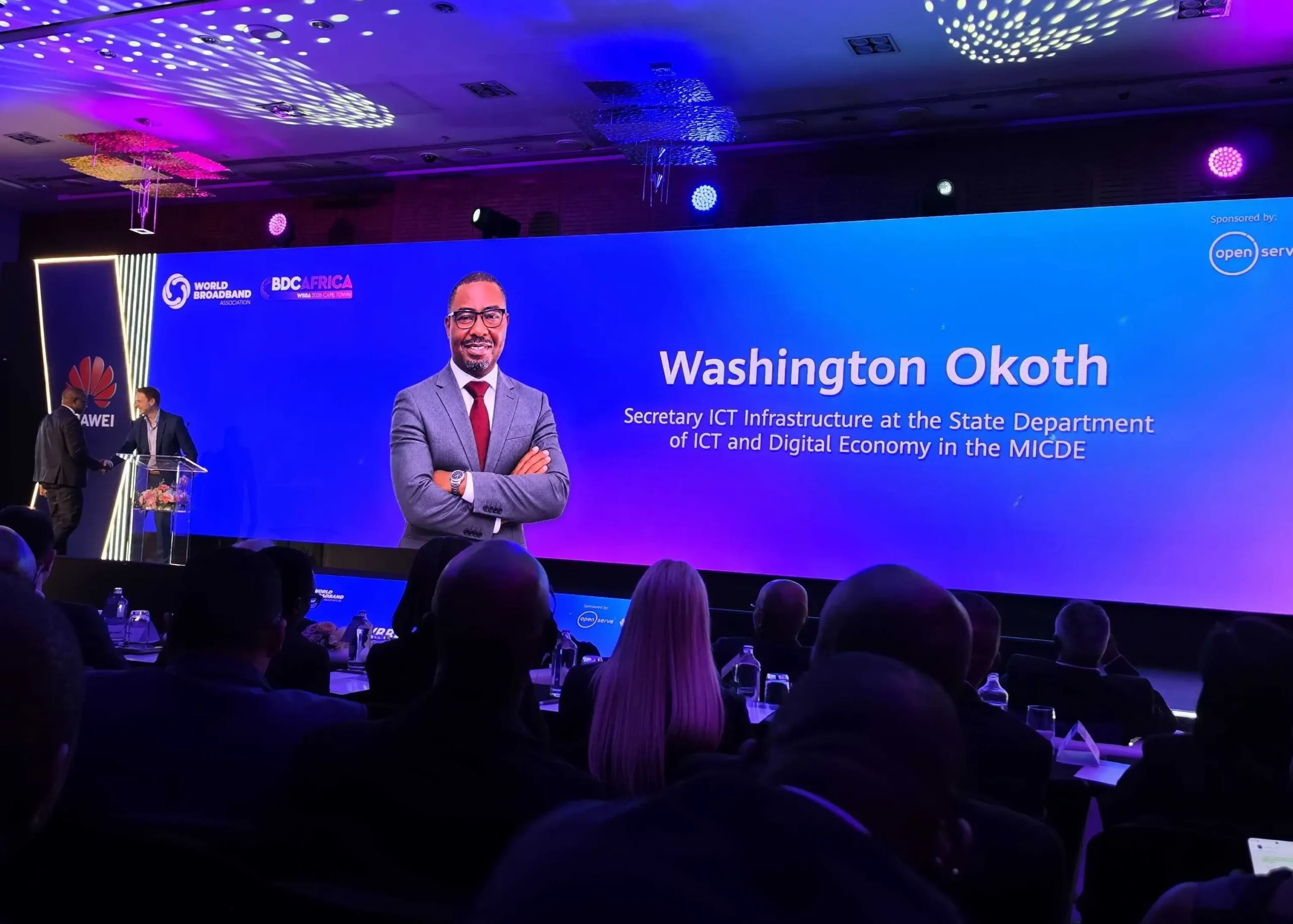
The proposed expansion was outlined by Washington Okoth, Kenya’s secretary for digital infrastructure in the State Department for ICT and the Digital Economy, at the World Broadband Development Congress in Cape Town last week. The event was hosted by the World Broadband Association, with support from Openserve and Huawei, as part of Africa Tech Festival.
Okoth said Kenya already had around 70,000km of fibre and intended to reach communities beyond the existing network through its next National Broadband Strategy, scheduled to run from 2027 to 2032. The programme is designed to reach public institutions as well as homes, bringing high-speed connections to schools and health facilities across the country.

Mukuru, an affordable-housing development in Nairobi where Safaricom has connected a site of 1,000 housing units, offers an early sample of what can be expected.
Huawei has supplied technology for a connected classroom at the New Mukuru primary school, including five Wi-Fi 7 access points and a smart screen. The household network uses Huawei’s Digital Quick Optical Distribution Network (DQ-ODN), which connects sections of fibre with pre-assembled components and reduces the on-site work involved in joining cables. This helps providers connect homes more quickly and at lower cost.
The government is encouraging private internet service providers to adopt other housing developments and install connectivity as part of the infrastructure.
The immediate benefits for households include access to education and online government services. Fibre also creates a way for government to deliver public services without expecting residents to travel to offices and queue for assistance.
Okoth said Kenya had already placed 20,000 public-facing services on its eCitizen platform. The country aims to train more than 20-million people in basic digital literacy by 2032, with an additional focus on the skills needed by civil servants and technology professionals.
The proposed expansion calls for substantial private investment, especially in areas where the cost of connecting individual households makes conventional commercial fibre deployment unattractive.

Okoth said Kenya was working with the World Bank on a new approach to financing these connections.
“We are actually the first country in the world where the World Bank is piloting what we call a reverse auction platform, where we use the private sector to compete in bidding for deploying fibre infrastructure for the various missing links.”
The mechanism allows the government to subsidise infrastructure investment in underserved areas. Okoth said bids had closed on 28 October, and the government expected the programme to address almost 80% of identified network gaps by 2032.
“If this works, then we expect the rest of Africa to adopt that same methodology,” he said. “Without the use of the private sector, government alone cannot afford to ensure that the entire country is connected.”
Kenya is also confronting the gap between its current broadband penetration and the next generation of communications technology being developed internationally.
Okoth said broadband coverage had reached 30% nationally by June 2026, compared with 45% in urban areas. The government wants to increase those figures to 60% and 95% respectively by 2032, and raise 5G coverage from around 30% to 80%.
“One thing that I like about Africa: we are sitting here in 2026 planning how to move 5G coverage by 2032 to 80%, while the rest of the world is planning how to roll out 6G.
“How I look forward to those days when, as we plan in Africa, we plan with the rest of the world. We should actually be talking about reaching 80% as far as 6G coverage is concerned.”
The digital superhighway also provides the infrastructure for Kenya’s national artificial intelligence strategy, which covers the period from 2025 to 2030. Government is targeting applications in healthcare, education and transport, alongside wider adoption of AI in public administration.
“The focus for us is to use AI in improving efficiency as far as public services are concerned, and that’s the reason why we are encouraging the use of AI in delivering public services,” said Okoth.
“We want our public service to be at the frontier as far as the use of AI tools and use cases is concerned.”
South Africa faces a similar challenge: extensive fibre investment has delivered high-speed connections to many urban households, but lower-income communities and rural areas face huge barriers to affordable fixed broadband.
Kenya’s combination of housing developments, public services and subsidised private-sector investment offers an alternative approach to connecting communities that have been left out of commercial network expansion.
Okoth said that broadband planning had to extend beyond national boundaries, and Kenya was working towards harmonising data protection laws across the East African Community.
“We cannot be talking about Kenya and forget about Tanzania,” he said. “We need to think about Uganda as we talk about and plan our connectivity, not forgetting the rest of Africa. Once connected, then we believe the world is connected.”
What does it cost?
In Mukuru, households can get unlimited fibre broadband from KSh800 (ZAR107) a month, using a Safaricom-enabled network developed with Huawei technology. Huawei says the entry-level package is far cheaper than conventional home fibre services.
What are the biggest negatives?
- The expansion depends on heavy investment and government subsidies.
- Kenya’s current broadband coverage of 30% leaves a large gap between existing access and its 2032 targets.
- Affordability achieved in a planned housing development may be harder to replicate in remote communities
What are the biggest positives?
- Fibre broadband from KSh800 a month brings high-speed internet within reach of lower-income households.
- Integrating broadband into affordable housing, schools and government services creates immediate applications for connectivity.
- The World Bank-backed financing model could offer other African countries a way to accelerate broadband expansion.
* Arthur Goldstuck is CEO of World Wide Worx, editor-in-chief of Gadget.co.za, and author of “The Hitchhiker’s Guide to AI – The African Edge”.