



GadgetWheels
Festival of Motoring: Electric sparks added to bakkie party
Introduced at the Kyalami festival, the Geely Riddara brings electricity to bakkies, while promising to drive more like an SUV, writes SHERYL GOLDSTUCK.

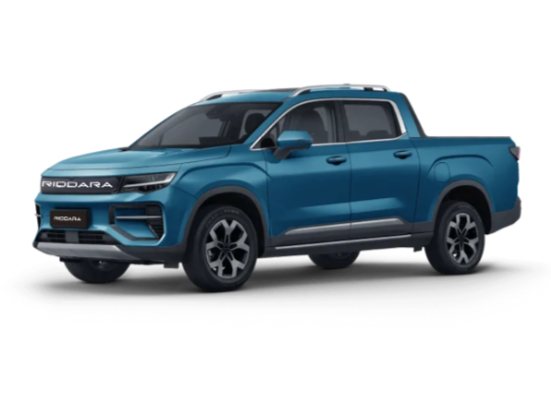
Geely Auto South Africa (GASA) has introduced Riddara, a new-energy bakkie brand, to the country.
Riddara has been developed as a new-energy bakkie from the outset, with the aim of combining the practicality and toughness expected of a bakkie with the refinement and driving characteristics more commonly associated with an SUV.
The company sums it up rather neatly: “Function as a bakkie. Drive as an SUV.”
That is an interesting proposition in South Africa, where the bakkie is about as much a part of the national automotive landscape as the braai and a dusty pair of takkies. A bakkie has to work, play, tow, carry and occasionally venture somewhere where the road has given up entirely.
GASA COO Greg Maruszewski believes Riddara could change the way South Africans think about electric bakkies.
“Electric vehicles have always had the potential to deliver exceptional performance, but the Riddara demonstrates that this does not have to come at the expense of the qualities that make a bakkie so versatile,” he says.

It is a bold claim, but the numbers give it some substance. The flagship Riddara Apex RD6 4WD produces 315kW and 595Nm from its dual electric motors, enough to propel it from 0 to 100km/h in a claimed 4.5 seconds under ideal conditions and with highway terrain tyres fitted.
That is sports-car territory rather than the traditional bakkie arena.
Riddara is the only bakkie brand within Geely Auto Group and benefits from the company’s wider engineering and technology expertise.
The RD6 is built on a marketing automation platform, described as China’s first native new-energy bakkie architecture. It was developed from Geely’s Sustainable Experience Architecture (SEA) and has been engineered specifically around the requirements of a bakkie.
That means the designers could concentrate on things such as strength, payload and towing ability without having to compromise the passenger-car characteristics that are increasingly expected from modern lifestyle bakkies.

The result is a low centre of gravity, instant electric torque, a spacious cabin and a quieter driving experience, while retaining the load-carrying and towing ability needed from a vehicle with a load box at the back.
The Apex RD6 4WD uses a dual-motor all-wheel-drive system capable of switching between two- and four-wheel drive in as little as 20 milliseconds, with torque distributed according to the available traction and driving conditions.
There are also six drive modes: Economy, Comfort, Sport, Sand, Mud and Off-road. So, while Sport might be the obvious choice when demonstrating that 4.5-second acceleration time, sand and mud are likely to get considerably more use when the RD6 leaves the showroom and heads for the great outdoors.
With 225mm of ground clearance and an 815mm wading depth, the RD6 is not intended to be a pavement-only lifestyle accessory either.
Its practical credentials are equally important. The flagship model can carry up to 1,030kg and tow up to 3,000kg, putting it firmly into genuine bakkie territory.
The RD6 uses a 73kWh battery in its 4WD derivatives. The flagship Apex RD6 4WD has a claimed 424km NEDC range, while the Aspire Econ 4WD offers 390km. The Aspire Econ 2WD uses a smaller 63kWh battery and has a claimed NEDC range of 369km.

Charging is handled by a DC system capable of up to 110kW, while the vehicle also features 6kW vehicle-to-load (V2L) capability.
That latter feature could prove particularly useful in South Africa. The RD6 can essentially become a large mobile battery, allowing owners to run equipment and appliances away from the grid. It could also provide a useful source of electricity during load-shedding, although the less said about that particular South African tradition, the better.
Inside, Riddara has taken the SUV part of its brief seriously.
The Apex gets a 14.6-inch infotainment screen, a 10.2-inch digital driver display, wireless smartphone charging and an eight-speaker audio system. This is rounded out by a panoramic roof, leather upholstery and ventilated front seats.
The flat-floor architecture creates additional space in the rear, making the second row more accommodating for adult passengers.
Riddara is entering a South African market where buyers have traditionally been remarkably loyal to familiar bakkie formulas. That makes the RD6 an interesting newcomer.
* Sheryl Goldstuck is general manager of World Wide Worx and editor of GadgetWheels. Follow her on Bluesky on @crazycatbuzz.bsky.social.