


Software
Signpost: And now
for Claudeforce
CRM giant Salesforce has joined forces with AI enterprise leader Claude at a key moment in Anthropic’s history, writes ARTHUR GOLDSTUCK.

Claude is fast becoming the AI model business wants to work with. Every time I give a talk on AI in the enterprise, and ask for an AI choice show of hands, Anthropic’s model moves further ahead of OpenAI’s ChatGPT. No surprise, then, that customer relations software giant Salesforce this week announced it would meet Claude in that same space.
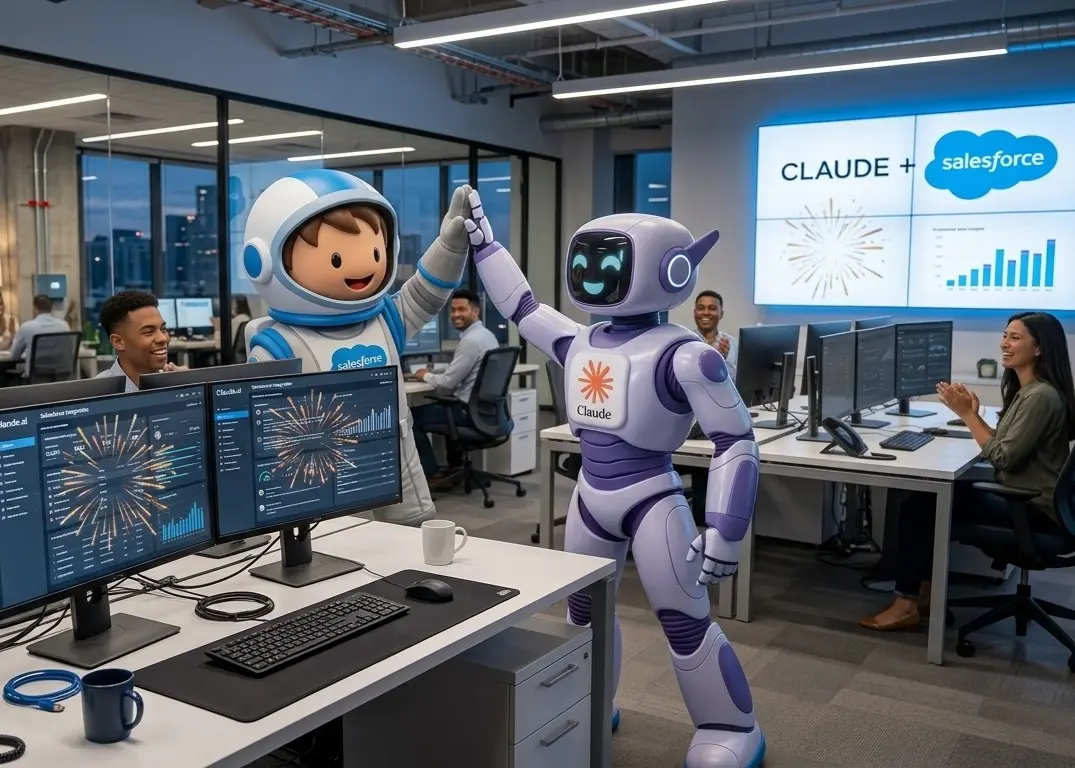
The result of the collaboration between the two leaders is the delightfully named Claudeforce. Unusually, it is a corporate mash-up word that works. A platform rather than a product, its first offering is Salesforce in Claude, a plugin with 37 prebuilt sales skills. A seller can ask Claude to prepare for a meeting or assess the health of a deal using live Salesforce data. Claude can also take actions back into Salesforce, subject to the permissions and business rules already in place there.
In effect, Salesforce controls what happens once Claude tries to act on an answer.
“Here, the UI (user interface) is the AI – allowing you to build custom apps dynamically and answer any enterprise question,” says Marc Benioff, chair and CEO of Salesforce. “Probabilistic intelligence alone doesn’t run a company, and deterministic systems don’t reason. By fusing Claude’s extraordinary reasoning with the trusted data, workflows, and governance every enterprise runs on, we’re delivering a dynamic interface that thinks, reasons, and acts.”
The irony is that Salesforce has built one of the world’s biggest enterprise software businesses by getting companies to work inside Salesforce. Claudeforce is a signal that Salesforce accepts that users may begin their work inside Claude.
In practice, that means a salesperson could ask which accounts need urgent follow-up, or why a deal has slowed. Claude can pull the relevant Salesforce information into the response and, where authorised, update the underlying record. The employee may barely see Salesforce, yet rely on it throughout the task.
Salesforce calls the architecture behind this AIforce. It makes business data and workflows available to AI agents through application protocol interfaces (APIs) – a set of rules that lets different software programs talk to each other – and Model Context Protocol, a common standard for connecting AI systems to external tools and information.
This is where Benioff’s distinction between probabilistic and deterministic systems kicks in. Claude can interpret an untidy request and work through the context, while Salesforce enforces the company’s permissions and workflows when the request turns into action.
The Anthropic tie-in is well-timed, with the AI company preparing for what is likely to be a record-breaking IPO, thanks to becoming one of the strongest contenders for enterprise use of generative AI. Claude has built a particularly strong following in coding and complex knowledge work, giving Salesforce access to an AI platform that many business users are already choosing for serious tasks.
For Anthropic, Salesforce supplies years of customer records and company-specific business process.
Dario Amodei, CEO and co-founder of Anthropic, says: “Salesforce in Claude brings this same frontier intelligence into the systems where much of the world’s commercial activity happens.”
A powerful model becomes far more useful when it can work with live customer information instead of relying on what users copy into prompts. The risk increases at the same time, because the model may be authorised to change records or trigger a workflow.
Claude is also available in Salesforce’s Agentforce as a reasoning model and powers several Salesforce products. It is the default model for Slack AI and Slackbot, while Salesforce plans to make Claude Code and Claude Enterprise available to its developers and knowledge workers as preferred AI tools.
Salesforce says Slackbot is already driving 8.1-million annualised hours of productivity gains among its employees, more than double the level of the previous quarter. It is Salesforce’s own measure, but it helps explain why the company is prepared to place so much of its AI strategy in Anthropic’s hands.
That level of commitment also raises the stakes. Claude is moving from answering questions inside Salesforce to taking actions inside the systems companies use to run customer relationships. Once that includes changing a live record or triggering a workflow, the reliability of Salesforce’s permissions and business rules becomes part of the AI experience itself.
The benefit is obvious, says Amodei: “Through this partnership, companies can point Claude at the customer information and business context that they’ve been building in Salesforce for decades, and use it to actually run and grow their businesses.”
* Arthur Goldstuck is CEO of World Wide Worx, editor-in-chief of Gadget.co.za, and author of “The Hitchhiker’s Guide to AI – The African Edge”.