


GadgetWheels
Guy Botterill takes us flying in a Dakar Hilux
Few drives compare with climbing into a Dakar Rally Toyota Hilux that transform unforgiving terrains, writes SHERYL GOLDSTUCK.

Some experiences stay with one forever. Riding shotgun in a Dakar Rally Toyota Hilux across the dunes of Namibia with Guy Botterill behind the wheel was one of those unforgettable moments. It was exciting, slightly terrifying and completely fascinating, all at the same time. As a motoring journalist, I have driven plenty of impressive vehicles over the years, but being a passenger in a machine built to tackle the toughest rally in the world, driven by the 2024 Dakar Rally Rookie of the Year, was in a league of its own.
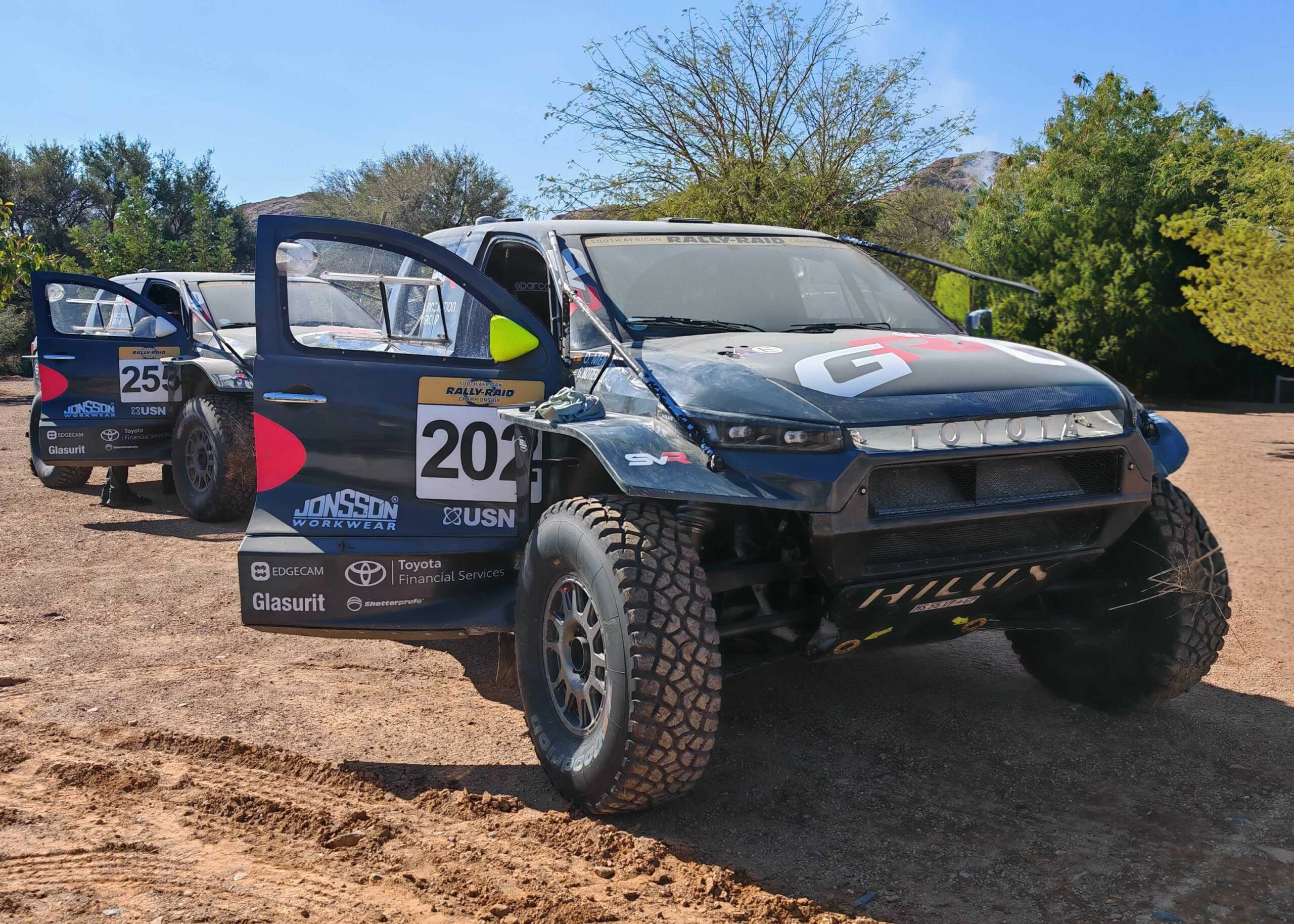
From the outside, the Dakar Hilux resembles a Hilux – on steroids – but that is where the similarity with the showroom model largely ends. Every component has been engineered with one purpose in mind: surviving thousands of kilometres of punishing terrain at extraordinary speed. The technology hidden beneath its composite bodywork is remarkable.
Before we even set off, I was struck by how purposeful everything looked. There are no unnecessary luxuries, flashy screens or decorative trim. Every switch, every display and every control exists because it serves a function. It is motorsport engineering in its purest form.
Sliding into the race seat, I immediately realised this was not going to be an ordinary drive. A multi-point racing harness held me firmly in place, while a roll cage surrounding the cockpit was a constant reminder that safety is as important as speed in rally raid competition. Visibility was excellent, although the interior felt more like a fighter jet than a bakkie.
The beating heart of the Dakar Hilux is a 3.5-litre twin-turbocharged V6 petrol engine, derived from the Toyota Land Cruiser 300. It produces around 298kW of power and approximately 660Nm of torque, although output is regulated under FIA rules. The engine is managed by a sophisticated Motec engine management system, allowing precise control of power delivery in some of the harshest operating conditions imaginable.
As Guy eased onto the throttle, the Hilux accelerated with astonishing urgency. There was no hesitation, only relentless forward momentum. Every squeeze of the throttle translated into immediate response, making the massive dunes and rough gravel tracks seem almost insignificant.

The experience that impressed me most was not the speed, but how intelligently the vehicle put that power to the ground.
The Dakar Hilux uses a six-speed sequential Sadev gearbox, allowing lightning-fast gear changes that keep the engine firmly in its sweet spot. There is no leisurely shifting here. Every gear engagement is crisp, mechanical and immediate. Combined with limited-slip differentials at the front, centre and rear, the drivetrain constantly works to maximise traction over loose sand, rocks and uneven surfaces.
Watching Guy work was almost hypnotic. His hands barely seemed to move as he guided the Hilux across terrain that looked completely impossible from my seat. Small steering inputs, tiny throttle adjustments and complete confidence allowed the vehicle to glide over obstacles that would stop most four-wheel drives in their tracks.
Then there is the suspension.
The Dakar Hilux features double wishbone suspension front and rear, with an incredible 350mm of wheel travel. On paper those numbers are impressive. Experiencing them is something else entirely.
We hit bumps that I instinctively braced for, expecting an enormous impact. Instead, the Hilux absorbed them. The suspension soaked up holes, ridges and uneven surfaces. At times it felt as though we were floating across Namibia rather than driving through it.
That sophisticated suspension technology also gives the driver enormous confidence. Guy maintained remarkable speed while the Hilux remained steady. It was an extraordinary demonstration of how advanced chassis engineering can transform impossible terrain into something almost effortless.
The tyres deserve their own mention. Massive 37-inch tyres wrapped around lightweight competition wheels provide exceptional grip on loose surfaces, while also helping protect the vehicle from the brutal punishment that Dakar competitors face every day. Their enormous footprint allows the Hilux to skim across soft sand, while maintaining stability over rocks and gravel.

One aspect that fascinated me was how much technology is dedicated to reliability. Dakar is won as much by endurance as speed. Every component has been developed to survive relentless punishment. The tubular chassis provides exceptional strength while keeping weight under control. The composite body panels reduce mass and are easier to repair should damage occur during competition. The 540-litre FIA-approved safety fuel cell allows crews to tackle vast distances between refuelling points, which is essential in remote desert stages.
Even inside the cockpit, the electronic systems continuously monitor engine performance, while specialised instrumentation provides critical information to the crew without distraction. Unlike a luxury SUV filled with entertainment features, every display in the Dakar Hilux exists to keep the crew moving at maximum pace, while protecting the vehicle from mechanical failure.
As we blasted across the Namibian landscape, clouds of dust trailing behind us, I found myself grinning inside my helmet. It was impossible not to. Every crest, every slide and every burst of acceleration reinforced just how extraordinary this machine really was.
Of course, technology alone does not create this experience. It still takes an exceptional driver to unlock the Hilux’s full potential. Watching Guy Botterill confidently place the vehicle exactly where it needed to be, while carrying astonishing speed across unpredictable terrain, gave me an entirely new appreciation for the skill required to compete in the Dakar Rally.
When I climbed out, my heart was still racing. I had experienced one of the most technologically advanced off-road racing vehicles ever developed, operating exactly as it was designed to do.
The Namibian desert provided the perfect proving ground, but the remarkable engineering hidden beneath the Hilux’s familiar shape was as spectacular. It proved that success in the Dakar Rally is not only about bravery and determination. It is also about intelligent design, cutting-edge technology and relentless engineering that allows driver and machine to conquer some of the harshest terrain on Earth.
* Sheryl Goldstuck is general manager of World Wide Worx and editor of GadgetWheels. Follow her on Bluesky on @crazycatbuzz.bsky.social.