


Gadget of the Week
Gadget of the Week: Power
without the wall
Lenovo’s Go power bank solves a specific laptop problem that has plagued ARTHUR GOLDSTUCK for years.

Airports are good places to test power banks.
Seats fill up quickly, plug points even faster, and anyone opening a laptop already knows whether the next two hours will be productive or spent watching a battery indicator tick down.
They are also the location where portable chargers are most likely to reveal their limits. They can rescue a phone, but are typically useless with a laptop.
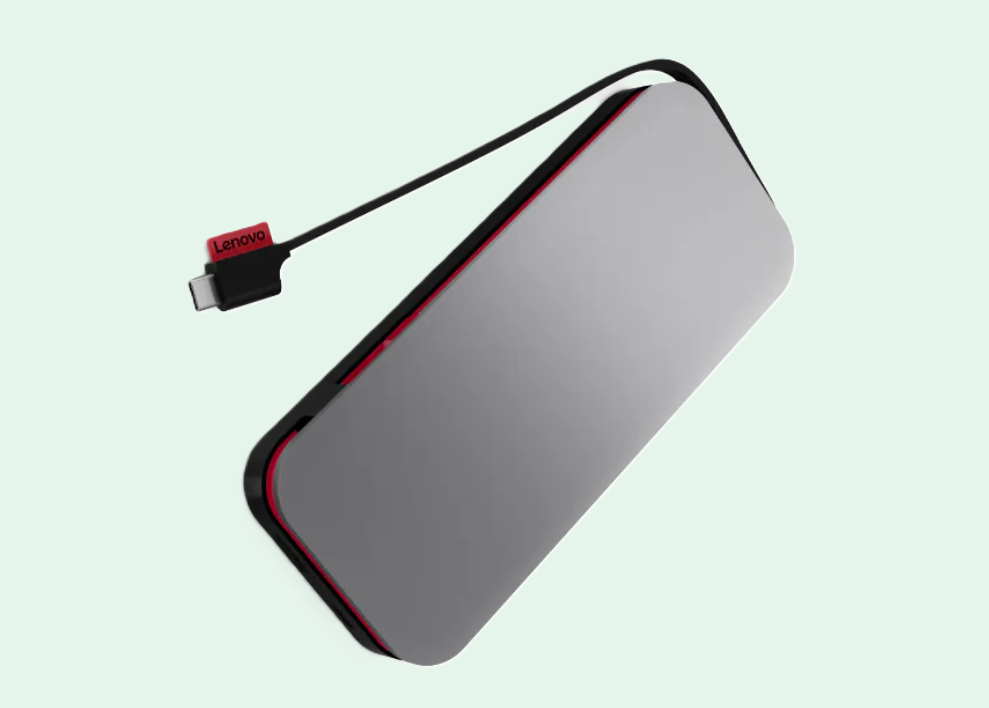
Lenovo’s Go USB-C Laptop Power Bank has been built for that moment, with a clear priority to keep a USB-C laptop running when a wall socket is out of reach.
What is it?
It is a 20,000mAh portable power bank designed to charge USB-C laptops at up to 65 W, with an integrated USB-C cable and support for charging multiple devices.
The specifications tell part of the story. The battery power is equivalent to about 74Wh, and when paired with a 65 W maximum output, means it fits into the narrow band where laptop charging becomes practical. Many power banks advertise large capacities, but fall short on output, and are only good enough for smartphones and less demanding devices. Lenovo has balanced capacity and output.
Connected to an ultrabook or productivity laptop, the Go behaves much like a compact mains charger. Battery levels rise, and the system does not complain about insufficient power as it would with a standard power bank. On a long flight, when portable charging is allowed, that difference is immediately noticeable. In an airport, it is a lifesaver. After years of surrendering to the limits of both battery physics and the ability of airlines to manage on-time departures, I finally have a device that almost elimninates departure lounge entropy.
Work continues as planned, without the constant calculation of which tasks to postpone.
The most useful feature is also the simplest. Lenovo has built a USB-C cable into the body of the power bank. It folds away neatly and removes a frequent failure point in mobile setups. There is no reliance on spare cables of unknown quality and no sudden throttling because the wrong lead has been pressed into service. It is a sensible decision that shows familiarity with real-world use.
The physical design avoids unnecessary fuss. At around 390 g, the unit has enough heft to feel serious but not enough to become a burden in a laptop bag. Its dimensions suit travel, and a four-LED charge indicator gives a quick status check. This is a tool designed to be used and put away.
Alongside the integrated USB-C cable is a second USB-C port and a USB-A port, allowing three devices to draw power at once. The total output remains capped at 65W, so priorities must still be set, but the setup allows a laptop to take precedence while a phone and accessories top up alongside it.
Refilling the power bank is faster than expected for its capacity. With a 65W USB-C charger, a full recharge takes roughly three hours. That makes it easy to incorporate into a daily routine between trips or meetings, rather than treating it as an overnight commitment.

Under sustained load, particularly when charging a laptop close to its maximum draw, the unit becomes warm. That behaviour is typical for compact, high-output power banks and never veered into discomfort during use. Lenovo includes standard protection against overheating, over-current and over-voltage, along with the certifications required for airline travel.
The limitations are straightforward. 65W is sufficient for most business laptops and thin-and-light machines, but performance laptops with dedicated graphics remain dependent on higher-wattage chargers. Phone charging is reliable, though newer fast-charging standards like PPS (Programmable Power Supply) are absent, which means some devices will not reach maximum advertised speed.
Long-term durability is harder to judge from short exposure. Broader user feedback suggests mostly consistent performance, with occasional reports of degradation over time. That reflects the realities of high-capacity portable batteries rather than a unique flaw.
The Lenovo Go USB-C Laptop Power Bank works because it focuses on a narrow problem and solves it competently.
How much does it cost?
Pricing in South Africa typically ranges between R2 000 and R2 500, depending on retailer. It is available through major online electronics stores and Lenovo’s local partners.
Does it make a difference?
It removes the guesswork from laptop charging away from mains power and turns portable charging into a reliable extension of the workday.
What are the biggest negatives?
- Output is insufficient for high-performance laptops under sustained load.
- Some newer phone fast-charging protocols are missing.
- Long-term performance varies, as with many high-capacity power banks.
What are the biggest positives?
- Integrated USB-C cable removes a common point of failure.
- Output level suits most business and productivity laptops.
- Recharge time aligns comfortably with regular use.
* Arthur Goldstuck is CEO of World Wide Worx, editor-in-chief of Gadget.co.za, and author of “The Hitchhiker’s Guide to AI – The African Edge”.