


Stream of the Week
Stream of the Week: Chaos shapes ‘Street Fighter’ score
Distinct sonic soundscapes shape a new movie’s intricate fight scenes, Emmy-winning composers Leo Birenberg and Zach Robinson tell JASON BANNIER.

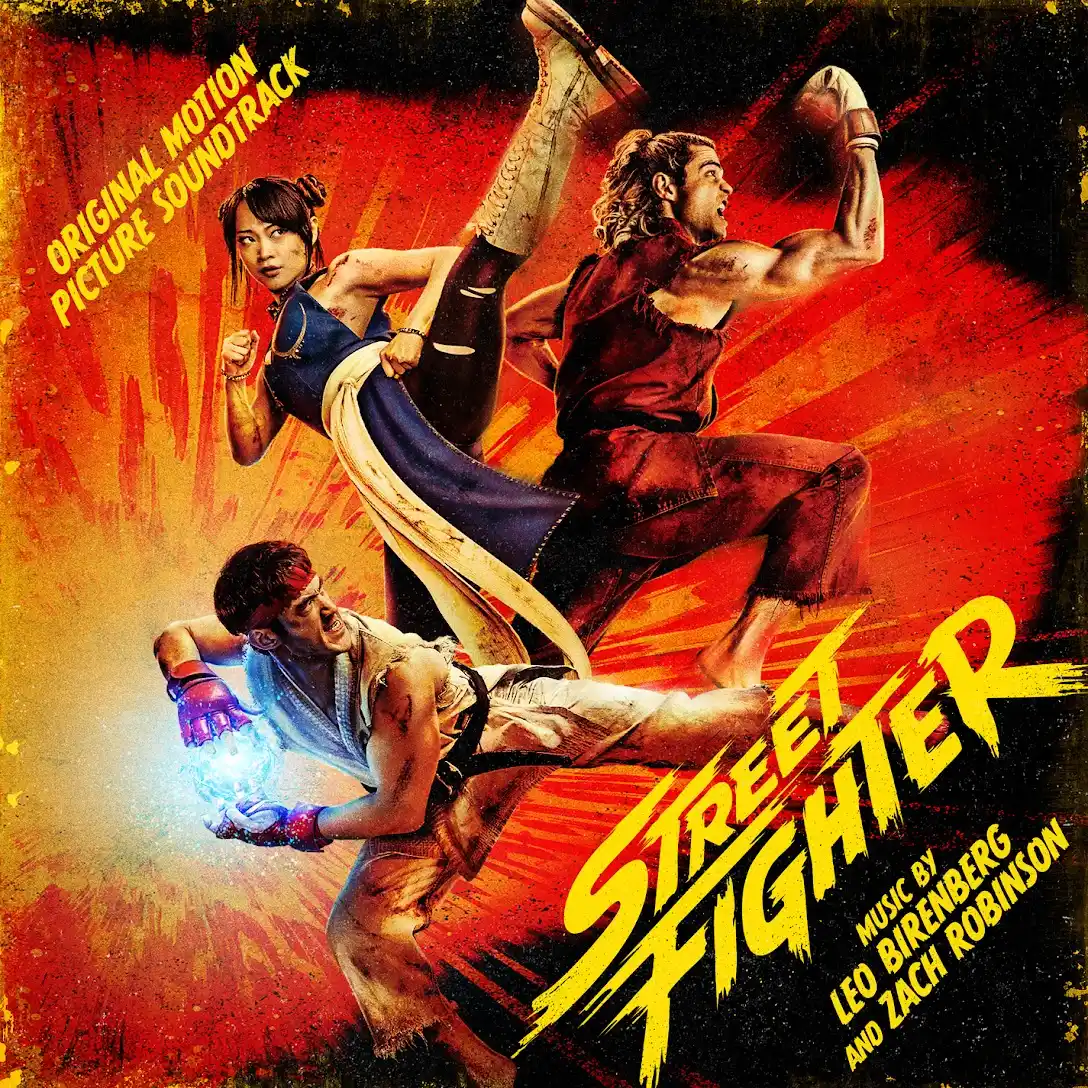
The live-action Street Fighter movie challenged composers Leo Birenberg and Zach Robinson, both Emmy winners, to carry the kinetic energy of old video-game music into film. The result is a score that shifts character, rhythm and intensity as the fights unfold.
“There are certain things that, if you listen to video-game music, you just know are part of the equation,” Birenberg told Gadget.
To carry what he describes as the “spiritual core” of video-game music into the movie, the pair looked beyond familiar themes. Game music traditionally had to loop while keeping players moving forward, often on modest hardware. Birenberg described the late-1980s and 1990s as a golden era of video-game music, when technological restrictions helped shape a distinctive musical style.
“[For] the Capcom sound team that wrote the [1991] Street Fighter II soundtrack, the music’s a little too complicated,” Birenberg said. “The melodies are all over the place, [and it] has this frenetic energy. It all lives in this jazz-fusion-adjacent world, which is funny because it’s all done on whatever chip was just in the console at the time.
“There [were] a lot of limiting factors, and then with all those limiting factors, there’s a huge amount of ambition. It created something unique that we think of as video-game music. Our job on this movie was to capture the spirit of that video-game music and turn it into a film score, which has its own set of needs that are subservient to the drama and images you see on screen.”
The movie puts those ideas into practice from the opening with FIGHT!, one of the first tracks the duo wrote for the score. The piece was released alongside the 39-track soundtrack and the movie last month (16 October 2026).
Robinson told Gadget: “The directive from the filmmakers is they didn’t want this score to sound like a normal kind of blockbuster score. There was going to be orchestra but they really wanted it to feel like this was coming from a place of love to the video game.”
Although the movie is set in 1993, the composers avoided simply recreating music from the decade. They had faced a similar challenge on an earlier project, martial-arts series Cobra Kai, taking elements of 1980s music and making them their own. The same approach shaped FIGHT!, which carries some 1990s influence without sounding like a period recreation.
“There are plenty of ways to score that opening,” Robinson said. “We wanted to treat it like something new that you haven’t heard in a theatre before, but maybe you’ve heard in a video game. Very four-to-the-floor, very aggressive.”
The opening track mixes Charlie Robbins’ percussive, thumping guitar with synthesizers, while Luke Silas helped shape the musical production. The aim was to make the music work as a standalone piece rather than something that only makes sense beneath a movie scene. FIGHT! establishes the main theme, with Robinson describing the piece as their “thesis statement” for the wider score.
Guile’s Theme, associated with the franchise’s American military fighter, posed a different problem because the composers were working with one of Street Fighter’s most recognisable pieces of music. Birenberg said: “Even people who don’t know what Street Fighter is have heard Guile’s Theme in some random pop-culture moment or meme, so we wanted to be faithful.”
The duo did not want to turn the track into another epic orchestral arrangement. With countless versions already circulating online, the aim was to preserve the original while adding some of their own character.
“We wanted to do something that honoured the original, was extremely polished and was just a good time, with a little bit of our special sauce that gives our music personality, but not take it over,” Birenberg told Gadget.
The difficult part, he said, was making sure every syncopation, where musical emphasis falls on an unexpected beat, was correct because the melody is extremely complex.
Robinson said: “The phrasing [in Guile’s Theme] makes no sense. But it is absolutely wonderfully chaotic.”
He said the international roster of fighters gave the composers an opportunity to separate the battles into “their own sonic soundscapes”.
Earlier Street Fighter games featured composers interpreting musical styles associated with each fighter’s country. The film gave the pair a chance to develop that approach further through fighters such as the sumo wrestler E Honda.
“You can very clearly hear, ‘This is the Honda fight,’ because we use Japanese Noh theatre. We use Japanese taikos. It sounds like you’re in Japan.”
Vidyut Jammwal, who plays Indian martial artist Dhalsim, sent director Kitao Sakurai an Indian psytrance track during production. The reference helped shape Dhalsim’s score into a blend of Bollywood music and psytrance.
“We love finding weird genres to mix and match into our projects,” Robinson said. “[For the character] Blanka, [there] is this horror-action piece, but there are a lot of Brazilian rhythms. We had a Brazilian percussionist play a bunch of this stuff. Part of the Street Fighter beauty is characters from around the world, sounds from around the world, so we had to dive into that.”
Akuma, one of the franchise’s most formidable fighters, takes the score somewhere heavier, with progressive-metal rhythms beneath a blaring orchestra. Technology made it easier for the composers to seek out performers suited to those individual sounds.
“Sometimes you find people online, and they’re a perfect fit,” Robinson told Gadget. “We got to work with Jiaju Shen, who’s a pipa player. It’s a traditional Chinese instrument, and she plays it in this incredibly unique way where she slaps it and sounds like a funky bass player. She puts distortion and effects on it, and it’s really cool.”
The unusual sound immediately suggested Chun-Li, the fighter who recruits Ken and Ryu into the World Warrior Tournament. Working across a roughly 15-hour time difference, the composers met Shen over Zoom, sent music to her and received performances back remotely.
“We had guitar players in the UK and people all around the world,” Robinson said. “We recorded in London and Budapest, and it’s all seamless. It’s just everywhere. It’s very Street Fighter. Everyone’s around the world, and they come and they give their best to us.”
Generative AI played no role in the Street Fighter score, but the music industry continues to wrestle with the long-running question of how AI and human creators can coexist. Birenberg said current tools do not fit easily into the particular niche in which the pair works. Their workflow combines highly customised software with constant input from the people making the movie, leaving relatively little that can simply be automated.
“There’s a lot of amazing technology out there, but our job involves wrangling too many human opinions and emotions,” he said. “There’s not really any way to automate parts of the process beyond what’s built into the extremely bespoke software collections that we use.”
Their digital studio has become increasingly dependent on established combinations of software, including older versions that connect with other programs, much like an analogue studio built around particular pieces of hardware. Birenberg could nevertheless see value in AI tools that automate practical parts of his workflow.
“I would love someone to create something that helps my workflow a little bit,” he said. “There are logistical elements that could maybe be automated if the computer could just guess what I was thinking. [For example], adding cymbal swells where I would normally add cymbal swells based on the last 300 action cues I’ve written.”
Robinson said: “People might disagree, but there is no way that AI is anywhere near as close to doing high-level, film-composer-level composing.”
Human judgement, which the pair identifies as fundamental to their specialised work, comes through clearly in the fight sequences. The score changes with each opponent and shifts again as control changes hands, while relationships cut across those individual sounds. Ken and Ryu, whose relationship sits at the movie’s centre, share a recurring brotherhood theme that surfaces during some of their more triumphant moments.
Robinson said: “Each [action] sequence has to be paced in a certain way where you can’t just go all out immediately. There have to be peaks and valleys. We like to construct our pieces of music where it can be easily digestible, whether you’re watching the movie or whether you’re just listening at home. It makes interesting pieces of music.”
Existing songs are interwoven with the original score. In a nightclub sequence, boxer Balrog enters to Many Men (Wish Death) by Grammy-winning rapper 50 Cent, who also plays the character. The combination can be seen and heard in one of the movie’s trailers.
As the fight unfolds, the original score begins to overlap with the song. Music editor Peter Myles deconstructs Many Men, leaving fragments of the vocals around the score rather than treating the two pieces of music separately.
Another layer comes from the movie’s visual style, which shifts between live action and anime-style sequences. The composers did not, however, reserve a separate musical language for the animation.
Birenberg said: “We scored the live action as if it was also anime because that’s the vibe of the era. The anime stuff was a brilliant directorial decision. There’s a thing with anime and Street Fighter in this era of video games. They’re all very interconnected in pop culture, and anime music has its own tendencies that are very different from what you hear in a Western TV show. It tends to just let its music play a lot of the time. It’s a little busier than it needs to be, probably, and as a result it’s really melodic and memorable. It provides a lot of character. We wanted to capture that in our score. We identified that as the glue that helps bridge the gap from video game to live-action movie. If we make it all sound like an anime, it’ll get us partway there.”
* The ‘Street Fighter’ soundtrack can be streamed on Apple Music, Spotify, Amazon Music, YouTube Music, Deezer and Tidal.
* Jason Bannier is a data analyst at World Wide Worx and deputy editor of Gadget.co.za. Follow him on Bluesky at @jas2bann.