


Connectivity
5G expands, but satisfaction falls
South Africa’s broadband gains are failing to translate into happier customers, according to Ookla’s latest network analysis, writes NDABA BIKA.

South African mobile and fixed broadband customers are becoming less willing to recommend their service providers, even as 5G coverage expands and more households connect to fibre.
Network testing company Ookla’s latest analysis, based on its Speedtest Intelligence data, records a sharp deterioration in customer sentiment since 2025. Its Net Promoter Score (NPS) fell to -23.9 for the mobile market and -20.5 for fixed broadband, following an earlier post-pandemic peak.
NPS measures willingness to recommend a provider, subtracting the percentage of detractors from the percentage of promoters. Both scores indicate that detractors outnumber promoters among the customers measured. The findings place the experience of using a connection alongside the industry’s progress in extending its networks.
Ookla’s analysis covers mobile network performance and 5G adoption, as well as fixed broadband trends. Across those measures, it identifies a gap between the availability of faster technology and the service customers receive.
5G reaches further
Ookla’s 5G Service metric recorded 5G coverage detection at 47% of scanned locations in October 2026, up from 14.4% in 2023. That is an increase of 32.6 percentage points, taking detection to more than three times its earlier level.
The measure describes the locations scanned by Ookla. It should be read separately from population coverage, which measures how many people live within a network’s footprint, and from adoption, which measures how many people use the technology.
Despite the expansion, 4G continues to support most users. Ookla’s summary says “4G remains the de facto technology for most users”, with its 4G Availability metric increasing to 94.9%.
The two measures describe different aspects of network access and cannot be added together. The continued importance of 4G also means that progress in the mobile market depends heavily on the experience delivered through that older technology.
A faster national figure masks slower networks
South Africa’s overall median mobile download speed increased by 6.5% to 55.71Mbps in the third quarter of 2026. A median divides the measurements in half, with equal numbers of results above and below it.
The national improvement coincided with declining speeds when 4G and 5G were assessed separately. Over the nine quarters examined, median 4G download speeds fell by 11%, and median 5G speeds dropped by 26.4%.
Ookla attributes the increase in the combined national median to users moving onto the much faster 5G network. As 5G contributes a larger share of measurements, it can lift the combined figure even as performance within each technology deteriorates.
That distinction changes how the headline speed should be interpreted. A higher national median can reflect a change in the connections people use, without establishing that an existing 4G or 5G customer’s service has become faster.
The metropolitan advantage
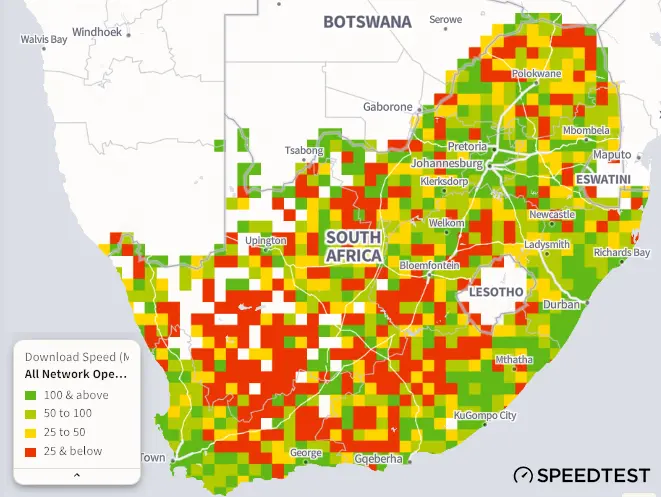
High-speed mobile connectivity remains concentrated in the country’s major metropolitan corridors. Gauteng and the Western Cape recorded the highest 5G shares of Speedtest samples, at 48% each.
Rural and non-metropolitan regions recorded overall mobile speeds below 25Mbps, according to Ookla’s summary. Those results are less than half the national mobile median, illustrating how a countrywide figure can conceal substantial differences in the connections available across South Africa.
Access to the fastest mobile technology remains uneven, with 5G tests concentrated in the two provinces. Users beyond the metropolitan corridors remain more dependent on the performance of 4G, making its declining median speed a concern alongside the expansion of 5G.
Fibre growth meets the package ceiling
Fixed broadband presents a different constraint. Despite rapid growth in fibre subscriptions, the national median fixed download speed increased from 47.75Mbps to 50.83Mbps over the past two years.
That is a gain of 3.08Mbps, or about 6.5%. Half of fixed Speedtest samples remained below 50Mbps, which Ookla links to the continued adoption of lower-speed packages.
Fibre can support speeds far above those recorded in the national median, but customers receive a service governed by the package they buy. Connecting more homes to fibre therefore expands access without automatically producing a large increase in the national download speed.
The findings make package choice central to understanding fixed broadband performance. The capabilities of the underlying network and the speed purchased by the household are separate parts of the service, and the national measurements reflect both.
The customer verdict
The declining recommendation scores accompany improvements in network reach and modest gains in the combined speed figures. They show that extending coverage and increasing connections have yet to produce an equivalent improvement in customer sentiment.
Operators face two immediate demands: improving performance on the 4G networks that still serve most users, and making faster fixed broadband packages accessible to more households. Customers in rural and non-metropolitan areas face an additional gap, with measured mobile speeds still below half the national median despite the broader expansion of faster networks.
* Ndaba Bika is writer and contributor for Gadget.