



GadgetWings
Namibia shines among world’s most Instagrammed places
A new report, mapping the world’s most Instagrammed destinations in 2026, covers over 240 locations across cities, landmarks, and unusual places.

In 2026, discovery happens on a feed before it happens on a map. For a growing share of travellers, the decision of where to go next is made mid-scroll, shaped by a reel, a tagged location, or an image that stops the thumb long enough to plant an idea. In light of this, the team at PlayersTime developed a bespoke Instagrammability Score, combining global monthly Google search demand analysed via Ahrefs Keyword Explorer with cross-platform hashtag volume measured across Instagram and TikTok.
The report, mapping the world’s most Instagrammable destinations in 2026, covers over 240 locations across three categories: cities, landmarks, and unusual places. All metrics were normalised to a 0-100 scale and combined into a single score, with Instagram hashtag volume given additional weighting to reflect its continued role as the primary platform for travel inspiration.
Dubai ranks as the world’s most Instagrammable city with a score of 100, driven by over 190-million Instagram and TikTok posts and 3.43-million monthly Google searches. In the global landmarks ranking, the Dubai-based Burj Khalifa also takes first place, recording over 10.1-million posts and 1.1-million monthly searches, the highest search volume of any landmark in the dataset.
Among the unusual places the team looked at, Setenil de las Bodegas emerged on top with a perfect score of 100. It is a small Spanish town built into overhanging rock formations and one of the most unexpected entries.
Africa stands out more prominently across landmarks and visually distinctive unusual places, and some of the continent’s most compelling findings sit close to the Southern Africa region. However, Namibia overshadows South Africa.
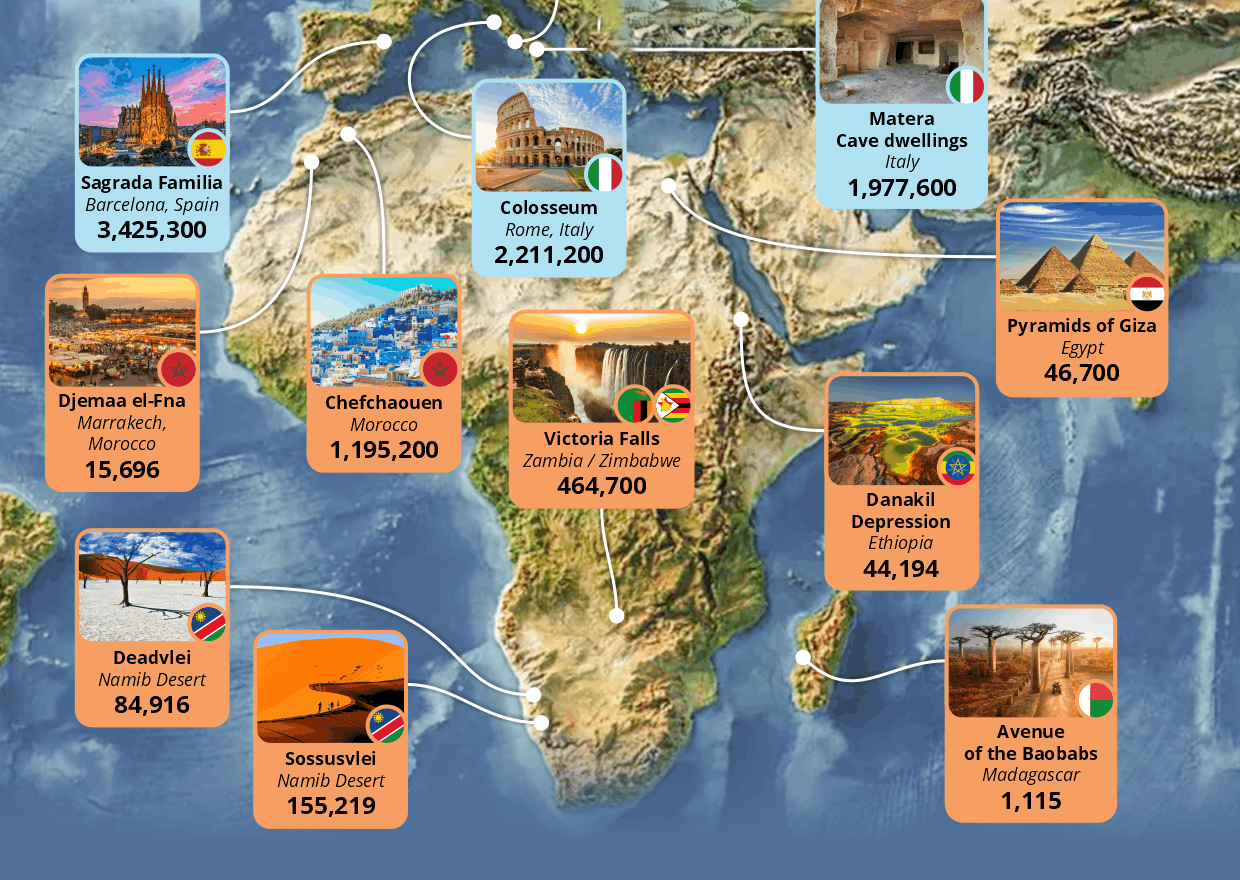
In the Namib Desert, Sossusvlei generates over 155K tagged posts despite modest Google search demand, a pattern that runs through much of the continent. Known for its vast salt and clay pan surrounded by some of the world’s highest red sand dunes, it produces highly recognisable landscapes that perform strongly on visual platforms.
Deadvlei follows a similar pattern, defined by its white clay floor, fossilised camel thorn trees and surrounding dunes, creating one of the frequently photographed desert scenes in Southern Africa. Both locations are often visited as part of wider Southern Africa itineraries.
For landmarks, Chefchaouen (the Blue City) in Morocco emerges as Africa’s most Instagrammable location in the report, generating over 1.19M posts alongside strong search demand of 157K Google searches per month. It is followed by Victoria Falls (Zambia/Zimbabwe), one of the world’s largest waterfalls, which combines high global interest (138K) with social visibility of 464.7K posts on Instagram and TikTok.
In the hidden gems category, Egypt’s White Desert achieves an Instagrammability score of 10.01 alongside Google search demand of 8.2K per month, while Madagascar’s Tsingy de Bamaraha National Park generates over 5.2K posts from a similarly niche audience.
“Instagram has shifted travel from being experience-led to image/reel-led,” says Silvana Vladimirova, data analyst at PlayersTime. “Destinations that rank the highest are those which consistently produce strong visual outputs, whether through architecture, density of landmarks, or atmosphere.
“As visual content continues to drive discovery, destinations that prioritise photogenic environments and recognisable aesthetics are likely to outperform those that rely solely on traditional appeal or historic and cultural significance.”
African Landmarks:
- Chefchaouen, Morocco – Google Search Volume: 157,000 | Social Media Posts: 1,195,200
- Victoria Falls, Zambia / Zimbabwe – Google Search Volume: 138,000 | Social Media Posts: 464,700
- Pyramids of Giza, Egypt – Google Search Volume: 104,000 | Social Posts: 46,700
- Sossusvlei, Namibia – Google Search Volume: 14,000 | Social Media Posts: 155,219
- Deadvlei, Namibia – Google Search Volume: 7,600 | Social Media Posts: 84,916
- Danakil Depression, Ethiopia – Google Search Volume: 15,000 | Social Media Posts: 44,194
- Djemaa el-Fna, Morocco – Google Search Volume: 5,200 | Social Media Posts: 15,696
- Avenue of the Baobabs, Madagascar – Google Search Volume: 2,600 | Social Media Posts: 1,115
African Unusual Places:
- White Desert, Egypt – Google Search Volume: 8,200 | Social Media Posts: 2,801
- Tsingy de Bemaraha, Madagascar – Google Search Volume: 7,000 | Social Media Posts Posts: 5,284
- Draa Valley, Morocco – Google Search Volume: 1,500 | Social Media Posts: 5,246
- Abuna Yemata Guh, Ethiopia – Google Search Volume: 150 | Social Media Posts: 1,078
Other highlights from the report:
- With an Instagrammability score of 100, Dubai tops the cities ranking of the top viral destinations. Its result is driven by more than 190-million Instagram and TikTok posts and 3.43-million monthly Google searches, reflecting its position as a purpose-built global hub for luxury-driven culture.
- London ranks as the second most Instagrammable city on the list, being tagged in 192.2-million social media posts and Googled 1.64-million times every month. Paris and Barcelona follow in the third and fourth positions, both scoring between 82 and 84 points on our Index. These form a tightly clustered European tier with consistently strong performance across both search demand and social media visibility, with Barcelona standing out as the world’s most Googled city – an average of 23-million times each month.
- Burj Khalifa, the tallest building on Earth at 829.8 m (2,722 ft), is the most Instagrammable landmark in the world with a perfect score of 100. It is featured in over 10.1-million tagged posts and 1.1-million monthly Google searches, the only landmark in the entire dataset to surpass one million searches per month. It is followed by the Eiffel Tower and the Grand Canyon, with 662,000 to 696,000 monthly Google searches, but they diverge significantly in social media buzz: 8.63-million posts for the Eiffel Tower compared to 4.75-million for the Grand Canyon.
- Spain’s Setenil de las Bodegas ranks first among unusual places, generating 83.8K posts and 97K monthly Google searches, defined by its houses built into overhanging rock formations. It is followed by Japan’s flower fields and Australia’s Wave Rock, where search demand drops off sharply, at four times lower or more, while social media volume remains comparatively close to the category leader.
- Japan’s Shibuya Scramble Crossing sits outside conventional ideas of a landmark, defined less by a static view and more by the experience of moving through it, with around 3,000 people crossing at peak times. This continuous flow helps drive its 6.57-million tagged posts.