



Gadget of the Week
Gadget of the Week:
IFA gets physical
The best ideas at IFA 2026 in Berlin came from engineers rediscovering what can be done with moving parts, writes ARTHUR GOLDSTUCK.

This weekend’s IFA Berlin 2026, Europe’s largest consumer electronics fair, had all the AI built into all of the hardware in all the usual places: televisions, headphones, kitchen appliances, wall sockets and computers. But the products that made the strongest impression changed what the hardware itself could do.
Flexible screens rolled sideways. Gaming handhelds opened into miniature laptops. A robot vacuum carried a second robot vacuum on its back, and a robotic lawnmower acquired an arm that could clear its own path. Some of it was even useful: a projector folded itself into its own support, and a conventional-looking laptop was designed so owners could get inside without reaching for a screwdriver.
They all added up to a welcome return to mechanical invention. Software may be eating the world, but it looks like hardware engineers are having fun again. Some of these devices may never go on sale, but they should:

Lenovo ThinkBook Project Swan
Lenovo Project Swan begins as a 14-inch business laptop with a flexible OLED display. Press a button and the screen extends horizontally to 17 inches, creating a 16:9 display, while keeping the machine compact enough for travel.
That horizontal expansion gives Swan a practical edge. It grows sideways into something closer to the desktop screen people already know how to use. It gives spreadsheets more room, makes side-by-side windows practical and offers a larger screen for video without asking travellers to pack a second monitor.
It remains a concept, although Lenovo has already proved that it can manufacture and sell a rollable laptop.

Acer Project DualPlay Mini
Acer’s Project DualPlay Mini starts with the familiar shape of an 8-inch gaming handheld, with controls on either side of the display. Then the screen flips and swivels upwards to reveal a physical keyboard underneath.
The effect is wonderfully quirky: a Steam Deck-style device turns into a tiny laptop without adding a detachable keyboard or separate accessory. Acer has kept most of the specifications private because the machine is a prototype, so its appeal is almost entirely in the mechanism.
There is a good reason for experimenting with it. Windows handhelds have become powerful enough to do far more than gaming, but typing on one remains a miserable affair. A built-in keyboard gives the device another life for email, documents, web browsing and PC games that expect keyboard input.
An 8-inch screen is still a very small laptop display and the keyboard is necessarily cramped. Yet DualPlay Mini answers a real problem with a physical solution.

iRobot Roomba Duo
The most delightfully excessive machine at IFA was probably iRobot’s Roomba Duo. It is a large robot vacuum and steam mop that carries a smaller robot vacuum with it. Yes indeed: a double-decker robot vacuum.
The main machine handles open floor areas and functions as a mobile base for the smaller unit. A mechanical arm mounted on top lowers the compact companion onto the floor when it needs to clean under furniture or enter spaces the larger robot cannot reach. Both use the same home map and coordinate their cleaning through the Roomba app.
iRobot says the larger unit can apply 46 newtons of mopping pressure and carries clean and dirty water tanks as well as a dust bag. The smaller robot handles the kind of gaps that expose the limits of bulky all-in-one cleaners.
Robot vacuums have grown taller and more complicated as manufacturers add lidar and advanced cleaning systems. iRobot’s answer is to split the job between two machines and make one carry the other, like a science-fiction mothership.

MOVA AstraX
MOVA took the same mechanical idea into the garden with AstraX, a robot mower equipped with an articulated arm and interchangeable tools.
Whereas robot lawnmowers are usually programmed to detect an obstacle and drive around, AstraX is designed to do something about it. MOVA says the arm can pick up objects that block the mower’s route, collect low-hanging fruit and swap to a spray attachment for watering parts of the garden. Once the obstacle is removed, the mower can continue cutting. That turns the lawnmower into a more general garden robot.
The mechanical arm also supplied one of IFA’s more eccentric demonstrations: several AstraX units moved their arms in synchronised routines to a DJ set.

Aurzen ZIP Pro
Aurzen’s ZIP Pro is the most immediately buyable example of the same thinking. It is a Full HD portable projector built around a body that folds into three sections.
Closed, it is compact enough to slip into a bag. Open it and the hinges become the projector’s support, allowing the lens to be angled without a separate support or tripod. The design also supports horizontal and vertical projection, useful for anyone determined to project phone video in upright format.
The Pro model increases native resolution from the original ZIP’s 720p to 1080p and doubles brightness to 200 ANSI lumens. Battery life rises from about 1.5 hours to as much as 2.5 hours, while USB-C video input allows a laptop, phone or gaming handheld to connect directly. Wireless casting includes AirPlay, Miracast and Google Cast.
At 200 lumens, it works best in controlled lighting. Its appeal is portability and the fact that the folding mechanism performs useful work.
Price: US$579.99 on pre-order.

Acer Vero 16
The Acer Vero 16 looks almost conservative beside rolling screens and robot motherships, but its best mechanical trick may have the longest useful life.
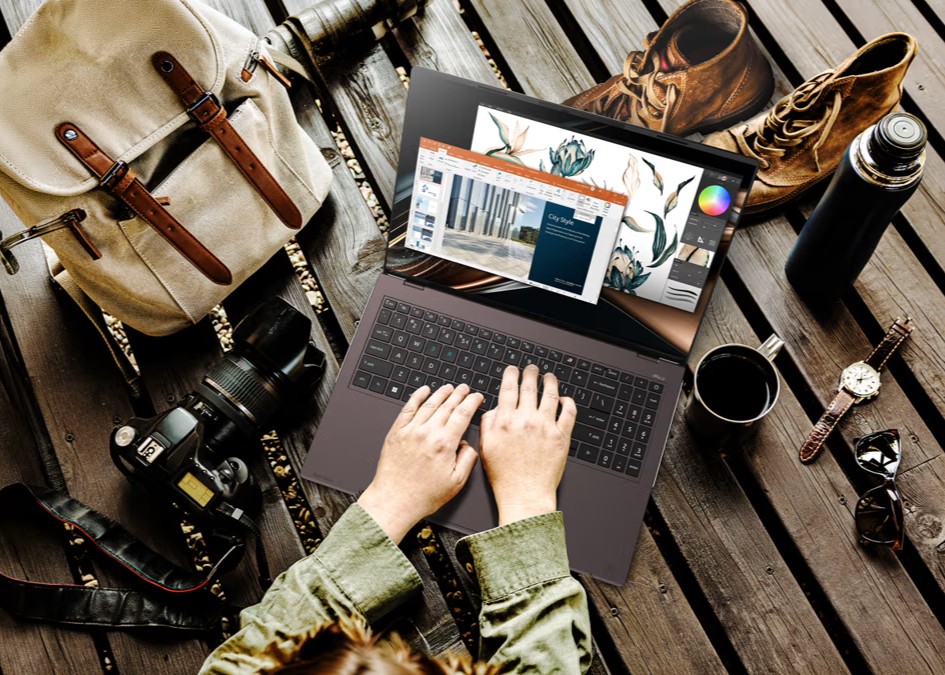
A latch on the underside opens the machine without tools, giving access to internal components. The SSD and battery are user-replaceable, the side I/O port covers can be removed for servicing, and Acer has made the hinge detachable from the chassis. The company says the design will support processor upgrades for at least two generations.
That last feature is unusual for a mainstream laptop. Processors are normally among the least accessible parts of a modern notebook, often soldered to the motherboard and effectively fixed for the life of the machine.
Vero began as Acer’s environmentally focused range, using recycled plastics and lower-impact materials. With the new Vero 16, the sustainability argument extends into repair. A laptop that can have a worn battery, damaged port, broken hinge or ageing processor dealt with separately has a better chance of remaining useful for longer.
The machine itself is a premium 16-inch Copilot+ PC, with Intel Core Ultra Series 3 processors, options up to a 3K OLED display and a weight of about 1.56kg. Those specifications make the repairable design more compelling because Acer has applied it to a serious everyday computer instead of a worthy but compromised eco-product.
* Arthur Goldstuck is CEO of World Wide Worx, editor-in-chief of Gadget.co.za, and author of The Hitchhiker’s Guide to AI – The African Edge.