
Software
SA app tracks financial cost of being a woman
Femio was founded on the observation that women spend money every month on costs tied simply to their biology.

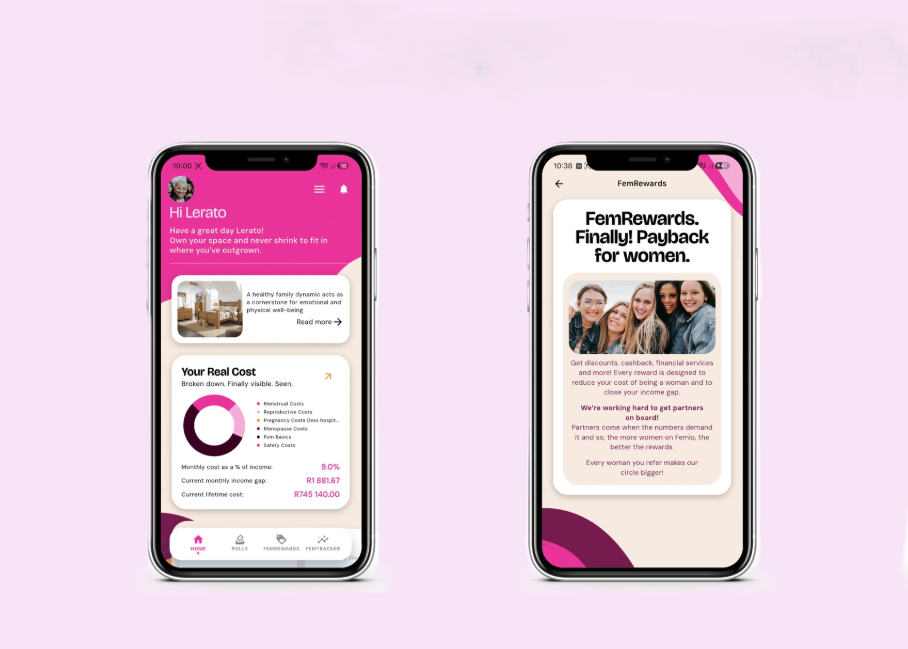
Femio, a “femtech” startup, has launched a mobile app to help women track the true cost of being a woman and turn their collective spending power into real, tangible rewards and agency.
Femio was founded on a simple but urgent observation: women spend money every month and every year on costs tied simply to their biology, from menstrual and reproductive products to menopause and personal safety. These costs increase a woman’s financial disadvantage even before she’s earned a salary, yet there is no data on this impact, and no policy addressing it.
Early estimates from FemTracker suggest these gender-specific costs can add up to roughly R900 a month per woman, though this will vary from woman to woman as more usage data is analysed.
Projected over a woman’s reproductive lifespan, that cost, and its future lost value is startling.
- R900: estimated monthly cost of being a woman (early FemTracker data)
- 28 years: a woman’s reproductive lifespan
- R302,400: total cost paid over that time (R900 x 12 months x 28 years)
- R657,000: what that same money could have grown to if invested monthly at a modest 5% average annual compound interest over the same period
(Figures are illustrative, based on early product data and standard compound interest assumptions.)

Femio was built to address the structural and financial disadvantage women continue to face:
- 42.4% of households in South Africa are headed by women, meaning nearly half the country relies on a single income to cover every household cost (Statistics South Africa, General Household Survey)
- South African women are paid 23-35% less than men for the same work (World Economic Forum, Global Gender Gap Report)
- At the current global rate of progress, full gender parity is still 123 years away (World Economic Forum, Global Gender Gap Report 2025)
- Despite this, women make up 80% of all purchases in supermarkets
The cost of being a woman only widens the gender pay gap further, a mandatory cost paid whether you’re employed or not.
Through FemTracker, women can calculate what being a woman actually costs them, and get real money back through rewards from retail, banking, education, and healthcare partners. Femio also connects women to a marketplace of women-owned businesses, and to FemUp, a hub of tools and resources to help them act on their financial power.
“I’ve lived the reality of so many women of being a single mother, working hard and still not having enough at the end of the month,” says Monalisa Sibongile Zwambila, founder and CEO. “Femio comes from that experience. The app is about giving women meaningful support and the agency to use it, so that when it comes to who benefits from being a woman, the answer is: finally, women do.”
Zwambila is also founder and CEO of Riverbed, a female-owned communications agency, which she built into the first women-owned agency to rank at the Loeries and to scale revenue beyond R100-million in an industry long dominated by men. Femio marks her entry into technology and femtech, spaces where women founders remain the exception rather than the rule.
Femio has been entirely self-funded through its pre-seed phase. Following the MVP (Minimal Viable Product) launch, the company will begin raising a seed round to accelerate growth and expand its partner network across retail, banking, education, healthcare and lifestyle.
Femio is available to download on the App Store and Google Play.