


GadgetWheels
CES 2026: Mapbox redraws the in-car map
From lane-level guidance to digital driver displays, Mapbox is reshaping how navigation works, writes ARTHUR GOLDSTUCK.

Mapbox sits behind more in-car navigation systems than most drivers realise. Rather than presenting a consumer product, the company supplies the mapping and location platform that carmakers use to build their own navigation experiences, shaped to their vehicles, software stacks and design priorities.
At CES 2026 in Las Vegas this week, Mapbox used a series of announcements and briefings to show how that role is expanding. Navigation built on its platform now reaches beyond turn-by-turn directions into lane-level guidance, digital instrument clusters and deeper integration with vehicle software.
David Sniderman, head of product marketing at Mapbox, described the shift as one of ownership rather than replacement. “We are seeing automakers wanting to build their own navigation experiences,” he told Gadget. “They don’t want something generic dropped into the vehicle. They want control over how it looks, how it behaves and how it evolves.”
That control extends to how maps are designed and rendered. Carmakers using Mapbox develop their navigation applications in-house, styling maps to match the digital cockpit rather than treating navigation as a separate layer. “They can customise it to meet the range of models they have. They don’t have to start from scratch every time.”
A key part of that flexibility comes from how Mapbox updates its data. Instead of relying on periodic map releases, the platform ingests de-identified telemetry from billions of miles driven, combined with satellite imagery and other sources. Updates reach vehicles through over-the-air delivery, allowing navigation to evolve as roads and driving patterns change.
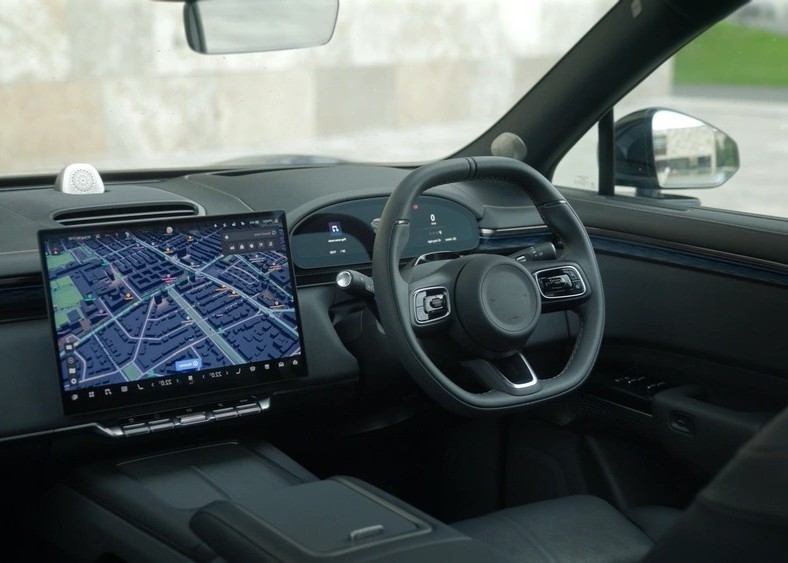
That approach underpins one of Mapbox’s most significant new features: 3D Lanes. The feature adds lane geometries, markings and three-dimensional road structures to navigation views, aligning what appears on screen more closely with what drivers see through the windscreen.
“Most expensive navigation mistakes happen at complex intersections,” said Sniderman. “That’s where people miss a turn and end up on a long detour. Lane-level detail gives drivers clarity exactly when they need it.”
Premium brands with tightly integrated digital dashboards and advanced driver displays gain the most from navigation that extends into the instrument cluster and adapts to driving context.
Sniderman linked that directly to the way vehicles are now designed. “The car is a software platform,” he said. “Navigation has to live inside that platform, alongside everything else the vehicle does.”
Lane-level guidance also extends beyond passenger vehicles. Sniderman pointed to applications in delivery fleets, logistics and ride-hailing, where missed turns translate directly into cost. “If you’re operating at scale, a wrong turn isn’t just annoying. It’s expensive.”
Toyota provides the clearest example of how that philosophy translates into mass-market vehicles. Starting with the new 2026 RAV4, Toyota is rolling out its next-generation Toyota Audio Multimedia system with navigation built on Mapbox.
In Toyota’s case, Mapbox enables the automaker to bring navigation development fully in-house, running on Toyota’s Arene software platform. Maps feature dynamic lighting, textures and shadows, with smooth rendering and responsive interaction.
One of the most visible changes is the introduction of full-screen maps in the digital meter cluster, placing navigation directly behind the steering wheel. Toyota positions this as a first within its lineup, enabled by the flexibility of the Mapbox platform.
Sniderman described Toyota’s approach as a signal of how mainstream navigation is changing.
“Toyota is showing what happens when navigation is treated as part of the vehicle’s core software,. They can roll features out over time and keep improving the experience.”
Toyota plans to extend the system beyond North America, with rollouts across Europe, Australia and New Zealand, reinforcing Mapbox’s role as a global platform rather than a regional solution.
For Mapbox, the combination of lane-level precision and Toyota’s production scale reflects a broader shift in how navigation is valued. “Everyone already has navigation,” said Sniderman. “The difference now is what you can do with it.”