


Product of the Day
Coding without computers
Tangible Africa, a coding education initiative, is helping schools overcome barriers to teaching programming skills, writes GUIDO RUSSO.

Despite two-thirds of South African schools having no computers, more than 350,000 learners have gained coding skills through an initiative that uses little more than puzzle pieces and a cellphone. The project, Tangible Africa, was founded at Nelson Mandela University in Gqeberha by the institution’s head of computing sciences, Professor Jean Greyling.
The initiative now operates on five continents, reaching nine African countries as well as Ireland, South Korea, Cyprus, Germany and Indonesia. About 50,000 teachers have been introduced to the project’s methods.
Speaking at the 4th Universities South Africa (USAf) Higher Education Conference in Tshwane, Prof Greyling described the “elephant in the room” in South African schooling. Many schools have no electricity or internet either, and by his own estimate, which he stressed was not scientific and probably conservative, 90% of teachers are not qualified to teach coding, even though coding and robotics are now in the curriculum from Grade R to Grade 9.
Speaking at the fourth Universities South Africa (USAf) Higher Education Conference in Tshwane, Prof Greyling said many schools also lack electricity and internet access. By his own rough estimate, 90% of teachers are not qualified to teach coding, despite coding and robotics forming part of the school curriculum from Grade R to Grade 9.
For more than 25 years, Greyling visited rural, township and urban schools in the Eastern Cape to encourage learners to take an interest in computing. Many of the learners had never seen a computer, while their schools often lacked electricity.
He said: “I had this sinking feeling that I was talking into a vacuum and I was not having any real impact.”
This changed in 2017, when one of his honours students, Byron Batteson, walked into his office and said: “Prof, I want to introduce coding to learners who do not have computers.”
Batteson went on to develop TANKS, a game that combines physical coding tokens with smartphone image recognition. Greyling called it “the best honours project I’ve supervised in 30 years”. He credits Batteson with laying the foundation for everything that followed. Batteson is now a senior software engineer at Amazon.
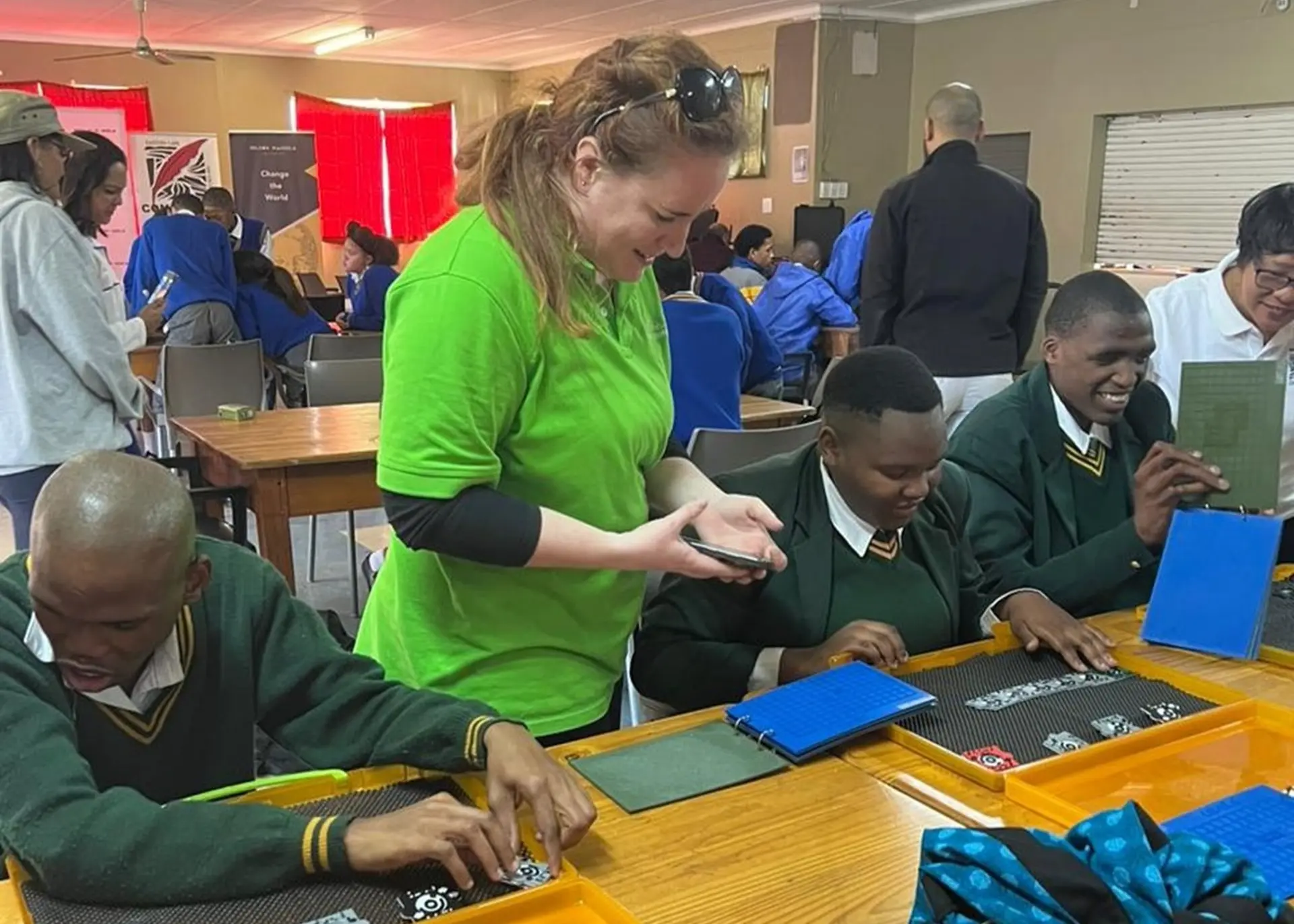
The system uses small puzzle-shaped tokens to represent coding instructions similar to those Greyling teaches first-year university students. Learners receive a challenge on a cellphone and work in groups to arrange the tokens into a program. They then photograph the arrangement with the phone, which recognises the instructions and runs the code. The process does not require computers, an internet connection or access to electricity. Teachers can be trained to use the tools in three hours before introducing them in their classrooms.
Greyling says: “If you take the fun aspect away, you are going to lose them.
“Tangible starts by making learning fun and accessible for both teachers and learners, while teaching the fundamentals of computational thinking and problem-solving. Through the process, many learners gain the confidence to pursue mathematics, which is essential for STEM careers.”
Tangible Africa aims to keep costs low and provide its tools free of charge wherever possible. Greyling estimates that about 90% of participating schools pay nothing, with corporate partners helping to cover the costs.
The tools have been adapted for blind learners using braille and 3D printing. A young blind man who has followed the project is expected to join as an intern next year to train other blind learners.
The project’s biggest tournament started with 30 learners in 2018. This year it drew 50,000 learners from 500 schools, who used Tangible’s products 220,000 times in a single month.
In 2025, Tangible ran an online coding World Cup with 340 teams from 30 countries. South African schools took first and second place, ahead of Indonesia, the previous year’s winner.
Prof Greyling says Tangible Africa focuses on developing computational thinking and problem-solving skills that extend beyond coding.
He questions how effectively the national coding and robotics curriculum can be implemented in schools that lack basic infrastructure. To support teachers, Tangible Africa offers a chatbot that provides weekly lessons aligned with the Curriculum and Assessment Policy Statement (CAPS) for each grade from Grade R to Grade 7. Teachers need a cellphone and printer to access the materials.
The project runs coding clubs for Grade 9 learners, covering programming, design thinking, entrepreneurship and careers in science, technology, engineering and mathematics (STEM). Greyling says the programme aims to encourage learners to pursue mathematics when selecting their Grade 10 subjects.
He cited figures indicating that 24% of Western Cape matriculants take mathematics, compared with 76% who take mathematical literacy.
Tangible Africa operates as an engagement project of Nelson Mandela University’s computing department, with day-to-day activities managed by the non-profit Leva Foundation. The project received the 2024 Institute of Information Technology Professionals South Africa (IITPSA) President’s Award and was selected as one of 23 case studies for USAf’s Impact Initiative in 2025. It has also undergone two global evaluations, including one through the UNICEF-led Learning Cabinet.
Greyling says the project has contributed to wider acceptance of unplugged coding in South Africa, with the Foundation Phase coding curriculum now using unplugged methods.
Katlego Nyambi, a second-year computer science student at the University of Pretoria, told the conference that he first encountered Tangible Africa through a workshop while he was in Grade 11. At the time, he described himself as “directionless”.
He said: “One of the most important things Tangible gave me was a clear direction, something to work towards.”
Following the workshop, Nyambi began researching computer science courses and setting academic goals. Greyling says he initially told Nyambi that his marks were insufficient to study computer science. Six months later, Nyambi sent him updated results showing that his average had increased by 20%.
Nyambi now studies at the University of Pretoria with a bursary from Amazon. He told the conference that he is “so in love with programming and everything computers, all because of that one point in time”.
* Guido Russo is writer and contributor for Gadget.