


GadgetWheels
Volvo codes a
greener future
Volvo’s next generation combines software-defined vehicles with environmental rules that reach from the battery pack to the office lease, writes SHERYL GOLDSTUCK.

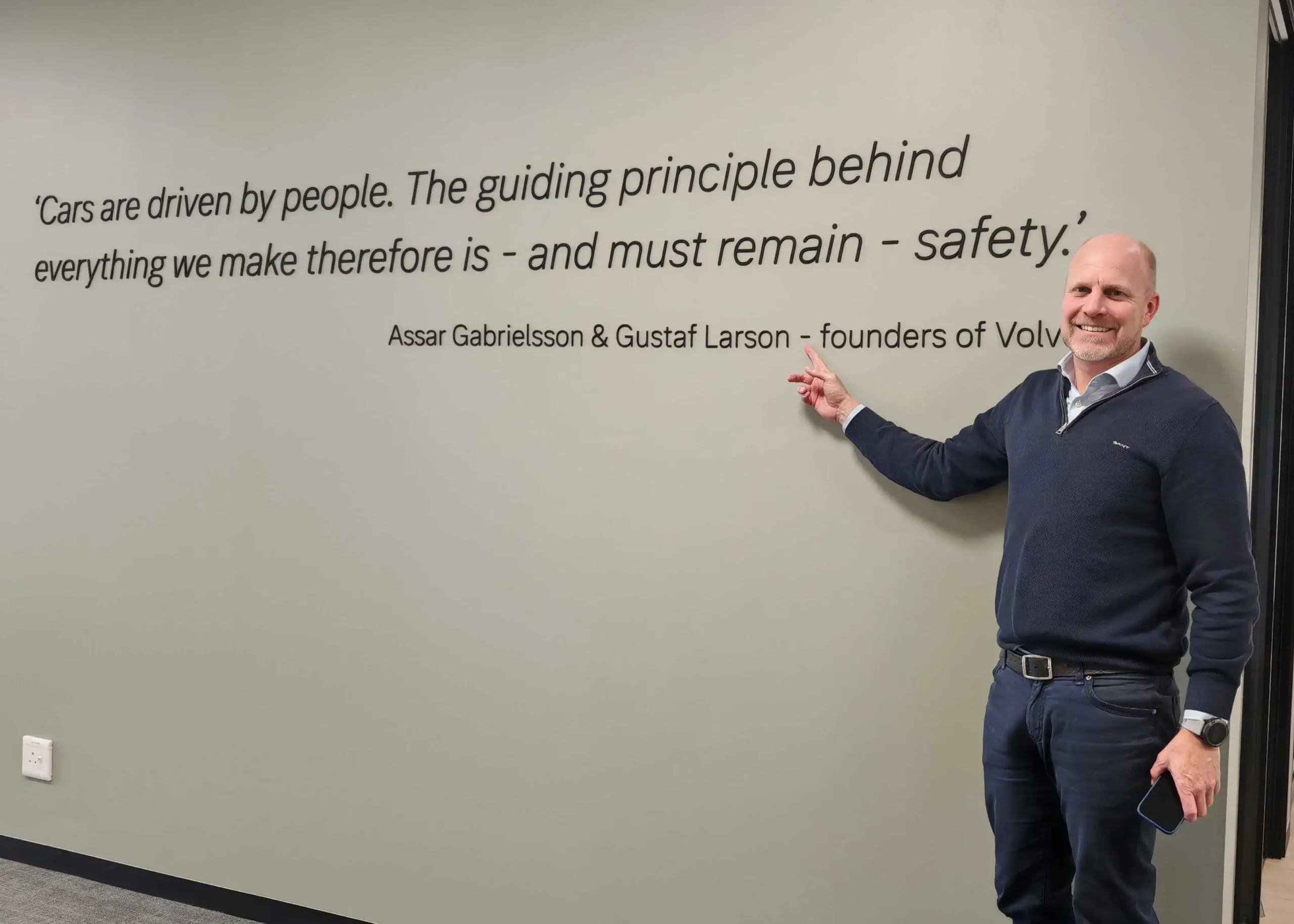
“Moving to software-defined vehicles is probably one of the most important and critical aspects of being an OEM in the future,” says Grant Locke, managing director of Volvo Car South Africa. “It has to happen, and every OEM will have to go through that transition at some point.”
The transition he describes reaches far beyond replacing dials with touchscreens. In Volvo’s newer cars, software increasingly governs how the vehicle responds, how it receives improvements after purchase and how its safety systems interpret what is happening around it.
The mechanics still count, of course, but software has become part of the machinery, Locke told GadgetWheels in an exclusive interview at Volvo Car South Africa’s offices in Centurion.
“Software is now part of the engineering and the core fabric of the vehicle,” says Locke. “You cannot separate the two anymore.”
Volvo has been working through that change across successive modular vehicle platforms in its Scalable Product Architecture (SPA). SPA1 introduced greater connectivity, SPA2 became what Locke calls the company’s first true software-defined vehicle platform, and SPA3 develops the approach further in the EX60.
The advantage of bringing more vehicle functions onto a common code base is that Volvo can correct problems and deploy updates without requiring every owner to book a workshop visit.
“One of the key aspects is to move the software for the vehicles as close as possible to a single code base,” says Locke. “When you identify errors, you update the code base and deploy a new version to the car in much the same way that you deploy a new version to a phone.”
That comparison has become familiar across the motor industry, but it carries a substantial engineering challenge. A phone update can irritate its owner when something goes wrong, but a vehicle update has to work with braking, steering, battery management, sensors and driver-assistance systems.
From updates to decisions
Connectivity allows Volvo to deliver software over the air, while data from the car can be used to improve later versions.
“As we begin to receive data from vehicles relating to autonomous driving, we can apply machine learning,” says Locke. “That can then be integrated more easily into the code base and redeployed to the car. It begins to refine the cycle of built-in intelligence within the vehicle.”
The computing hardware is already being installed. Volvo has upgraded the processing chips in the EX90, while the ES90 was developed with the capability from the outset.
“You need two Nvidia Drive AGX Orin controllers, capable of around 500-trillion operations per second,” he says. “That provides enough processing power to analyse data and make decisions in real time.”
The phrase “make decisions” can sound unnerving when the decision-maker is a car. Yet many drivers have already experienced it through autonomous emergency braking.
I had encountered the system that morning when the car stopped abruptly while I was reversing. Locke recognised the experience immediately.
“It catches me out as well,” he says. “Do I sometimes disagree with the decision when it intervenes? Yes, because it gives me a fright and sometimes I feel I still have space available.
“Am I comfortable that it makes that decision and that the system is there? Yes, I am.”
For now, the driver retains control and can disable systems such as autonomous emergency braking. Volvo’s expectation is that the car will take on more responsibility as its software and sensor data improve.
Pilot Assist, Pilot Assist Plus and other advanced driver-assistance systems still demand close supervision. Drivers have to keep their hands on the steering wheel, while internal monitoring checks that they remain focused on the road.
“As those systems are refined, we will gradually allow the car to make more decisions,” says Locke.
Safety for real people
Volvo’s investment in software is closely tied to the safety reputation it has spent decades building. Crash-test scores provide part of the picture, but the company also studies the less predictable circumstances found in real accidents.
Locke says one of the clearest lessons from Volvo’s accident database is the variation in people, seating positions and collision outcomes.
“It is the differences that matter,” he says.
Euro NCAP testing measures performance in defined scenarios. Volvo also considers incidents like a vehicle leaving the road or striking an animal, along with the different ways in which an impact affects individual occupants.
The EX60’s multi-adaptive safety belt shows how software, sensors and physical safety equipment can work together. Traditional pretensioners tighten a belt with a preset force during a collision. Volvo’s system adjusts that force using information about the occupant and seating position.
“The new system senses the dynamics and physical characteristics of the person using the seat belt,” says Locke. “It adjusts the pretensioning so that the belt itself does not cause additional injury.”
The company applies the same caution to speed. Volvo limits its cars to 180km/h, a restriction that has prompted debate among drivers who expect a premium car to offer unrestricted performance.
Locke links the decision to Volvo’s stated goal that no one should die in one of its cars.
“At a certain velocity, there comes a point where the vehicle’s safety systems may no longer be able to save you,” he says.
“From that point of view, embedding a 180km/h speed limit in the vehicles increases the chances that no one will die in a Volvo.”
Sustainability beyond the showroom
The software-defined car forms one part of a wider overhaul in propulsion and energy use. Vehicle makers spent more than a century refining the internal-combustion engine. Over roughly two decades, they have had to rethink how a car stores energy, manages temperature and delivers power.
A modern electric vehicle has a battery-management system, battery cooling and often a heat pump, along with software controlling the interaction between them. The car’s energy use is now measured in kilowatt-hours per 100km, language that would have been foreign to most drivers a few years ago.
Volvo had planned to become fully electric by 2030. It later adjusted that target to about 90% electrified vehicles, a category that includes hybrids and battery-electric cars, with internal-combustion models making up the remaining share.
“At the moment, I think around 46% of our global sales are electrified, so we are still some way from 90%,” says Locke. “However, compared with our premium peers, we are probably further along in terms of the proportion of electrified sales.”
The environmental requirements also extend into Volvo’s daily operations. When Volvo Car South Africa moved offices, the local operation required approval from the company’s Swedish central team. The chosen premises had to use renewable energy and meet current energy-efficiency principles.
It was a detailed requirement for one of Volvo’s smaller national operations, and it gives the company’s sustainability claims a practical test. Environmental policy has to survive the ordinary decisions of running a business, including the building from which that business is managed.
The same standards apply across Volvo’s manufacturing network, where renewable energy has become an important part of factory operations.
Locke says the company remains committed to full electrification over the longer term, even as different countries move at different speeds.
“It may take longer to reach that point in countries such as South Africa, but Europe is adapting very quickly,” he says. “Even if some countries move their targets backwards, the company still believes that, in the long term, we will all be fully electric.”
South Africa sets its own pace
South African motorists have to weigh those targets against electricity supply, charging access and the cost of installing equipment at home.
Locke says the economics are difficult for a local operation selling between 1,000 and 1,500 cars a year. Volvo has concentrated on support for individual buyers instead, supplying a GridCars wallbox, two years of free public charging and three years of connectivity with a battery-electric vehicle.
The electricity grid creates another complication, especially for customers who cannot charge from solar panels or rely on stable home supply. Volvo’s response is to keep several propulsion options available.
The choice ranges from the mild-hybrid XC40 B3 to the fully electric EX90 and ES90. It allows Volvo to keep serving buyers who are interested in electrification but cannot yet make a battery-electric car work in their daily lives.
Locke has already made the switch himself, despite an obvious affection for petrol engines.
“I will never go back to an internal-combustion engine,” he says.
His reasons are practical. He can charge at home, avoid filling-station visits and service the car every two years or 30,000km. He also expects the lower number of moving parts to contribute to a longer useful life, although he acknowledges that South African residual values and total ownership costs still need time to become clear.
“I believe that if you buy well, the vehicle will last a long time,” he says. “I like looking after things and holding on to them. For me, an EV has become my first choice.”
* Sheryl Goldstuck is general manager of World Wide Worx and editor of GadgetWheels. Follow her on Bluesky on @crazycatbuzz.bsky.social.