

Product of the Day
Zoho Analytics goes agentic
An update to the business intelligence platform lets agents uncover problems in company data and set automated responses, writes GUIDO RUSSO.

Zoho has expanded the role of AI in its Analytics platform, moving beyond answering questions and generating reports to supporting business decisions and workflows. New Agentic Analytics capabilities allow AI agents to work with information from different business systems, understand how an organisation operates and respond to findings within that context.
“For businesses operating in increasingly data-driven environments, the ability to turn information into meaningful insights is essential to making informed decisions and responding to changing business needs,” says the company. “With the latest enhancements, Zoho Analytics moves beyond traditional reporting and data analysis to help organisations understand their data in context and use AI to support more informed, practical business decisions.”
To make the findings relevant to each business, Zoho Analytics uses a semantic layer that defines company-specific terms and performance measures, alongside an ontology layer that maps relationships between departments, processes and other business information. These provide AI agents with the context needed to interpret data accurately, while allowing organisations to control how information is accessed and used.
Andrew Bourne, Zoho SA regional head, says: “We are at the beginning of the next leap forward in data analytics, where a strong data foundation is the starting point for all agentic activity in business operations. Agents, however, cannot function only with data, but require a robust intelligence layer. Today’s updates to Zoho Analytics provide that and more: one open and extensible trusted intelligence layer that gives every AI tool in your business the context, metrics, and governance to deliver answers users can rely on.”
Ask Zia
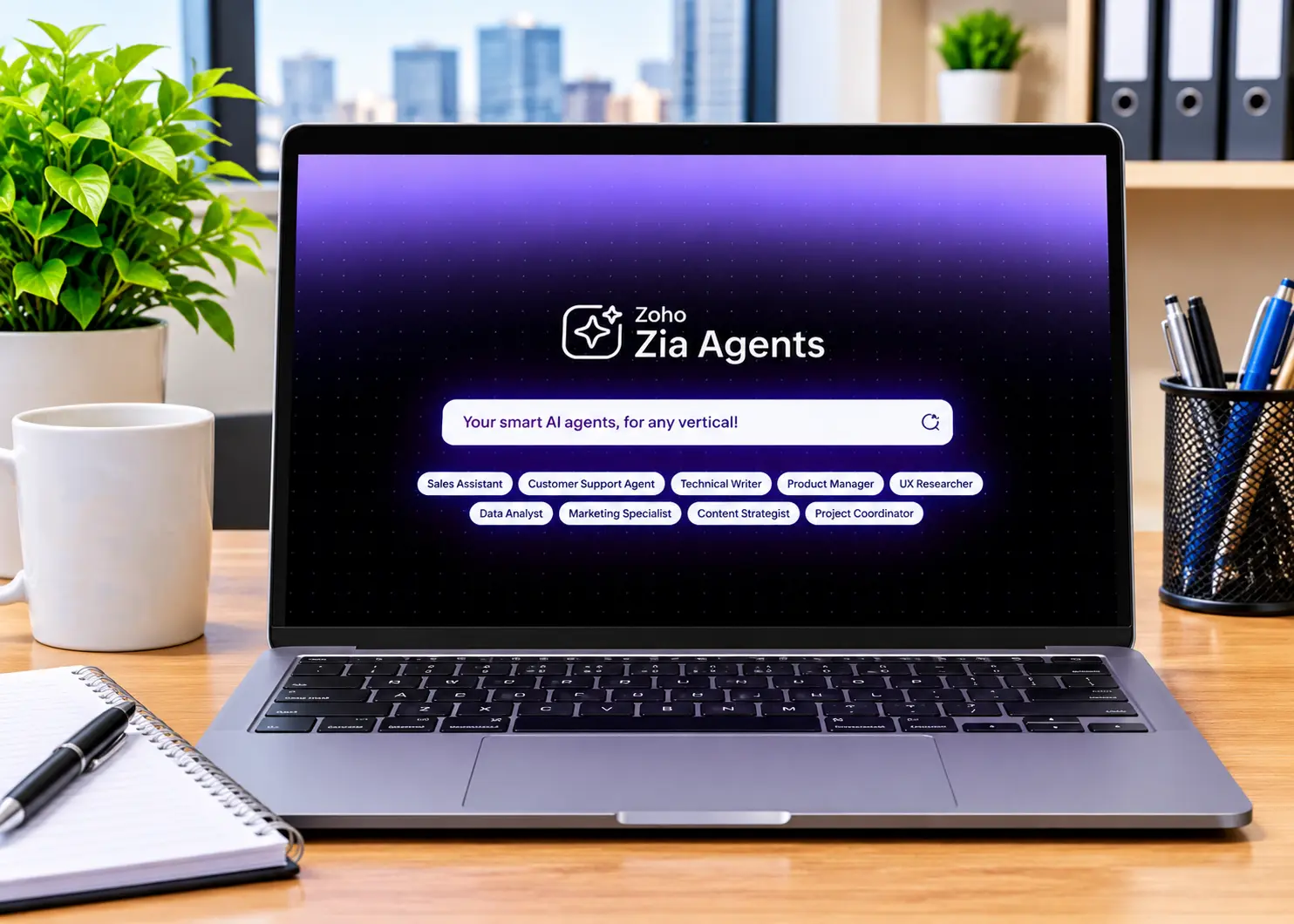
Zoho Analytics includes a conversational AI assistant, Ask Zia, which co-ordinates specialised AI agents for data analysis, visualisation, preparation, modelling, coding and automated tasks. Users can ask questions about business information, develop analyses and create workflows through a single interface, with previous requests providing context for subsequent tasks.
Ask Zia uses company-specific definitions, relationships between business operations and conversation history to interpret requests. Organisations can also create custom AI agents using their own data, business models and knowledge bases. These agents can connect to external tools through the Model Context Protocol (MCP), a standard that allows AI systems to communicate with other applications and data sources.
Zoho Analytics allows organisations to standardise business terminology, performance measures and instructions, while mapping relationships between different parts of a business. According to Zoho, these functions are built into the platform, removing the need for a separate data platform or cloud data warehouse.
Connecting data
Zoho Analytics is adding more than 30 data connectors to the existing 500-plus integrations, allowing businesses to access information from a wider range of applications. The additions include Zoho’s own business software, as well as third-party services such as SAP, PayPal, Adobe Commerce, Twilio, Notion and Intercom.
These connections allow organisations to analyse information from different systems in one place. Businesses can create separate data models for departments such as finance and operations, allowing each team to use relevant terminology and performance measures.
Zoho Analytics includes a workflow builder that allows businesses to configure AI agents to carry out tasks in response to specific findings. For example, an agent could identify a problem in business data and trigger a predefined process, rather than requiring an employee to initiate the next step manually.
Beyond analytics
Developers can use Zoho Analytics capabilities in other applications through an MCP server, which allows AI systems to connect with external tools and data sources. The integration supports data preparation, analysis and visualisation. Developers can access the platform through a command-line interface, which allows software to be controlled using text commands, or through a plug-in for Claude, an AI assistant developed by Anthropic.
Zoho Analytics supports white-label integration, allowing organisations to add AI agents to their own applications, websites and customer portals without displaying Zoho branding. Businesses can control access to information and manage permissions for these embedded tools.
Governance, visibility and control
Zoho Analytics includes administrative tools for managing AI agents, monitoring their activity and controlling access to business information.
A data catalogue organises business information, performance measures and analytical models, allowing administrators to track where data comes from, how data is used and which processes may be affected by changes. Monitoring tools show which AI agents have been used, who accessed them, what information was retrieved and how the agents responded to requests. Administrators can track AI usage and costs across teams and adjust Ask Zia’s settings.
The platform provides a separate testing environment, called a sandbox, where teams can develop and test AI agents and analytical tools before making them available for use. Administrators can manage deployments and restore earlier versions when necessary.
Data analysis and reporting
Zoho has expanded the data analysis and reporting capabilities of Zoho Analytics with more than 50 additional features, including over 10 new ways to visualise data, custom charts and reports with precise layout controls. The additions include tools for testing different business scenarios, examining relationships between data sets and forecasting future trends.
A data science studio supports Jupyter notebooks, which allow users to write code and analyse data in an interactive environment, along with the import of predictive models through the Predictive Model Markup Language (PMML) format. Zoho has also updated the mobile interface for Ask Zia, the platform’s AI assistant.
According to Zoho, 100,000 businesses worldwide use Zoho Analytics daily. The platform is available through Zoho Cloud, on-premises infrastructure, through cloud providers including Amazon Web Services (AWS), Microsoft Azure and Google Cloud, or through a combination of these environments.
The next phase of business intelligence
Zoho plans further updates to Zoho Analytics, including tools that adjust to changes in business data and provide information to support AI-driven decisions. The company intends to improve compatibility with external applications and systems through open technical standards.
Future developments are expected to bring data integration, preparation, analysis, forecasting and AI agent development into a single platform. Zoho plans to introduce preconfigured business models for specific functions, allowing organisations to use established data structures rather than building their own from scratch. The company aims to extend these capabilities across other Zoho business applications.
Pricing
The Zoho Analytics Basic plan starts at R336 per month, billed annually, and supports two users, 500,000 data rows and 10,000 Zoho LLM credits.
The latest updates are available for the cloud-hosted platform, with preview versions of some reporting and data-modelling features being rolled out separately. The on-premises version, installed on an organisation’s own infrastructure, is expected to receive the update in the first quarter of 2027.
* To view Analytics pricing options, visit the Zoho website here.
* Guido Russo is writer and contributor for Gadget.