


GadgetWheels
Signpost: No room for ‘doom and fume’ in car industry
In his annual State of the Motor Industry address, Toyota SA CEO Andrew Kirby called on the industry to build resilience, writes ARTHUR GOLDSTUCK.

The surge of lower-cost, higher-tech Chinese car brands into South African showrooms has sparked what we can only call “doom and fume”.
Doom about shrinking margins, and incensed fuming about uneven competition has become almost a prevailing narrative among “traditional” manufacturers with a long-established presence in the country.
It is refreshing, then, to hear one of the longest-established of these brands telling the incumbents to get their act together.
The ninth annual State of the Motor Industry (SOMI), hosted by Toyota South Africa Motors last week, could easily have hurled more burning coals at the supposed “foreign invaders”. Instead, a cooler head prevailed as Toyota SA CEO Andrew Kirby used the platform to call on the industry to become more resilient.
Not that it was all in their court. He also emphasised the need for a balanced import and local manufacturing approach, and the importance of government support for New Energy Vehicle (NEV) production.
“Of course, everyone talks about disruptions. We do know that we live in a fairly uncertain time, both globally and in South Africa. The question is, how do we respond to that?” he asked.
“It is more difficult to plan and forecast. It is more difficult to anticipate what 2026 is going to bring, but (also) the next five to 10 years, which is crucial for us in our planning horizons. But what that does mean as an industry is that we need to be a lot more resilient. We need to have ways in which we adapt very quickly and respond to these changing trends.”

South Africa’s 15.7% rise in new vehicle sales in 2025 lifted volumes back above 2019 levels to roughly 600,000 units. Kirby gave a sober historical perspective.
“Yes, this is the first time that we are seeing volumes higher than the pre-Covid years … volumes not as high as 2006-7, certainly not where they were from 2012 to 2016, so it’s a fairly pedestrian market.
“We really lack scale in South Africa, (but) if we consider our population size, if we consider the mobility needs, if we consider the quality of our public transport, we should be a lot bigger.”
GDP growth of 1.2% served as a revealing context for the sales increase: “Within each segment … it was the entry level models that grew faster than all the others. It created an artificial growth in volume.”
However, production rose to just over 600,000 vehicles, and exports reached 411,000 units.
“This is definitely something to celebrate. It makes a huge contribution to our economy, especially in terms of forex. But creating jobs, creating skills, are very, very important to us.
“We’re now at a point, though, where 68% of all the vehicles manufactured in SA are exported, and only 198,000 are sold in SA. 81% of all vehicles exported were exported to the UK and the EU. We used to export 19% of our vehicles into Africa. Now (it is) 8%. The Africa market is really a tough market. So we do need to work harder to strengthen our business in Africa.

Right there is the attitude that separates leaders and survivors from those who throw up their hands in despair.
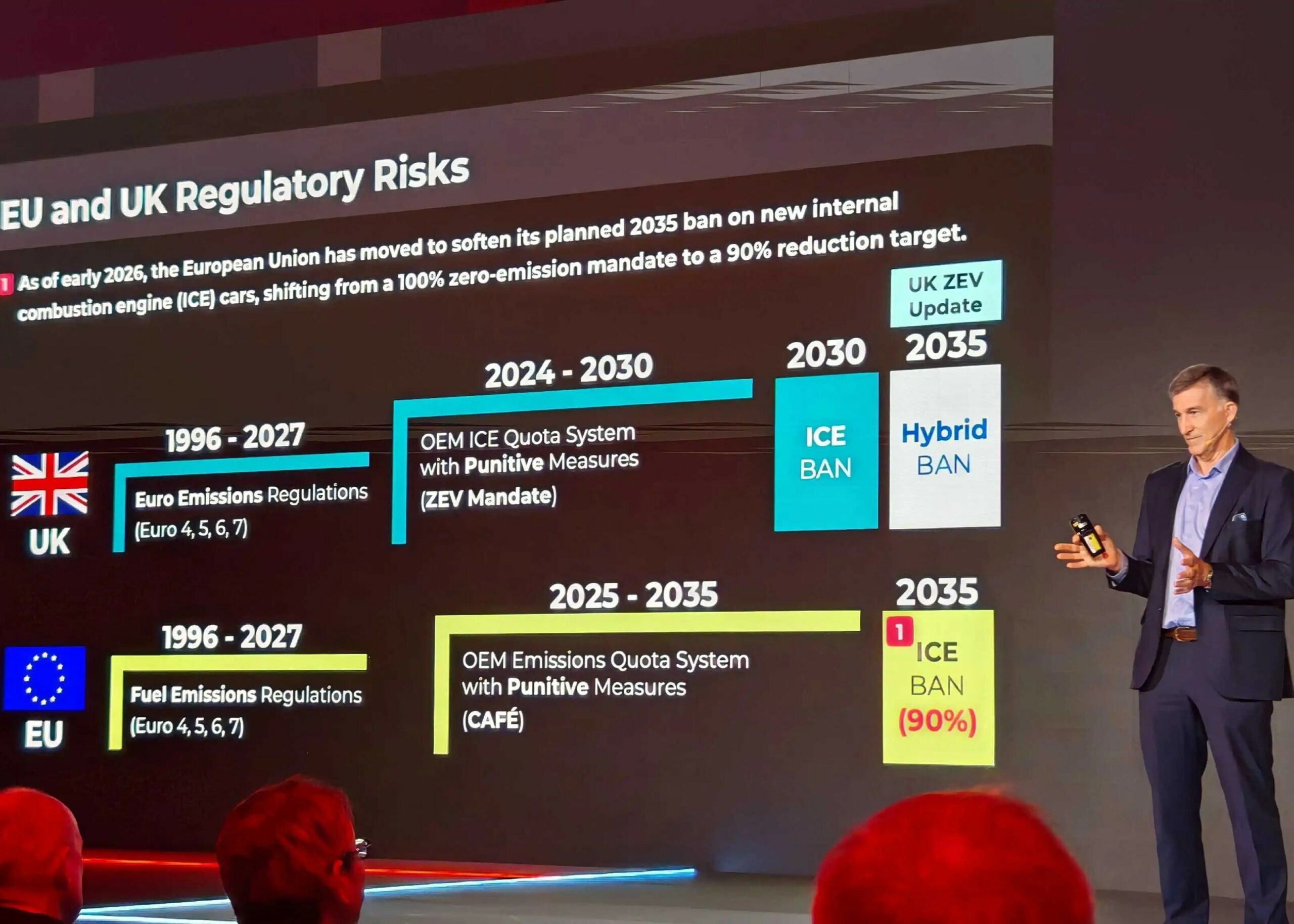
But then, there is a massive responsibility on government to support the new energy roadmap of the car makers, and the eventual collapse in exports of fuel-driven vehicles.
“We are most likely over the next five years going to see significant decline in exports to Europe and the UK. Most big markets around the world have all put specific interventions into place, supporting customers, supporting the business, creating penalties, creating incentives to accelerate the transition to new energy vehicles.
“There are very few, if any, markets that have naturally progressed into new energy vehicles, simply because the value proposition is not there yet. We need specific government support and interventions to support the investments in low scale New Energy vehicle production … and we need to support the customer transition.”
“If we say we can’t afford to transition, we are saying, effectively, we will also give up on exports,” said Kirby. The result: South Africa will become “a rearguard manufacturer of old conventional technology”.
Said Kirby: “It’s not the strongest of the species that survives, nor the most intelligent, it’s the one that’s the most adaptable to change.”
- Arthur Goldstuck is CEO of World Wide Worx, editor-in-chief of Gadget.co.za, and author of “The Hitchhiker’s Guide to AI – The African Edge”.