



GadgetWheels
Discover new horizons with Toyota RAV4
From mountain passes to the rugged beauty of the West Coast, the setting was ideal to experience the latest evolution of one of the world’s most influential SUVs, writes SHERYL GOLDSTUCK.

There are few vehicles that can claim to have changed the motoring landscape, but the Toyota RAV4 is one of them. The RAV acronym stands for Recreational Active Vehicle. When it first arrived in 1994, it introduced a fresh idea to buyers: a vehicle that combined the comfort of a passenger car with the practicality of a sport utility vehicle (SUV). More than three decades later, that formula has become one of the most popular vehicle segments in the world.
Last week I attended the South African launch of the Toyota RAV4 in the Western Cape, where Toyota showcased the most technologically advanced version of the model yet. We were given the opportunity to drive all the derivatives over challenging routes.
The adventure began at Cape Town International Airport, where we collected our vehicles before setting off towards Tulbagh. The route provided the perfect opportunity to get acquainted with the newcomer as we travelled through some of the Cape’s most picturesque landscapes. Upon arrival in Tulbagh, we were treated to a lunch unlike any at Chef & Co, where we were treated to exceptional fish and warm hospitality.

With appetites satisfied, the convoy continued towards the West Coast fishing village of Paternoster. Our overnight destination was the Abelone Hotel, which offered magnificent ocean views and a fitting backdrop for the launch. Watching the Atlantic Ocean stretch endlessly into the distance while discussing Toyota’s latest SUV felt like the perfect way to end the first day.
The new RAV4 enters its sixth generation with impressive credentials behind it. More than 15-million units have been sold globally, making it one of Toyota’s most successful models and one of the world’s best-selling SUVs.
While previous generations have evolved steadily over the years, this latest version feels like a much bigger leap forward. Toyota has focused on improving efficiency, safety, connectivity and driving refinement while ensuring the RAV4 remains practical enough for everyday family life.
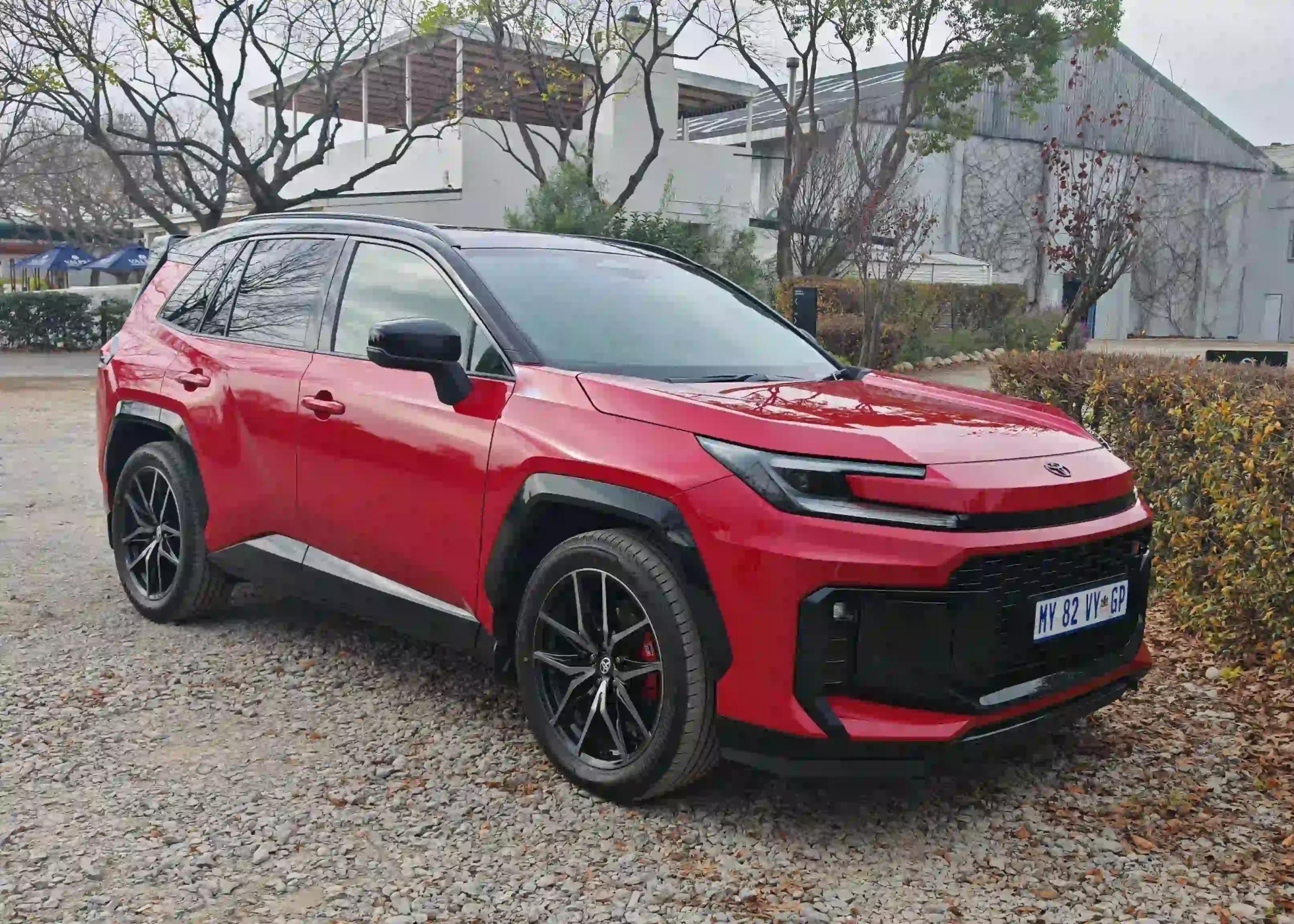
The car has a noticeably stronger road presence than its predecessor. At the front, a bold bumper design, distinctive lighting signatures and sharp headlamp treatment create a bold appearance. Along the sides, muscular wheel arches and sculpted bodywork reinforce the SUV character, while redesigned mirrors and body details improve aerodynamic efficiency.
The rear styling has also been modernised, with slim lighting elements stretching across the tailgate and framing the prominent RAV4 badge.

Cargo space has grown slightly, offering more room for luggage, sports equipment or family gear. A broader selection of wheel designs and colour options allows buyers to personalise their vehicles more than before.
One of the most significant changes is the expanded powertrain line-up. For the first time, South African buyers can choose from petrol, hybrid, performance-inspired hybrid and plug-in hybrid models.
The familiar 2.0-litre petrol engine continues to serve as the conventional option, producing 127 kW and 203 Nm.
Toyota’s latest hybrid technology powers the 2.5-litre HEV models, delivering a combined system output of 163kW. During the launch drive, the hybrid powertrain impressed with its smoothness and refinement, particularly when transitioning between electric and petrol power.
The top of the range is represented by the new plug-in hybrid. Producing an impressive 225kW, it combines strong performance with the ability to travel considerable distances on electric power alone. Toyota claims an electric driving range of up to 142km under test conditions, meaning many daily commutes could be completed without using a drop of fuel.

The PHEV also supports both AC and DC charging, while an 11kW onboard charger helps reduce charging times.
The introduction of the RAV4 GR-S is a particularly interesting addition.
Inspired by Toyota Gazoo Racing, the GR-S receives model-specific suspension tuning, revised springs and dampers, additional chassis bracing and a lower ride height designed to create a more engaging driving experience. I found the Toyota RAV4 GR-S a bit harder on the road and maybe not as cosy as the VX model.
Visually, it stands apart with larger alloy wheels, red brake callipers and GR branding throughout. Inside, sports seats, alloy pedals and red stitching help reinforce its sportier character.
The redesigned cabin centres on a digital-first layout featuring a 12.3-inch digital instrument cluster and either a 10.5-inch or 12.9-inch infotainment screen, depending on the model.
Wireless smartphone connectivity is claimed but did present its challenges. I resorted to using a Type-C cable to connect to Android Auto.
Higher-specification models add features like JBL audio, wireless charging, panoramic roofs, heated and ventilated seats, memory functions and a digital rear-view mirror. The overall design is clean, uncluttered and far more sophisticated than previous generations.

Toyota has also introduced its latest Toyota Safety Sense 4.0 package to the RAV4, marking its first appearance on a South African Toyota model. The suite includes technologies like a Driver Monitor System, Adaptive High Beam Assist, Road Sign Assist, Emergency Steering Assist and Intersection Collision Avoidance.
Depending on specification, buyers can also benefit from Blind Spot Monitoring, Safety Exit Assist, Intelligent Park Assist and a 3D Panoramic View Monitor.
These systems are designed to make driving less stressful while providing an extra layer of protection in increasingly busy traffic environments.
For a vehicle that helped create the crossover segment more than 30 years ago, the latest RAV4 appears more than ready for the next chapter of its journey.
*Pricing
| RAV4 2.5 HEV GX | R770,500 |
| RAV4 2.0 VX | R799,900 |
| RAV4 2.5 HEV VX | R927,800 |
| RAV4 2.5 HEV GR-S | R941,800 |
| RAV4 2.5 PHEV | R1,043,900 |
All RAV4 models are sold with a 6-services/90 000 km service plan (intervals at 15 000 km) and a 3-year/100 000 km warranty. The EV battery is covered by an 8-year/160 000 km warranty. Service and warranty plan extensions are available through Toyota’s national dealer network.
* Sheryl Goldstuck is general manager of World Wide Worx and editor of GadgetWheels. Follow her on Bluesky on @crazycatbuzz.bsky.social.