

Gadget of the Week
CES 2026 Gadget of the Week: Leion Hey2 gets translation right
The augmented reality smart glasses change how real-time translation looks inside a conversation, writes ARTHUR GOLDSTUCK.

What is it?
The glasses go on and a conversation begins. As the other person speaks, translated words appear in front of the eyes. The speaker’s face stays in view. Mouth movements remain visible. Facial expressions remain readable. The text appears line by line, then clears as speech continues.
Nothing else changes. Hands remain free, the exchange continues without interruption, and the translation stays in place while the conversation moves forward.
That experience defines the Leion Hey2, launched this week at the CES tech expo in Las Vegas, USA. Translation becomes something that remains inside the interaction instead of sitting aside from it. Subtitles appear in the line of sight, close enough to speech to follow while watching expression and body language. Attention stays with the person speaking, and the exchange keeps its shape.
After a short period of adjustment, reading and listening begin to run in parallel. The brain adapts to absorbing text and expression together. Conversation becomes the dominant activity again.
The Hey2 is a pair of augmented reality smart glasses built by Beijing LLVision Technology, a company whose vision is to embed the interactions between human, machine and data with AI and AR technologies. That focus shapes the product. The device is a pair of glasses designed specifically for live, face-to-face translation, and almost every design choice reflects that single use case. Spoken language turns into text positioned inside the wearer’s line of sight.

Language support spans more than 100 languages and dialects. Translation latency stays below 500 milliseconds in real-world testing. In use, subtitles remain aligned closely enough with speech to preserve meaning and tone together, rather than demanding that users look down at translation apps on phones for other devices. The result is that the flow of conversation remains intact.
The display plays a central role in shaping this behaviour. Subtitles appear through waveguide optics driven by a micro-LED light engine. Text is rendered in green, with brightness reaching up to 1,500 nits. This keeps it readable indoors and outdoors without overwhelming the visual field. Resolution sits at 480 × 640 across a 25-degree field of view. The text occupies a defined area near the centre of vision, remaining legible without blocking what the wearer sees. Subtitle size and placement can be adjusted to suit comfort and eyesight.
Audio capture influences behaviour just as strongly as the display. A four-microphone array with spatial detection works alongside directional prioritisation. Voices directly ahead receive focus, while surrounding sound drops away. Translation follows attention naturally, without manual speaker selection or on-screen controls. During testing, the system consistently tracked the person being engaged with, even in busy environments.
Battery performance supports extended use. The glasses deliver six to eight hours of continuous translation on a single charge. A charging case extends total use to as much as 96 hours and supports multiple recharges through a magnetic interface. This suits conferences, long meetings and travel days without frequent power checks.
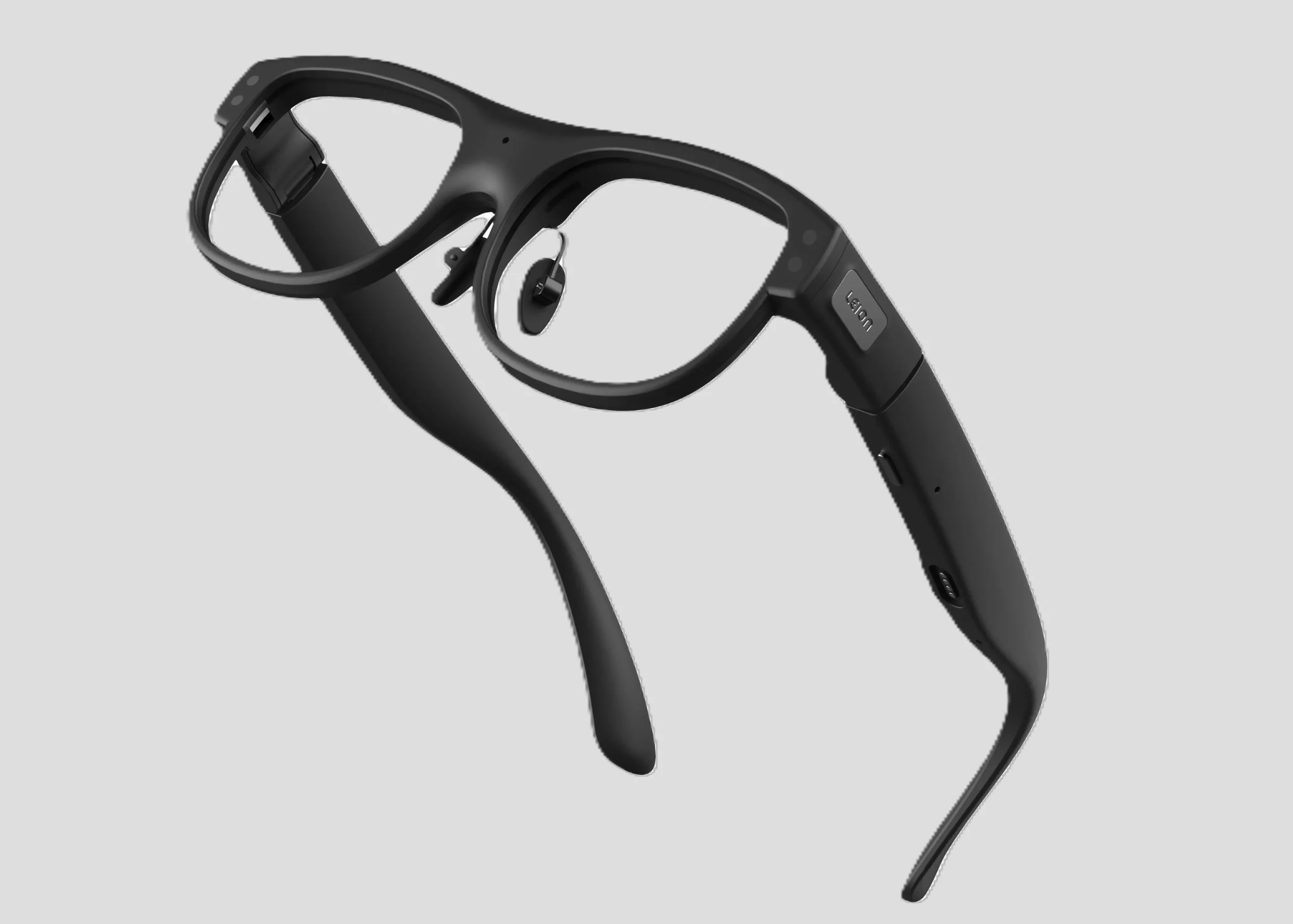
Physically, the Hey2 weighs 49 grams. The frame uses a magnesium-lithium alloy with a browline design that resembles everyday eyewear. Adjustable titanium nose pads and a spring hinge help the glasses sit comfortably across different face shapes. During use, the glasses draw little attention, which suits professional and social settings where visible technology can alter behaviour.
Several design omissions stand out as features rather than gaps. There is no camera and no external speaker. Audio input exists solely to support translation. These decisions simplify behaviour and reduce distraction. Data handling follows data privacy principles, with translation processed through cloud infrastructure hosted on Microsoft Azure and user control over translation history.
Beyond translation, the Hey2 includes a short-form AI Q&A function. Activated through the right touchpad, it allows spoken questions to surface brief responses in view. During testing, this proved useful in settings like a tech expo, where quick context added value without overtaking the interaction.
Extended use highlights Leion’s priorities. The company has built a device that serves a specific behaviour and resists feature creep. The Hey2 stays focused on how translation fits into conversation rather than how many functions can be layered on top.

How much does it cost?
Leion Hey2 is priced at $549 in the United States. A pre-order price of $499 runs until 31 January and includes a clip-on sunglass lens and 1,200 minutes of Pro translation service. South African pricing and availability have yet to be confirmed, but the device can be bought online at https://leion.glass/products/leion-hey-2-translation-ar-glasses.
Why does it make a difference?
Leion Hey2 changes how translation integrates into face-to-face communication. By placing text in the line of sight and aligning audio capture with natural attention, it allows conversation to proceed without behavioural adjustment. For professionals, educators and travellers who rely on direct interaction across languages, translation becomes part of the exchange rather than a parallel process.
What are the biggest negatives?
- Cloud-based processing depends on stable connectivity across locations.
- The absence of a camera limits broader smart-glasses use beyond translation and reference.
What are the biggest positives?
- Subtitles remain aligned closely enough with speech during conversation.
- Battery performance supports extended use across a full working day.
- The focused feature set keeps attention on people rather than devices.
*Arthur Goldstuck is CEO of World Wide Worx, editor-in-chief of Gadget.co.za, and author of “The Hitchhiker’s Guide to AI – The African Edge”.