


CES
CES 2026: Lenovo tries out new formats
Proof-of-concept devices unveiled in Las Vegas last week showed that the era of innovation in form factors is not over, writes ARTHUR GOLDSTUCK.

The most startling sight in Las Vegas during CES 2026 last week may well be an example of the old cliche. “what happens in Vegas stays in Vegas”. But, with luck, the prototypes of two “rollable” laptops will become reality before long.
Lenovo’s proofs of concept at CES shifted attention away from performance benchmarks and back to the physical shape of personal computing. While processor upgrades and AI features dominated much of the show, Lenovo’ drew interest for a different reason: laptops that change their size while you are using them.
Two rollable concepts led that conversation. Each addressed the long-standing trade-off between portability and screen space from a different angle, without asking users to carry a larger device.

The ThinkPad Rollable XD Concept presented the more surprising of the two ideas. In its closed state, it looks like a conventional 13.3-inch laptop. When activated, the screen extends vertically from within the chassis, increasing the usable display area to close to 16 inches. The expansion happens smoothly, without hinges or visible folds, and retracts just as easily, with a tap at the top of the screen chassis.
Lenovo described it as one of the first out-folding laptops with both a world-facing display and an expanding user-facing screen. In practical terms, that allows the device to support shared viewing while still giving the primary user additional vertical space for documents, code or design work.
The design builds on Lenovo’s earlier experiments, including the ThinkPad X1 Fold and the ThinkBook Plus Gen 6 Rollable AI laptop. In the Rollable XD, the company claims more than 50% additional screen area without increasing the footprint of the device. That figure is startling in a category where size and weight still determine daily usability.

Part of the appeal lay in the mechanism itself. The screen is protected by a transparent Corning Gorilla Glass Victus 2 cover that exposes the internal components responsible for the rolling action. It is an unusual choice, and one that signals the device’s status as a concept rather than a near-term product.
Interaction relies on touch gestures and voice input. Lenovo demonstrated a Swipe to X gesture that allows users to launch applications or switch modes by dragging a finger across the display. These features suggest how the device might support hybrid work or shared environments, although Lenovo avoided positioning it as a finished solution.
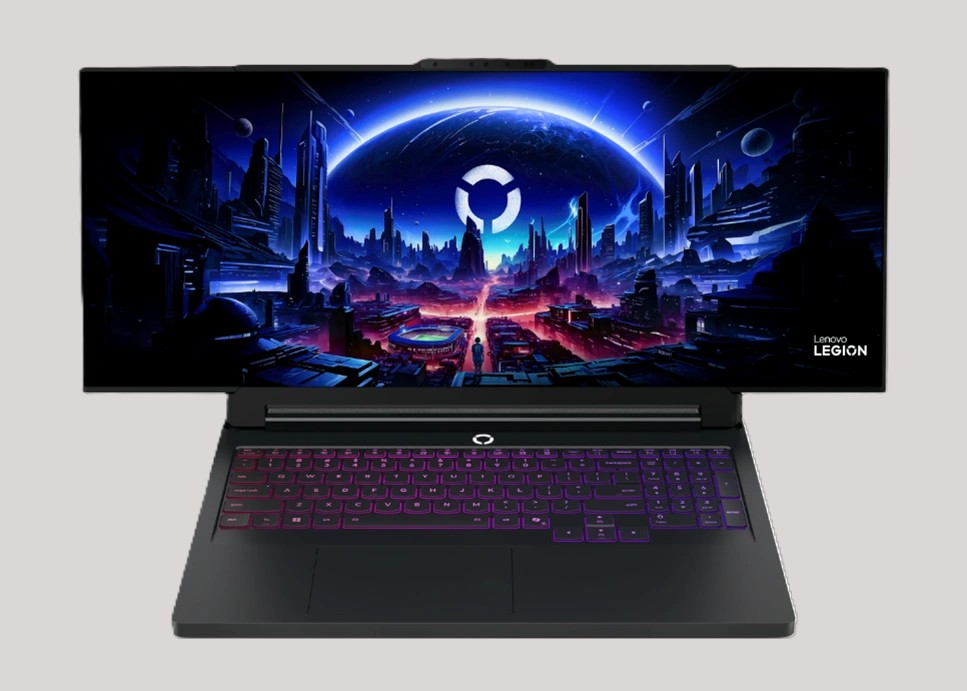
The Legion Pro Rollable Concept applied the same idea to a very different audience. Instead of extending vertically, its display unrolls horizontally from both sides, widening the screen to suit gaming formats that favour broader aspect ratios. The mechanism uses a dual-motor, tension-based system designed to keep the display stable as it expands.
Gaming laptops have long struggled to balance portability with immersion. Lenovo’s concept proposed a way to offer a wider display when space allows, while keeping the device compact enough to travel. As with the ThinkPad, the emphasis was on demonstrating what is possible rather than announcing a product.
Beyond laptops, Lenovo’s concepts explored how computing might spread across multiple devices. Project Kubit, described as a Personal AI Hub Concept, was presented as a personal edge cloud designed to sit at the centre of a user’s ecosystem. Behind a transparent touch screen sit two ThinkStation PGX compact AI workstations powered by Nvidia Grace Blackwell Superchips.

The idea is to centralise processing for AI-enabled applications used across PCs, smartphones, wearables and smart-home devices. Lenovo positioned the hub as touch- and voice-controlled, collecting data across platforms to support personal analytics and AI applications. As with the rollables, it was framed as an exploration rather than a product announcement.
Wearables formed another strand of Lenovo’s thinking. The Lenovo AI Glasses Concept showed how lightweight smart glasses could act as an interface to existing devices. Wirelessly tethered to a smartphone or PC, the glasses support hands-free calling, music playback and a teleprompter function aimed at presentations and speaking engagements.

Weighing 45g, the glasses are designed for extended wear, with Lenovo claiming up to eight hours of use. Features such as live translation and image recognition depend on processing from paired devices, reinforcing the idea that the glasses function as an access point rather than a standalone computer.
Displays also received attention. The Lenovo Smart Sense Display Concept reimagines the monitor as a hub that connects wirelessly to multiple devices, including phones, laptops and tablets. The 27-inch UHD display supports content casting, multi-screen use and interaction via touch or voice commands.

A related personalised display concept focused on user comfort, adjusting brightness and colour temperature according to profiles, time of day and location. Lenovo suggested it could respond to posture and eye fatigue during extended sessions, adapting display settings in real time.

Even accessories became sites of experimentation. The Lenovo Adaptable Keyboard Concept allows users to adjust keystroke force for different tasks, while the Lenovo Self-Charging Kit Concept pairs a keyboard and mouse powered by indoor light, operating at illumination levels as low as 50 lux.

Lenovo’s CES 2026 concepts focused attention back on the physical form of personal computing. The rollable laptops in particular questioned the assumption that portability and screen size are fixed compromises. By altering how displays occupy space, Lenovo explored alternatives to simply making devices thinner or faster.

None of the concepts came with timelines or commitments. That reflected the role CES still plays as a testing ground, where manufacturers expose ideas before deciding which ones justify the cost and complexity of production.
For now, the prototypes stayed in Las Vegas. The questions they raised about how laptops might change did not.