



Artificial Intelligence
Signpost: African banks
teach AWS about AI
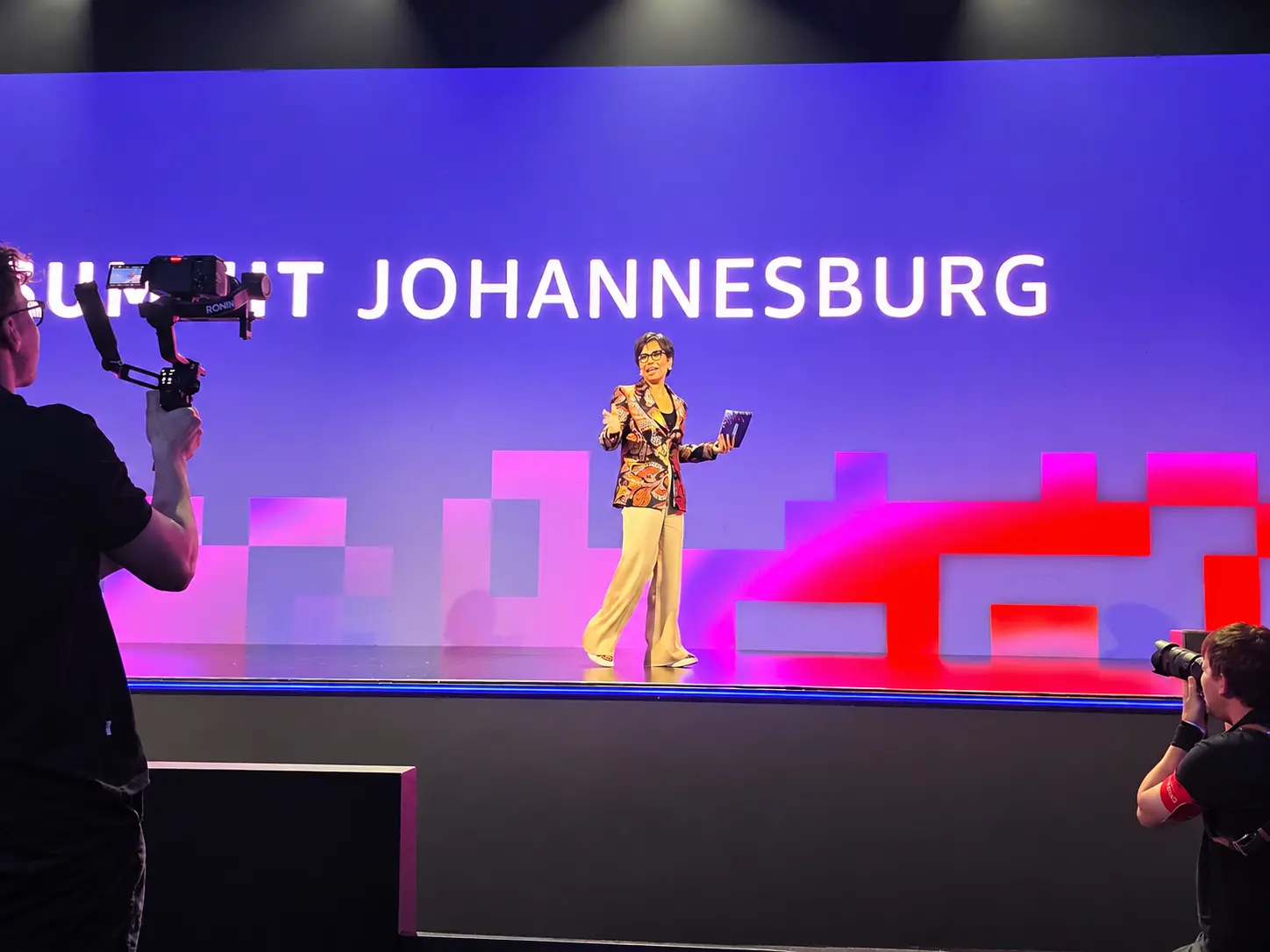
Building the original cloud was only the beginning of African influence on the organisation, AWS MD and SVP for EMEA Tanuja Randery tells ARTHUR GOLDSTUCK.

It is an open secret that the original Amazon Web Services (AWS) cloud came out of Cape Town, where a local team developed Elastic Compute Cloud, or EC2, the computing engine that became the foundation of Amazon’s global cloud business. It is also the most profitable division of Amazon, with its $42.2-billion revenue in the second quarter accounting for over a fifth of group turnover.
Now, African banks have helped create another core AWS service. And they are influencing how the company adds AI to customer operations.
Tanuja Randery, AWS vice president and managing director for Europe, the Middle East, and Africa, told Gadget that Amazon EC2 was one of the core building blocks of AWS, and was used to run applications, host websites, process data and carry almost any compute workload.
“In 2004, engineers from Cape Town developed the foundation of what would become a key component of AWS’s cloud services that have enabled customers across the globe, including the likes of Standard Bank and Absa Bank, transform how they operate and serve customers.”
The next stage is under way in banking. Randery said banks were using Amazon Connect, its platform for contact centres and customer interactions, to reconsider the economics of their call centres, including the potential for agents to identify sales opportunities during service interactions.
“They’re now looking at Amazon Connect as the way they not only serve customers in terms of call centres and agents, but how they completely rethink how call centres are run – the fundamental processes – so they can increasingly drive more upsell and cross-sell.
“It becomes a growth engine rather than a cost centre.”
Across a large institution, that demands cloud systems that can use AI to process customer data securely and at scale.
Standard Bank supplied the most detailed African example at the recent AWS summit in Johannesburg. The bank operates in multiple markets and says it has moved beyond isolated AI use cases into deployment at scale. More than 1,000 engineers use a combination of Amazon Bedrock, which allows companies to build generative AI tools from a choice of leading AI models, while keeping them under their own security controls, and the Q developer assistant. The bank says these tools have doubled the speed at which it delivers solutions.
Randery points out that management decisions lie behind that progress. Africa adopted cloud technology earlier than several European markets, and its biggest banks, fintech companies, retailers and media groups often directed the change from the executive suite.
“They brought technology and business together earlier than I’ve seen elsewhere. When I speak to CEOs, this idea of reimagining their businesses is much stronger here, and CEOs themselves are getting involved in the conversation.”
However, Randery sees a clear divide between two types of AI-using companies: basic users, who summarise text or query a large language model; and advanced users, with governance, an executive strategy, direct participation by business heads, and staff training.
The hesitation makes sense: AI agents can plan and carry out transactions, so failures can travel much further than a dodgy chatbot answer. Banks also have to consider both external regulators and their own customers’ money.
Speed raises an obvious question about software quality. Randery’s answer is to use agents throughout the development process, including testing and quality assurance, while keeping people responsible for the work.
“Of course, there are humans in the loop the whole time.”
She cited AWS’s development of a new version of Amazon Bedrock. A project planned to take about a year was completed in 76 days by around six people.
“It’s not just 20% productivity. It’s not even 30%. Standard Bank is absolutely right: it is double the productivity and outcome.
“But you must always have skilled people, governance and security at the core. Then you can experiment freely, and that’s what we make possible.”
AWS plans to invest R46-billion in South African cloud infrastructure between 2018 and 2029. Randery put expenditure so far at about R15-billion. The original investment plan predates generative AI, which changes what the remaining capital must buy.
She expects more local AI infrastructure, including graphics processing capacity, AWS’s Trainium chips alongside Nvidia hardware, and further Bedrock capabilities in the Cape Town-based cloud region.
“Needs evolve. Who knows what comes two years from now?” says Randery. “What we don’t want to do is put something in that doesn’t match the needs of our customers.”
* Arthur Goldstuck is CEO of World Wide Worx, editor-in-chief of Gadget.co.za, and author of “The Hitchhiker’s Guide to AI – The African Edge”.