



GadgetWheels
Signpost: AA prepares
for tomorrow
The Automobile Association is preparing to shift gear, its CEO, Bobby Ramagwede, tells ARTHUR GOLDSTUCK.

The roadside-assistance business that built the Automobile Association of South Africa (AA) is approaching its own expiry date. As electric vehicle sales begin to register on the dashboard of the Automotive Business Councell, known as naamsa, a new reality is dawning: EVs have far fewer mechanical parts to fail.
A broader revolution of increasingly connected cars means the vehicle itself can warn of trouble before the driver is stranded. That realisation is already contributing to a gear shift at the AA.
“Roadside assistance as a service will rapidly die,” says Bobby Ramagwede, CEO of the AA. “The AA of the future is probably going to be like a Google. It will just happen to have fulfilment partners that send out vehicles to assist what is meant to be a broken-down EV.”
For many South Africans, the AA was a sticker in the back window of their parents’ or grandparents’ cars.
Today, the patrol vehicle and the human at the roadside are still central to the organisation. Ramagwede uses the Thai-English phrase to describe the scenario: “The same, same, but different”.
“Your grandfather’s AA was probably the AA that attended to him on the side of the road when he either had a flat tyre, a mechanical issue or a flat battery. That’s still the cornerstone of the physical services that we provide.
“An EV probably has 10% of the number of mechanical parts that a conventional vehicle has, which means you’ve got 10% of the failing. It’s going to require someone who can manage the data that comes out of these vehicles – and comes out of that broader mobility system. I see an opportunity for the AA to evolve into that business.”
Norway offers the closest working example, courtesy of NAF, the Norwegian equivalent of the AA.
“The reality that NAF is facing is that what they thought was going to be the typical failure point of the vehicle is not. The motors don’t pack up. The batteries are becoming increasingly efficient, a lot more tolerant of extreme temperatures and extreme conditions, to the extent that the only things that they are changing are tyres and shock absorbers.”
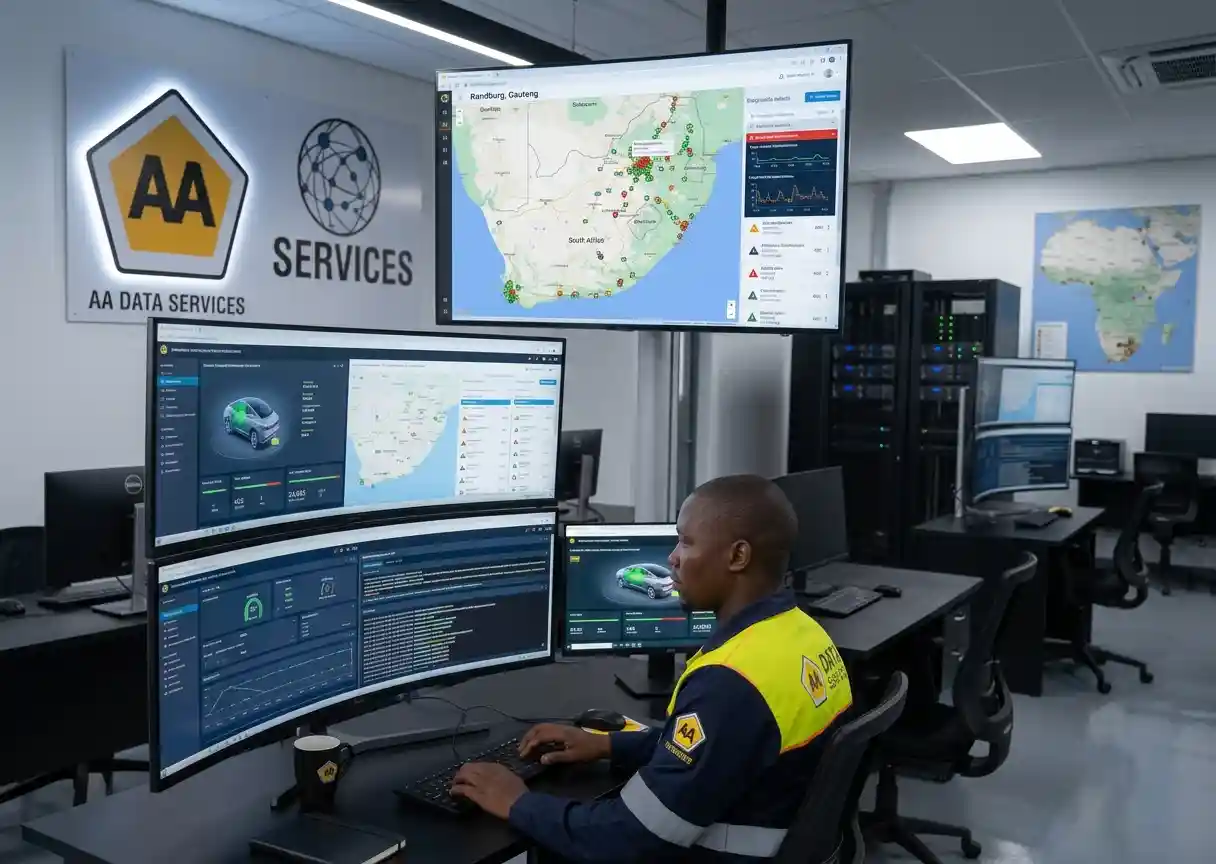
The AA already receives information through the manufacturers it services. In future, says Ramagwede, he wants direct access to diagnostic data from connected vehicles.
“A debate we’re having right now with the OEMs (original equipment manufacturers, as car makers are known), as far as data is concerned, is: who owns the data, and can we tap into that data?
“It’s a battle that’s being won very well by our counterparts in Europe. In fact, they’ve managed to convince the likes of BMW, Mercedes-Benz and Volkswagen to gather consent from the vehicle owner for the AA equivalent to collect vehicle data and use it as pre-emptive data to manage the vehicle.
“So instead of being a reactive organisation that catches up with the user when the vehicle breaks down, rudimentary diagnostic data gets fed into the AA’s engine, and they catch you before the event occurs. We want that for South Africa.”
Modern cars can gather information about the occupants as readily as they diagnose themselves. Ramagwede says the AA does not yet collect such data, but plans to begin through its membership base.
“The advent of cameras in the vehicle, the ability to measure thermal dynamics within the vehicle, where your head turns towards: I can see what you’re looking at, I can see what you’re interested in, and I can see your distraction points.”
Of course, the AA will have to prove it can be trusted with information about what happens inside the car. Meanwhile, Ramagwede sees the AA changing from what he calls a “mobility house” to a “data-in-mobility house”. It is already adding WhatsApp, AI and voice channels, although Ramagwede does not believe a distressed motorist wants to wrestle with automation.
“When a person’s in distress and you’re trying to deliver them from distress to relief, the last thing they want is a chatbot sequence overlaid with an AI response and a mechanised voice. They want to see a human being.
“Our commitment to society needs to be – in 10 or 15 years’ time – that when the phone gets answered, it still gets answered by a human being.”
This means that, while the AA will embrace AI to enhance its services, it is not about to become the AI-A. Not yet.
* Arthur Goldstuck is CEO of World Wide Worx, editor-in-chief of Gadget.co.za, and author of “The Hitchhiker’s Guide to AI – The African Edge”.