


Artificial Intelligence
SAS tackles AI chaos
SAS launched AI Navigator at its Innovate 2026 conference to bring visibility and control to enterprise AI, writes ARTHUR GOLDSTUCK.

The world’s oldest data analytics company used last week’s SAS Innovate 2026 conference in Dallas, Texas, to introduce AI Navigator, addressing the chaos of the very newest forms of data processing.
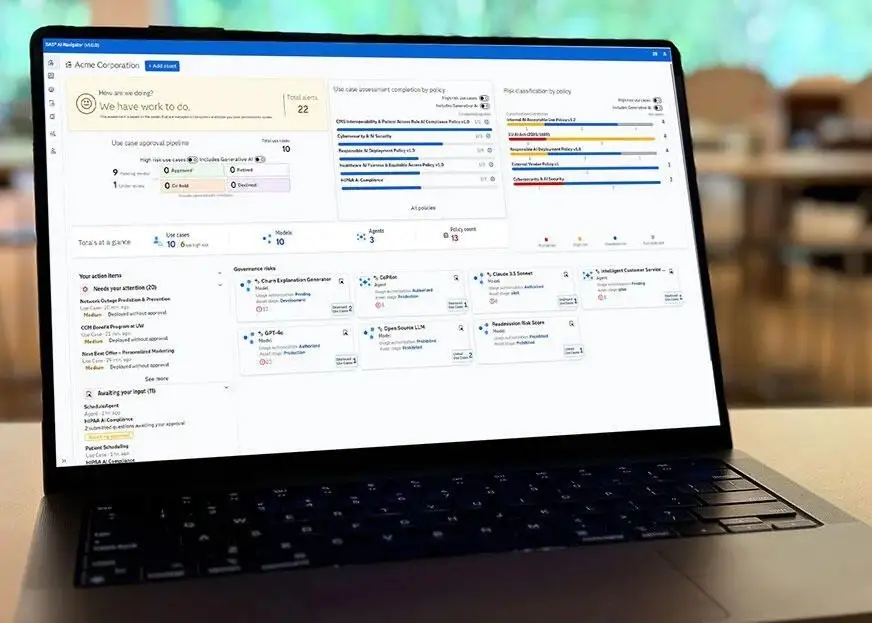
AI Navigator is a platform designed to help organisations understand where artificial intelligence is being used across their operations, and to apply governance where that use has an effect.
The premise is straightforward. Most companies no longer have a single AI system or even a clearly defined set of them. They have multiple models, agents and tools, some built internally, some bought in, all being used in different parts of the business. The missing link is a consistent view of how those systems are connected to real decisions.
AI Navigator is SAS’s attempt to provide that view. It builds an inventory of AI use cases, links them to the models and agents behind them, and applies policies to each one.
“AI systems designed to scale human judgment are gradually displacing human judgment, ” said Reggie Townsend, SAS vice president of AI ehics, governance and social impact. “Governance is a system for scaling our judgment and preserving our culture.”
The shift is already embedded in how organisations operate. AI is now part of everyday workflows, often without a complete understanding of where it is used or how it behaves.
The new SAS platform addresses this gap by moving governance away from models in isolation and towards use cases.
“When I say use case, what I mean is a specific business implementation of AI,” Townsend said during the opening keynote of Innovate 2026. “I’m not talking about a model that’s just sitting in isolation.”
That distinction runs through the design. A model on its own does not represent risk or value until it is applied. By focusing on use cases, the system tracks AI where it intersects with business activity.
Townsend was joined on stage by Christy Boyd, a SAS product leader working on AI Navigator, who set out a scenario that is already familiar to most organisations.
“Let’s say my company is using AI. We’ve got it used in a variety of ways. We’ve got vendor models, we’re doing stuff in house, and we’re using an open source model.”
The example looked at a model flagged for “data poisoning”.
“That’s exactly the kind of problem that SAS AI Navigator is designed to solve,” Boyd said. “It’s designed for folks like you who need to make a quick, informed decision and then be able to move on with your day.”
The system identified the model and showed the use cases connected to it. In this case, two applications were affected. It isolated one of them, while allowing other processes to continue.
Said Townsend: “We’ve identified the points of impact, we’ve confirmed the remediation necessary, we’ve ensured that the asset owners have visibility into the incident, and we also discovered that there’s an alternative… in about five minutes or so.”
The emphasis is on visibility and response rather than control for its own sake. The underlying assumption is that most organisations will continue to use a mix of systems, and that governance needs to work across that mix rather than replace it.
“AI governance is too often thought of as a compliance measure,” said Townsend. “It’s a growth driver.”
That position reflects SAS’s longer-standing work in regulated industries, where governance is already embedded in how systems are deployed. AI Navigator extends that approach into a broader environment where AI is more widely distributed.
The platform is designed to underpin existing tools and models, whether they are built in-house or sourced externally. It tracks them through their lifecycle and links them to internal policies and external regulatory frameworks.
That approach is intended to address what SAS sees as a widening gap. The use of AI agents and large language models is accelerating, while governance mechanisms are not keeping pace. The result is increasing exposure to risk, particularly from unauthorised or poorly understood systems.
“The biggest risk to any AI governance program isn’t regulation,” said Townsend. “It’s a tool so complex that no one uses it.”
AI Navigator is intended to be used by the teams responsible for managing AI risk, such as compliance, data and governance functions, without requiring changes to how AI systems are built.
“We decided that we’re going to make being responsible irresistible.”
The emphasis on usability reflects a practical reality. Governance tools tend to fail when they operate separately from the systems they are meant to oversee. If they require additional steps or duplicate work, they are often ignored.
By anchoring governance at the use case level, SAS is trying to connect it directly to business activity. Each use case carries its own policies, risk profile and accountability, making governance part of how AI is used rather than something applied afterwards.
“We need to know what’s deployed, where, how much it costs, if it’s drifting outside of its intended purpose, and who’s accountable.”
Those questions are not new, but they are becoming harder to answer as AI becomes more embedded and more autonomous. The combination of models, agents and workflows creates layers of dependency that are not always visible.
The timing of the launch reflects where the market has moved. AI is no longer experimental, but operational and increasingly complex. The challenge now is how to keep track of it.
* Arthur Goldstuck is CEO of World Wide Worx, editor-in-chief of Gadget.co.za, and author of “The Hitchhiker’s Guide to AI – The African Edge”.