


Gadget of the Week
Gadget of the Week: The tech
that keeps a country afloat
Rijkswaterstaat is a concept right out of science fiction, but it provides a national digital twin for the Netherlands, writes ARTHUR GOLDSTUCK.

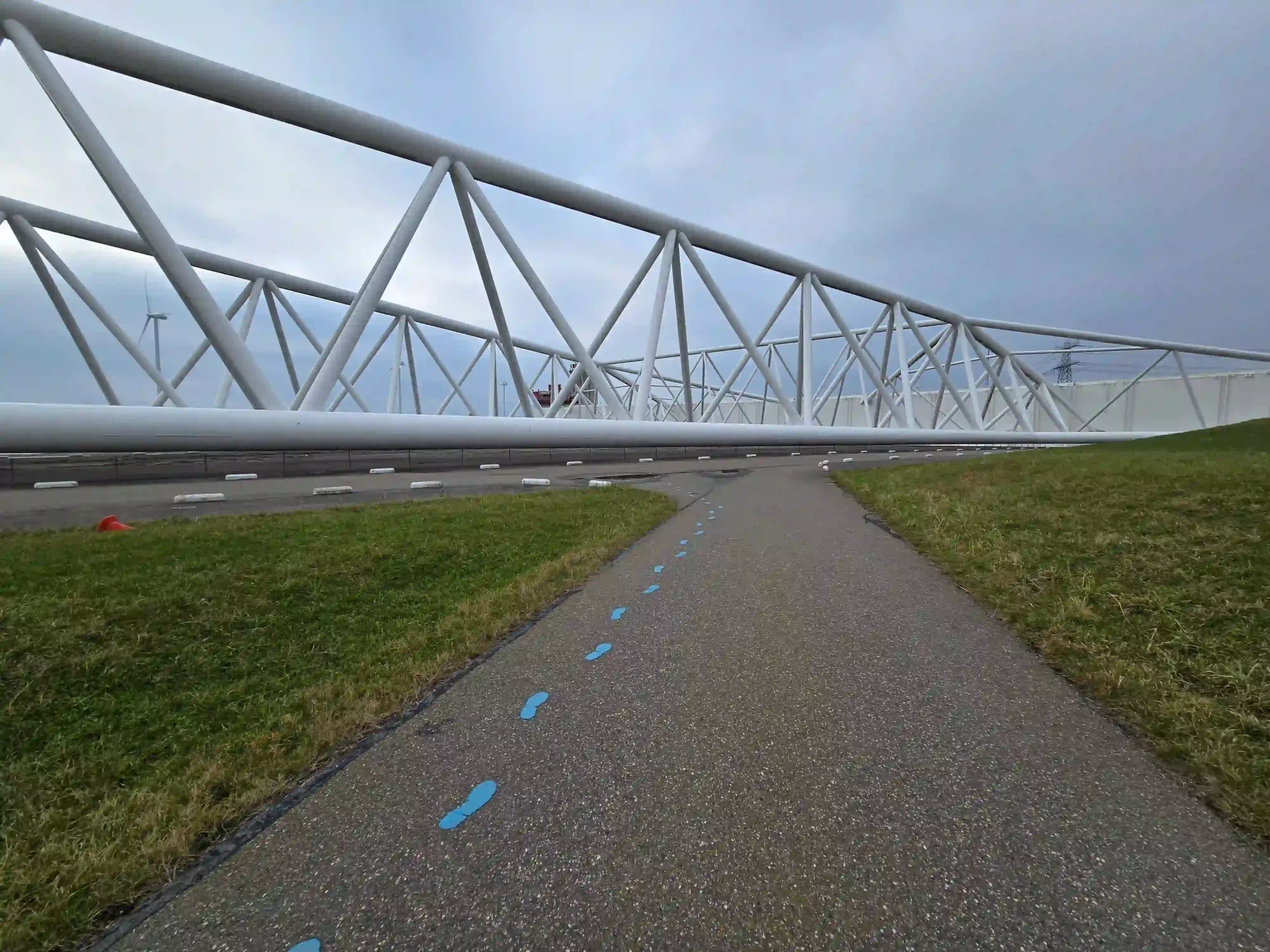
Standing beneath the Maeslantkering storm surge barrier on the Dutch coast, it is hard to grasp its scale all at once. Two steel arms, each as long as the Eiffel Tower is tall, rest open over the Nieuwe Waterweg near Rotterdam. When the North Sea rises beyond a critical threshold, they swing shut, sealing off Europe’s busiest port from the ocean.
The steel colossus is, in turn, one of the biggest moving structures in the world. It is unapologetically physical. And yet, Maeslantkering is also one of the most software-dependent pieces of infrastructure on the planet.
Its operation depends on a steady flow of data from tide gauges, wind sensors, river discharge points and weather systems. Long before the arms move, models assess conditions and project outcomes. Closure follows a defined sequence once thresholds are crossed.

That orchestration relies on a digital network that behaves like infrastructure rather than background IT. It connects sensors, control rooms, operators and models across the country, allowing physical systems to be coordinated as a single whole.
The organisation coordinating this activity is Rijkswaterstaat, the Dutch authority responsible for roads, waterways and flood defences.
The name translates as “national water state”, a phrase that could easily belong in a dystopian science-fiction novel. Yet, Rijkswaterstaat is one of Europe’s oldest continuously operating public institutions, founded in 1798 to manage a harsh reality for the Netherlands: water is an existential problem before it is a political one. Numerous floods in the last few centuries left thousands dead and hundreds of thousands homeless.
That long institutional memory still shapes how the Netherlands approaches infrastructure. Roads, rivers and ports were never treated as separate domains. They evolved together, driven by geography, trade and survival, long before digital systems entered the picture.
Today, those influences are expressed through software layered onto physical assets that still do the heavy lifting.
“The network connects that all, and that’s what makes this orchestration possible,” said Michiel Koolen, chief network architect at Rijkswaterstaat, during a briefing at Maeslantkering this week.

The facility is one element in a far broader operational landscape. On a normal day, Rijkswaterstaat control rooms track river levels along the Rhine, traffic density on national highways, wind loads on bridges and the operating status of locks feeding Europe’s busiest port.
Across the country, more than 10,000 employees operate one of Europe’s most complex infrastructure portfolios. Roads, tunnels, bridges, waterways, locks and storm surge barriers run continuously in a country that depends on them.
“At a fundamental level, we call these roadways, waterways and water systems our three major networks,” said Adriaan Schutte, Rijkswaterstaat chief technology officer. “What’s often less visible, but just as critical, is that every physical asset is now part of a digital system.”
That digital layer spans thousands of kilometres of fibre and connects hundreds of locations, linking field sensors, control rooms and operational platforms. Internally, it is often described as a fourth national network, sitting alongside roads, waterways and water systems.
“Historically, infrastructure was about objects: building dikes, tunnels, barriers, constructing bridges, operating water locks,” Koolen said. “Over time it became clear you cannot manage a country like the Netherlands asset by asset. You must manage it as a system.”

Much of that system intelligence comes from infrastructure that predates the software now running on top of it. Fibre-optic cables originally installed for communications double as continuous traffic sensors, revealing vehicle density and movement through vibration patterns. River gauges, wind sensors, lock controls and weather data feed into shared platforms that model downstream effects in near real time.
Taken together, this creates a continuously updated operational picture: a practical digital twin used to anticipate pressure rather than respond after the fact.
A key provider of this digital layer is Cisco, the US-based technology group best known as world leader in networking equipment that carries internet and data traffic between organisations, cities and countries. While the brand is often associated with corporate IT, its core business has long been large-scale, mission-critical networks used by governments, telecom operators and utilities.
Cisco has worked with Rijkswaterstaat for more than two decades, supplying and supporting the backbone network that links control centres and field systems across the Netherlands. Around 1,000 Rijkswaterstaat sites, including Maeslantkering, are connected via Cisco technology, forming a nationwide service-provider-style network spanning almost 5,000 kilometres of fibre-optic cable.
This network underpins day-to-day operations that attract attention only when something goes wrong. Nearly 60 traffic control centres managing bridges, tunnels and roads depend on it for real-time decision-making, while more than 5,000 roadside cabinets feed data into 17 control centres coordinating traffic and water systems. The hardware footprint alone runs into the thousands, with roughly 1,500 routers and more than 6,000 switches deployed nationwide.

Rijkswaterstaat also uses Splunk software – now owned by Cisco – to observe network behaviour and system health alongside traffic and water data. This gives engineers and operators early warning when conditions begin to degrade.
This approach reflects how the Dutch state thinks about infrastructure more broadly. Roads, waterways and flood defences are not managed as separate assets, but as a single operational system. The digital layer is expected to be predictable and observable. Not to mention, resilient under stress.
For the Netherlands, that thinking is key to national continuity. More than a quarter of the country lies below sea level, and a far larger proportion – around 40% – is floodable. Ports, airports and logistics corridors underpin an economy built on being Europe’s gateway.
The relevance to South Africa is obvious. The country manages national roads, freight corridors, ports, water systems and power transmission across far greater distances, but with almost no coordination between responsible entities. Flood damage in KwaZulu-Natal, congestion along Gauteng freight routes and repeated port disruptions have shown how quickly physical breakdowns translate into economic ones.
The country has a formal National Water Resource Strategy, now in its third iteration, and a legislative framework that recognises water as a strategic national asset. However, implementation is missing in action. Institutional fragmentation, skills erosion, infrastructure failure and political interference have weakened execution, even as climate crisis intensifies. South Africa’s challenge lies in the absence of capability: turning policy into sustained stewardship at a moment when water security is becoming a defining constraint on economic and social stability.
Rijkswaterstaat highlights the solution: coordination via digitalisation.
Digital representations increasingly guide how physical risk is managed, but only while data remains available and trustworthy.
That places leadership, rather than technology, at the centre of the discussion.
“If you don’t know the water is coming, you don’t close the gates,” said Christian Korff, vice-president for strategic sales, strategy and planning for EMEA at Cisco, during our visit to Maeslantkering. But the real test, he said, lies further upstream.
“Forty years ago, people made the decision to put fibre into the ground. Our generation now has to make the right decisions for the infrastructure we require.”
Rijkswaterstaat (RWS) fact sheet
Aside from maintaining the Netherlands’ main infrastructure, RWS is also responsible for:
- 24 lighthouses and 325 movable bridges.
- 3,642 km of canals and rivers
- 7,372 km of carriageway
- 90,192 km² of surface water
With Cisco and other business partners, Rijkswaterstaat has built a robust, nationwide infrastructure that serves as the “invisible force” behind Dutch mobility and safety. It comprises:
- 1,500 routers and over 6,000 switches deployed nationwide.
- 5,000 roadside cabinets and 17 control centres to manage traffic.
- A Cisco backbone network comprising almost 5,000 km of fiber-optic cable and 100+ Points of Presence.
- Cisco infrastructure connecting nearly 60 Traffic Control Centres for bridges, tunnels, and roads, supporting real-time decision making.
* Arthur Goldstuck is CEO of World Wide Worx, editor-in-chief of Gadget.co.za, and author of “The Hitchhiker’s Guide to AI – The African Edge”.