


GadgetWheels
Chery prepares to upend
SA bakkie market
Automation at Chery’s Wuhu factory has driven productivity to unprecedented levels – the same system behind two new double-cabs heading for SA in 2026, writes ARTHUR GOLDSTUCK.

Chery’s factories in China are producing vehicles at a rate that vastly surpasses anything achieved by its Western rivals. The factories’ combination of robotics, AI-driven process control and minimal staffing has turned them into some of the most efficient automotive plants in the world.
During a tour of the manufacturer’s plant in Wuhu, where Chery is headquartered, a plant employee told Gadget that about 200 people work in the facility. Chery has not confirmed the figure, and it is not echoed in Chery staffing levels previously reported, but it reflected what was visible on the floor: vast automated lines where robots carried out welding, painting, assembly and inspection while engineers monitored performance from digital consoles.
Despite this minimal staffing level, the facility maintains an annual production capacity of 300,000 vehicles.
That number implies an extraordinary level of productivity. Public data accessed by Gadget from comparable factories, which produce similar numbers of cars per year, fully reveal Chery’s revolution: Tesla Fremont produces about 50 cars per worker each year, BMW Spartanburg 39, and Ford Dearborn 62. At Wuhu, the ratio is closer to 1,500 cars per worker per year, achieved at similar line speeds with fewer than one-twentieth the staff. The scale of the difference illustrates that Chery has re-engineered the fundamentals of manufacturing efficiency.
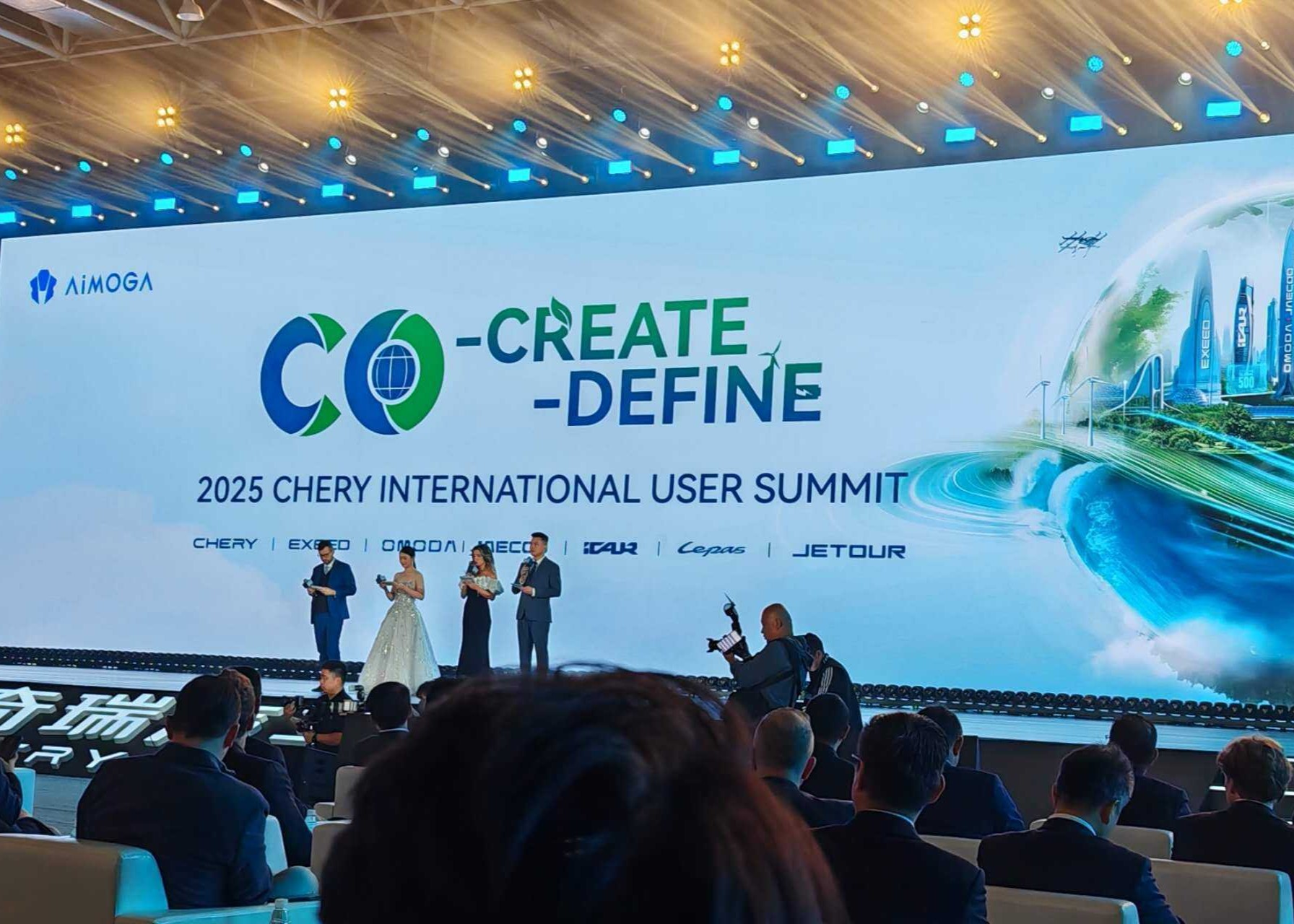
That foundation of productivity is now feeding directly into new vehicles designed for global markets and due to arrive in South Africa in 2026. This week’s 2025 Chery International User Summit saw the world debut of two new double-cabs — the Himla and the T1TP PHEV — positioned to reshape the premium bakkie segment in South Africa as decisively as Chery, along with Great Wall Motors’ Haval models, helped transformed the SUV market.
Verene Petersen, national brand and marketing manager for Chery South Africa, said During the Summit that the company would “bring the same kind of competition to the double-cab market that Chery brought to SUVs”. She said that Chery’s production scale “allows more technology and versatility at a level of efficiency that changes how we think about cost and value”.

The Himla is built on Chery’s Super Hybrid (CSH) platform, pairing a high-efficiency petrol engine with an advanced electric drive system that extends range and strengthens acceleration, while maintaining low fuel use.
The T1TP PHEV represents a new category altogether. It draws directly from the engineering philosophy of Chery’s Transformable Multi-SUV concept. That concept illustrated how a single modular platform could shift between multiple roles, from seven-seater SUV to pickup-style configuration or eco-camping setup.
In effect, the T1TP is a modular SUV with a detachable rear hatch, allowing transformation into a double-cab bakkie. It’s built on a unibody chassis and uses Chery’s CSH hybrid system.

At a Chery Brand Night held alongside the Summit, Zheng Songzhi, executive deputy GM of the Chery International Marketing Centre, said that the Multi-SUV concept was a result of in-depth research across international markets. In February 2024, Chery assembled a team of 20 product experts who, over 300 days, gained insight into diverse user needs spanning work, family and leisure scenarios.
Centred on the concept of “space freedom,” the concept introduces a flexible seating configuration and quick-release rear panel design, described as a “6=1” formula: six different interior and exterior combinations are available across three key configurations:
- A seven-seater SUV with a 2,900 mm wheelbase and 69.5% space utilisation rate;
- a dual-row pickup offering 600 litres of cargo space; and
- an eco-camping mode featuring an intelligent power system and off-road capability with 700 mm wading depth.
“South Africans value practicality and freedom, whether it’s a school run in the city or a long drive to the coast,” said Petersen. “The Transformable Multi-SUV captures that spirit perfectly – one vehicle that adapts effortlessly to every journey.”
Executives at the summit described it as “a new generation of vehicle architecture that integrates personal and professional use through adaptable design”.
The combination of flexible vehicle platforms and highly automated factories reveals that Chery’s production model supports rapid diversification. The company’s intelligent manufacturing network is designed to build multiple vehicle types simultaneously, allowing it to extend from small SUVs to large pickups without the cost burden of traditional expansion.
The Wuhu facility lies at the centre of Chery’s intelligent manufacturing strategy. Every process is digitalised, monitored and adjusted in real time. Robots perform the precision work while engineers refine calibration and software systems. Human involvement focuses on analysis and optimisation rather than repetition.
Chery’s AiMOGA Robotics division, also based in Wuhu, helps develops this automation. At the 2025 AiMOGA Global Business Conference, held during the Summit, Chery introduced “its new robotics brand strategy, integrating automotive and intelligent technology”. AiMOGA’s global head, Xia Peng, said its systems had advanced “from L2 to L3 assistance-level capability,” enabling autonomous decision-making within defined parameters.
The highly anticipated AiMOGA robot made its debut, showcasing advanced capabilities, such as multimodal environmental sensing, autonomous navigation, precise manipulation, and intelligent Q&A functions, using Chery’s proprietary AI model.
The AiMOGA is certified for the EU and operates in more than 20 countries. In South Africa, the humanoid robot can be expected to greet customers at dealerships and introduce cars to them.
To illustrate what robotic and AI systems can achieve at scale, a case study by ForwardX Robotics, which manages several of Chery plants’ logistics automation, offers a detailed breakdown of the technology in use at Chery’s factory in the port city of Dalian. It is described as “the world’s largest just-in-time automation project in electric-vehicle manufacturing”.
The study reports 435 autonomous mobile robots (AMRs) performing over 100 processes with 99.5 percent material-delivery accuracy and a 30 percent reduction in labour costs. The Dalian site produces about 300,000 vehicles a year.
In the factory, ForwardX Rover X robots complete about 40,000 deliveries a day, travelling 200 kilometres within the factory. Production runs continuously at 60 cars an hour: similar to Western benchmarks but achieved with a fraction of the workforce.
The Wuhu operation applies the same principle across a wider range of models and research projects. Supervisors manage clusters of robotic cells from digital hubs, while live data adjusts operations automatically to maintain consistency and speed.
Chery’s global output now exceeds 1.5-million vehicles a year, sustained by this connected network of intelligent plants. The Himla, and T1TP PHEV demonstrate how manufacturing innovation now flows directly into product design.
An analysis suggests that a 30% reduction in labour cost, which ForwardX claims for the Dalian plant, equates to a saving of about R100,000 on a mid-range SUV or double-cab. That cost base provides the freedom to build higher specification vehicles while pricing them competitively for emerging markets, such as South Africa.
Sidebar/graph
The Chery advantage
If the claim of 200 workers at the Wuhu plant is correct, this table shows the comparative productivity:
| Factory | Annual output | Workforce | Automation | Cars per worker per year |
| Chery Wuhu (China) | 300 000 | ~200 | ~95% robotic | 1 500 |
| Tesla Fremont (US) | 500 000 | 10 000 | ~75% | 50 |
| BMW Spartanburg (US) | 430 000 | 11 000 | ~55% | 39 |
| Ford Dearborn (US) | 500 000 | 8 000 | ~60% | 62 |
| VW Wolfsburg (Germany) | 800 000 | 60 000 | ~45% | 13 |
* Arthur Goldstuck is CEO of World Wide Worx, editor-in-chief of Gadget.co.za, and author of “The Hitchhiker’s Guide to AI – The African Edge”.