
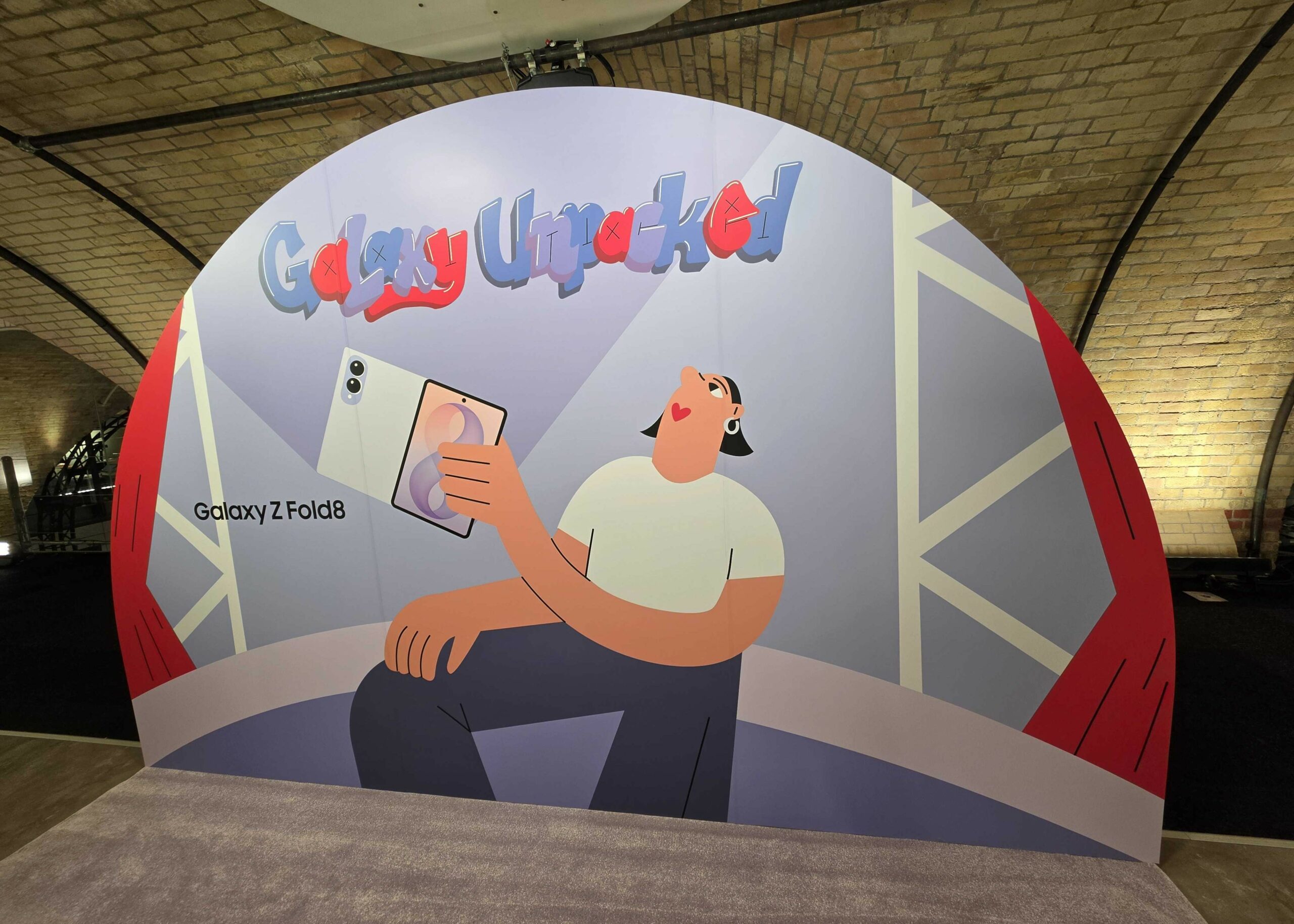


Photo: ARTHUR GOLDSTUCK.
Hardware
Samsung plays foldable triple card
The new passport-shaped Galaxy Z Fold8 gives Samsung three distinct foldable formats just as Apple prepares to enter the market, writes ARTHUR GOLDSTUCK.

Samsung has turned its foldable phone range into a triple threat, adding a passport-shaped Galaxy Z Fold8 alongside the powerhouse Z Fold8 Ultra and compact Z Flip8.
The Fold8 is the surprise package of the eighth-generation Galaxy Z series unveiled in London yesterday. Shorter and wider than Samsung’s familiar book-style Fold, it has a 5.5-inch cover display and opens into a 7.6-inch screen with a 4:3 aspect ratio. At 201g, it is Samsung’s lightest Fold yet.
It gives the company three distinct form factors, drawing a line in the sand ahead of Apple’s expected entry into the category in September.
Reports suggest Apple’s first foldable iPhone will use a similar passport shape, opening into a display of around 7.7 inches. Apple has yet to confirm the device or its launch date, but the industry expectation makes Samsung’s timing especially pointed.
Samsung now has an answer waiting at every end of the foldable market: the pocket-sized Flip8, the content-focused Fold8 and the productivity-driven Fold8 Ultra.

Justin Hume, vice-president for mobile experiences at Samsung South Africa, says the expansion reflects the point the category has reached after seven previous generations.
“The question is no longer about whether a foldable has a place within the market,” he told Gadget. “It’s now a question about which foldable is the right one to go for, which is where the line-up expansion comes from.”
The naming may cause some initial confusion. Last year’s Galaxy Z Fold7 has effectively evolved into the Z Fold8 Ultra, while the Fold8 name has been given to the all-new passport design.
Hume rejects the suggestion that the standard Fold8 is a cut-down version of the Ultra.
“I wouldn’t call it a light version at all. I’d actually call it a different perspective on the product. The Z Fold8 Ultra is about productivity. It’s about the 200-megapixel camera and high-intensity usage, whereas we are prioritising the Z Fold8 more for content, media and e-book-type utilisation. These are actually three different phones for three different audiences.”
That distinction is clear in the specifications.
Galaxy Z Fold8 Ultra
The Z Fold8 Ultra is the successor to the conventional Fold. It retains the tall book-style format, with a 6.5-inch display on the outside and an 8-inch Dynamic AMOLED 2X screen when opened. The displays reach a peak brightness of 3,000 nits and support an adaptive refresh rate of up to 120Hz.
Despite its two-screen construction, the Ultra measures just 4.1mm thick when open and weighs 215g, making it the thinnest Galaxy Z Fold yet.
Samsung has also adjusted the folding magnets, hinge and display tension to make the phone easier to open, while refinements to its edges give fingers a better grip. Flex Titanium technology beneath the display is intended to strengthen it and make the crease less visible.

The camera system places the Ultra in the same league as Samsung’s top conventional phones. It combines a 200MP main camera with a 50MP ultra-wide lens and 10MP telephoto camera offering 3x optical zoom. It can record 8K video and provides digital zoom of up to 30x.
A 5,000mAh battery is rated for up to 27 hours of video playback. A Snapdragon 8 Elite Gen 5 for Galaxy processor supplies the computing power for multitasking and on-device AI.
The 256GB and 512GB versions have 12GB of RAM, rising to 16GB in the 1TB edition.
Samsung is using the larger screen to move beyond the familiar collection of AI photo-editing tricks. Gemini Notebook can turn meeting minutes or a recorded presentation into a summary and then convert the same source into formats like slides or a podcast.
Another feature, Now Nudge, anticipates when a second app may be useful, and opens Multi Window. Samsung gives the example of receiving dinner plans in a message: Now Nudge can offer to add them to the calendar and open the calendar beside the message.
Galaxy Z Fold8
The passport-shaped Fold8’s 5.5-inch cover screen has a 10:16 aspect ratio, giving it a broad, almost square appearance. Opened, its 7.6-inch screen changes to 4:3, which Samsung considers ideal for games and movies. Rotating it produces a 3:4 display intended for web browsing and e-books.
Hume says it can be used in either orientation according to the content.
The Fold8 is 4.5mm thick when open and weighs 201g. It uses the same Snapdragon processor and Flex Titanium display construction as the Ultra, but has a dual-camera arrangement comprising 50MP wide and 50MP ultra-wide cameras. It has no dedicated telephoto lens, and digital zoom is limited to 10x.
Its 4,800mAh battery is rated for more than 26 hours of video playback.
The apparent disparity between its advanced displays and less elaborate camera system is deliberate, says Hume.
“With the Ultra classification, we have taken it up to the 200-megapixel camera. But with the passport, if I may call it that, we’ve gone with the 50-megapixel camera, thinking very much about what the audience intends to utilise and what they prioritise.”

The balance also had to take account of the weight and placement of the camera modules, the battery and the structural requirements of the wider body.
“We’ve had to create a structurally optimised product. In no way did we go, ‘It’s got this and not that.’ It was about creating the balance across the product.”
The wider screen is also central to a new feature called My FanCam. A user selects a person in a recorded video and the software automatically reframes the footage to follow that subject.
Samsung also demonstrated more ambitious agent-like functions. In one example, a user sends Gemini a photograph of the Eiffel Tower and asks it to find a nearby hotel. The software continues the search while other apps are in use, returning later with accommodation options and asking for approval before taking any action that requires confirmation.
Samsung originally expected the passport model to account for about 20% of the new Fold range in South Africa. Early purchase orders from local sales channels have overturned that forecast.
“In fact, it’s closer to 50% at the moment,” says Hume. “The people who actually sell the device in the channels are seeing strong demand for that.”
Galaxy Z Flip8
The third part of Samsung’s foldable assault is the Galaxy Z Flip8. It retains the familiar Z Flip clamshell design, with a 6.9-inch main display and 4.1-inch FlexWindow on the outside.
At 6.1mm thick when open and weighing 180g, it is Samsung’s slimmest Flip yet. It has a 50MP main camera, 12MP ultra-wide camera and 4,300mAh battery, with a claimed 31 hours of video playback. Unlike the two Fold models, it is powered by Samsung’s Exynos 2600 processor.
Samsung has extended more apps and AI functions to the outer screen. Now Brief displays the weather, appointments and important notifications as personalised cards, including exchange rates and share-price updates. Users can also browse their photo gallery, respond to messages and complete selected tasks without opening the phone.
The camera takes advantage of the folding body. Camcorder Grip supports one-handed recording, while a horizontal lock in Super Steady keeps footage level. Dual Recording captures the person filming and the subject at the same time, with a live preview on the cover display.

All three phones run One UI 9 on Android 17 and carry an IP48 rating for water and limited dust resistance. Samsung promises seven generations of operating-system and security updates.
South African recommended retail pricing starts at R26,999 for the 256GB Galaxy Z Flip8 and R40,999 for the 256GB Fold8. The 512GB Fold8 costs R45,999. The 512GB Fold8 Ultra is priced at R50,999, rising to R60,999 for the 1TB version.
Samsung’s advantage over Apple will extend beyond reaching the new form factor first. It has eight generations of engineering experience, established distribution, and extensive data on how people use folding phones. It can also offer three formats, while Apple is expected to begin with one.
Hume says the enlarged range is a product of that accumulated knowledge, especially the strong performance of last year’s Fold7.
“This does give a very complete portfolio,” he says. “As the technology develops around folding screens, we’re suddenly able to add a lot of structural integrity to screens that have the ability to be lightweight and foldable – and perhaps in the future do other things as well.”
* Arthur Goldstuck is CEO of World Wide Worx, editor-in-chief of Gadget.co.za, and author of “The Hitchhiker’s Guide to AI – The African Edge”.