



GadgetWheels
Volvo ES90: The passenger review
In the latest in our series looking at cars from the passenger’s perspective, ARTHUR GOLDSTUCK finds himself reinvented as a guest in the Volvo ES90.

There are cars in which the passenger is in fact a co-pilot, expected to assist the driver in managing a multitude of controls, options and features. The Volvo ES90 takes the diametrically opposite approach. Here, the passenger is a guest.
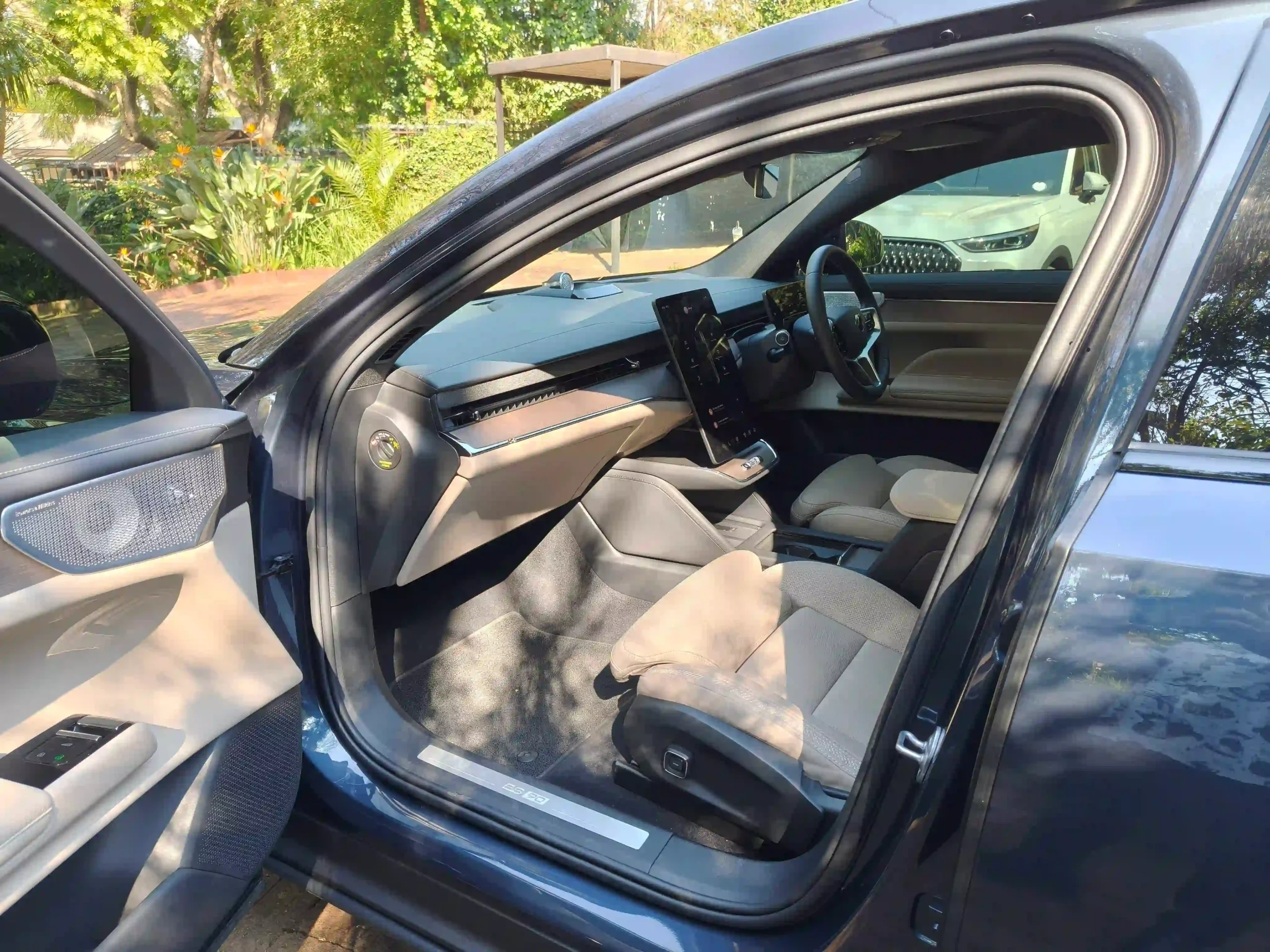
Almost every control has been absorbed into the vertical infotainment screen that dominates the centre of the dashboard. The driver is expected to customise it to their own habits, and even to their own Google account, because Volvo has bought fully into the Google ecosystem.
That leaves the co-pit, our word for the passenger equivalent of the cockpit, with remarkably little distraction. Which raises the question every screen-first car must answer: what remains for the passenger?

Volvo’s answer begins with the most essential feature for a passenger, and it is also the most sensibly applied feature in the ES90: music control. Backwards, forwards and volume are probably the three functions most sought after by anyone in the other seat. Volvo has given it pride of place as the only physical element on the central console, below the infotainment screen
The control echoes what the driver has on the steering wheel, but in far more elegant form: a crystal roller sits between the backward and forward buttons. It takes a moment to realise this is a volume control. It looks more like a decoration, yet it becomes a wonderfully functional way of bringing the soundtrack into the passenger’s ambit.

The display offers a fairly accessible set of controls below the default content area, which is usually taken up by a very large and useful map. The bottom row starts with the emergency button, or the thank-you button, as we call it. Alongside it, a car logo opens settings that include quick controls for lights and roof shading, along with driver support, sound, connectivity, charging and system software.
Then come the climate and seat controls. Usefully, the passenger’s controls sit closer to the passenger side of the screen, offering three levels of seat heating and three of cooling. The driver gets the same, plus a steering wheel temperature setting for anyone particularly sensitive to cold wheels on a winter morning.

An app button brings up a fairly stingy selection, minimal even by the standards of Android Auto screens. It allows access to Apple CarPlay for those who resist buying into the Google system, yet does not offer Android Auto: a strange dichotomy in a Google-powered vehicle. A home button returns you to the map, while a second row holds a Bluetooth media player, Google Assistant, camera controls, single-pedal driving and a max defrost button. Pull down from the top of the screen for notifications.
Seat adjustment lurks on a rotary control on the side of the seat. The passenger has to get used to the idea that there is a rotary effect rather than a dedicated backrest switch.
Does all of that matter? In a car with multiple physical controls, yes, because the passenger doubles as co-pilot. In the ES90, the passenger is a guest, so the real question becomes: how comfortable is the guest? The answer is: very.

The cabin is quiet, with hardly any tyre or powertrain noise. The suspension almost leaves the passenger isolated from the outside world. It is a cocoon rather than a control centre: a high-end lounge interior with soft-touch materials even in the doors, panelling that mimics wood, and beautifully finished speaker grilles for the sound system.
It is a beautiful room in which the driver holds the only remote. The guest gets to bask in comfort.
One element of the co-pit disturbs the serenity. The door handle is built into the same control cluster as the window switches and the door lock, echoing the needlessly complicated layout previously noted in the Land Rover Defender. The handle is tiny, and someone with thick fingers may find them stuck under it.

The verdict from the back seat, where Zianda Goldstuck presided, was “incredibly comfortable, incredibly luxurious”. The middle seat folds down into a comfortable armrest with storage spots for drinks, buttons move the two outer seats back and forward, and the warmers and coolers offer three settings, with adjustable fan strength. Her one complaint matched mine: “It’s a handle within the door armrest that you have to lift. It takes a little bit more hand dexterity.”
The one obvious negative, which I suspect any reviewer of this car is going to highlight, is that the cubbyhole can only be opened from the infotainment system. Fortunately it is not too hard to find the control. The boot is opened the same way, and any driver will say to Volvo: please give me a separate button.
That said, the cubbyhole will be forgotten long after the comfort of the drive is remembered.
* Arthur Goldstuck is CEO of World Wide Worx, editor-in-chief of Gadget.co.za, and author of “The Hitchhiker’s Guide to AI – The African Edge”.