



Connectivity
Signpost: How Leo stole an
SA base from Starlink
The entry of players like Herotel and Avanti means the next generation of satellite technology could target single countries, writes ARTHUR GOLDSTUCK.

The satellite broadband race for South African homes has been decided before it began, and the winner is not the likeliest suspect.
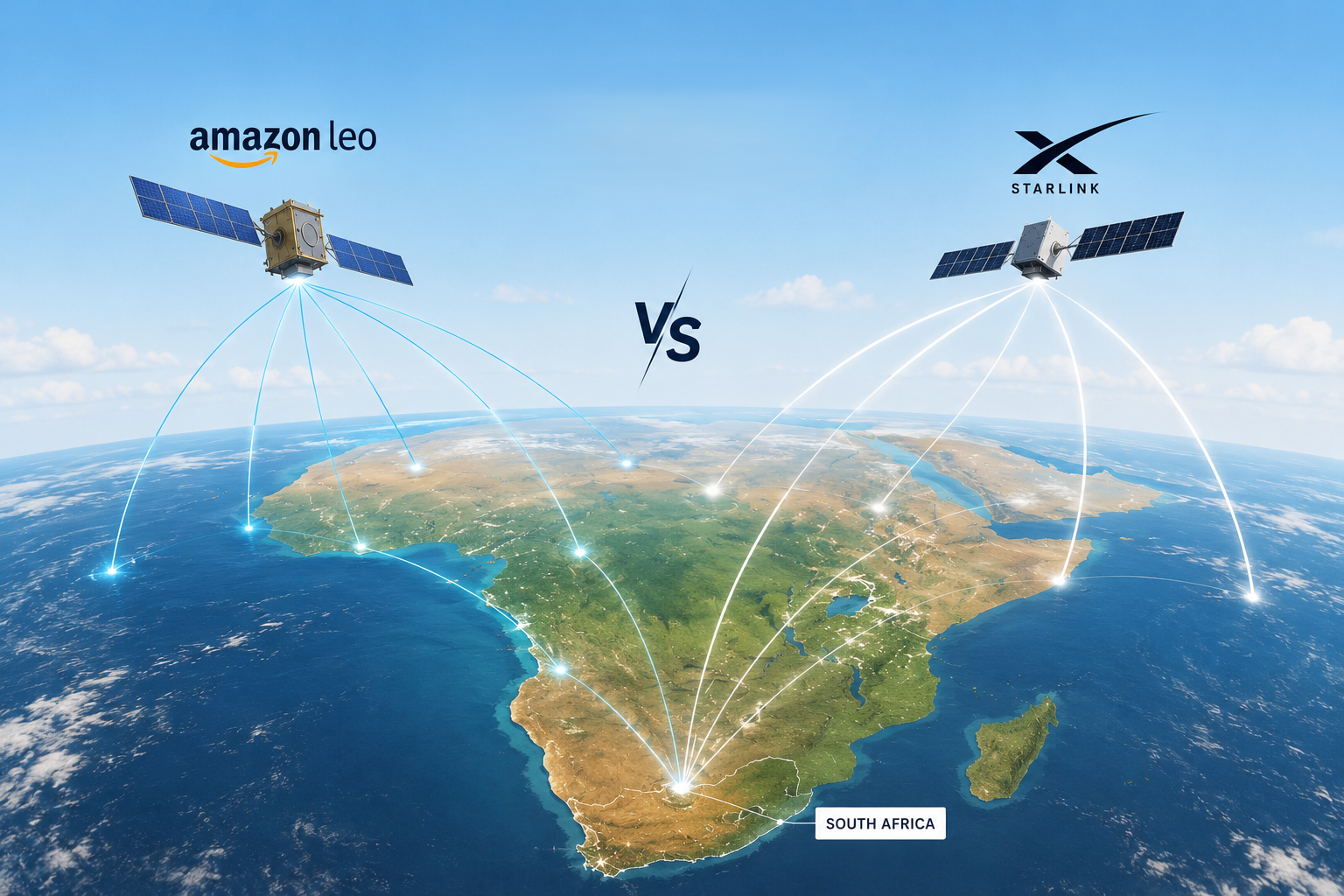
This week Herotel, a fibre and wireless operator that has built a business connecting the small towns, farms and townships the big networks bypassed, announced a distribution agreement with Amazon Leo, the low Earth orbit (LEO) satellite network formerly known as Project Kuiper. Through a new service called evry, Herotel will sell Amazon’s satellite broadband to households and small businesses across all nine provinces, at speeds of up to 300Mbps, with commercial launch expected in 2027.
In short, Amazon, not Starlink, will be the first low orbit constellation legally beamed into South African living rooms. Elon Musk’s service, available in 27 other African countries, remains locked out of the market of his birth. Icasa (the Independent Communications Authority of South Africa) confirmed in June that Starlink has still not lodged a single licence application.
Amazon routed round that requirement. Instead of demanding its own licence, it sells wholesale capacity to partners who already hold the licences. First Vodacom signed up to use Amazon Leo to connect remote 4G and 5G base stations across Africa. Now Herotel is doing the same for the home market.
Herotel is owned by Maziv, the fibre group in which Vodacom holds a 30% stake. The consumer satellite play thus touches down inside the same ecosystem that already carries Amazon’s backhaul business. While Starlink waits for the law to change, Amazon has assembled a South African distribution machine.
None of this would have surprised Kyle Whitehill, CEO of Avanti Communications, a leading provider of “agile satellite technology” across Europe, the Middle East and Africa.
During a visit to Johannesburg last week, before the Herotel news broke, he predicted almost exactly this sequence of events.
Whitehill ran Vodafone operations in Ghana, India and Qatar, and spent a year at the helm of Liquid Telecom in South Africa, where he merged Liquid and Neotel. Avanti, which he has led for eight years, operates geostationary satellites, with 75% of its network capacity over Sub-Saharan Africa, and gateway earth stations in South Africa, Nigeria and Senegal.
“We can thank Elon Musk for helping make satellite mainstream,” he told Gadget. “And we can thank competition for bringing prices down to where it’s reasonably competitive.”
The consumer market, he said, belongs to the LEO players. “They’re going to deliver a very compelling consumer-to-the-home product. In North America, they’ve completely devastated the traditional satellite-to-the-home market.”
He was speaking about Starlink, but the logic applies equally to Amazon Leo, which beams in a crucial local advantage: a support structure comprising120 Herotel offices, 1,400 staff and close to 500 service vehicles. The standard objection to satellite broadband, that support resides on another continent, evaporates when the installer is based up the road.
About three years ago, Avanti wrestled with a simple question for MTN: is Starlink a friend or an enemy? Mobile operators were relaxed at the time, because they owned the customer relationship. Then came direct-to-device satellite connectivity, which bypassed the mobile operator altogether.
However, around 80% of mobile data is consumed indoors, where satellite signals struggle to reach.
“You can’t build an entire mobile business around direct satellite connectivity,” said Whitehall. “Most people don’t really mind if they lose signal for ten seconds while driving between towns.”
Avanti has planted its satellite dish on the opposite side of that debate. “We’re the friendly partner,” said Whitehill. “We’re not trying to replace mobile operators. We’re trying to strengthen what they already have.”
In practice, that means satellite backhaul for about 1,000 rural villages in Nigeria on behalf of MTN, in communities where terrestrial infrastructure cannot earn its keep. Or keeping point-of-sale systems running at remote Spar stores across South Africa, in places fibre will never go.
Avanti has launched four geostationary satellites, each costing around $400-million and taking as long as eight years to design and build. Whitehill does not believe it will ever do so again.
“Instead, we’ll increasingly buy much smaller satellites,” he said. “They will cost a fraction of the price. They’ll focus on very specific geographies.”
Where Avanti’s HYLAS 4 satellite covers all of Sub-Saharan Africa, the Middle East and much of Europe, the next generation could be dedicated to a single country.
“Rather than covering half the world,” said Whitehill, “they cover exactly the geography we need.”
* Arthur Goldstuck is CEO of World Wide Worx, editor-in-chief of Gadget.co.za, and author of “The Hitchhiker’s Guide to AI – The African Edge”.