


Picture: JASON BANNIER.
Software
Spotify fights back
against ‘spammy’ AI
As AI blurs the line between human and machine, Spotify used a report launch to address growing trust concerns, writes JASON BANNIER.
Spotify South Africa faced a thorny question centred on AI-generated music during the launch of the platform’s 2026 Loud and Clear transparency report in Johannesburg last week.
Lloyiso Gijana, a local singer-songwriter with almost 1-million monthly Spotify listeners, told the room that AI-generated music was becoming increasingly difficult to distinguish from human-created music. In the spirit of the report, which revealed that SA artists on Spotify generated R504-million in 2025, he posed the question: “What is Spotify doing to make sure that there’s a difference and people know what they’re listening to and what they’re putting money into?”
Bryan Johanson, Spotify head of artists and industry partnership, answered: “We’ve been investigating crediting AI. We’ve been working with select distributors to give us the label copy metadata, who’s on the track, who wrote it, who performed the song, names on the title, [and] which instruments use AI.”
Johnson said Spotify is not asking if the overall song is AI. Rather, the focus is on inputs. The idea, he said, is working towards an industry standard where listeners can go to a platform like Spotify and they have that transparency to give listeners more confidence and trust in the business.
“For artists, they have the option as well to disclose [AI use]. It’s optional right now. It’s something we’re testing. We’ve seen really good uptake so far. We’re going to be rolling that out.”
This transparency measure sits alongside the platform’s current Verified By badge.
Phiona Okumu, Spotify Sub-Saharan Africa head of music, said: “[The badge] is not like one of those social media platforms ones that you can buy. This will go through a very stringent criterion that’s weighed up so that people know that this is an artist that’s based on things like your momentum of release, [and] checking that you’re a real person.”
The report revealed that the royalties generated by SA artists from Spotify alone (R504-million) increased by 28% year on year, nearly doubling since 2023. The growth in streaming revenue has intensified efforts to exploit the system.
Johanson said: “People use new technologies as a tool to accelerate spam for artificial streaming. AI is the latest tool that people using. We’ve got very strict spam filters and impersonation policies. For example, if you found the song was impersonating your music on Spotify, you can tell us directly. We investigate that, and take it down.”
Spotify has removed 75-million “spammy” tracks over a recent 12-month period after identifying attempts to deceive and manipulate the platform through artificial streaming and other non-genuine activity. He said the company continues to implement behind-the-scenes measures aimed at protecting artists and the broader streaming ecosystem.
Joceleyne Muhutu-Remy, Spotify Sub-Saharan Africa MD, said: “Loud and Clear’s report this year proves that South African artists are not only experiencing explosive growth but have solidified their position as a globally dominant creative force. Their success is driven by worldwide demand, ensuring that independent and local talent alike are being discovered by billions of listeners and taking the international stage by storm.”
Key findings from the report include:
1. Commercial power and momentum
- Royalties generated by South African artists from Spotify alone reached nearly R504-million in 2025, an increase of 28% year on year (compared to South Africa’s total recorded music market increase of +18%, looking at streaming alone (IFPI South Africa)), and nearly doubling since 2023.
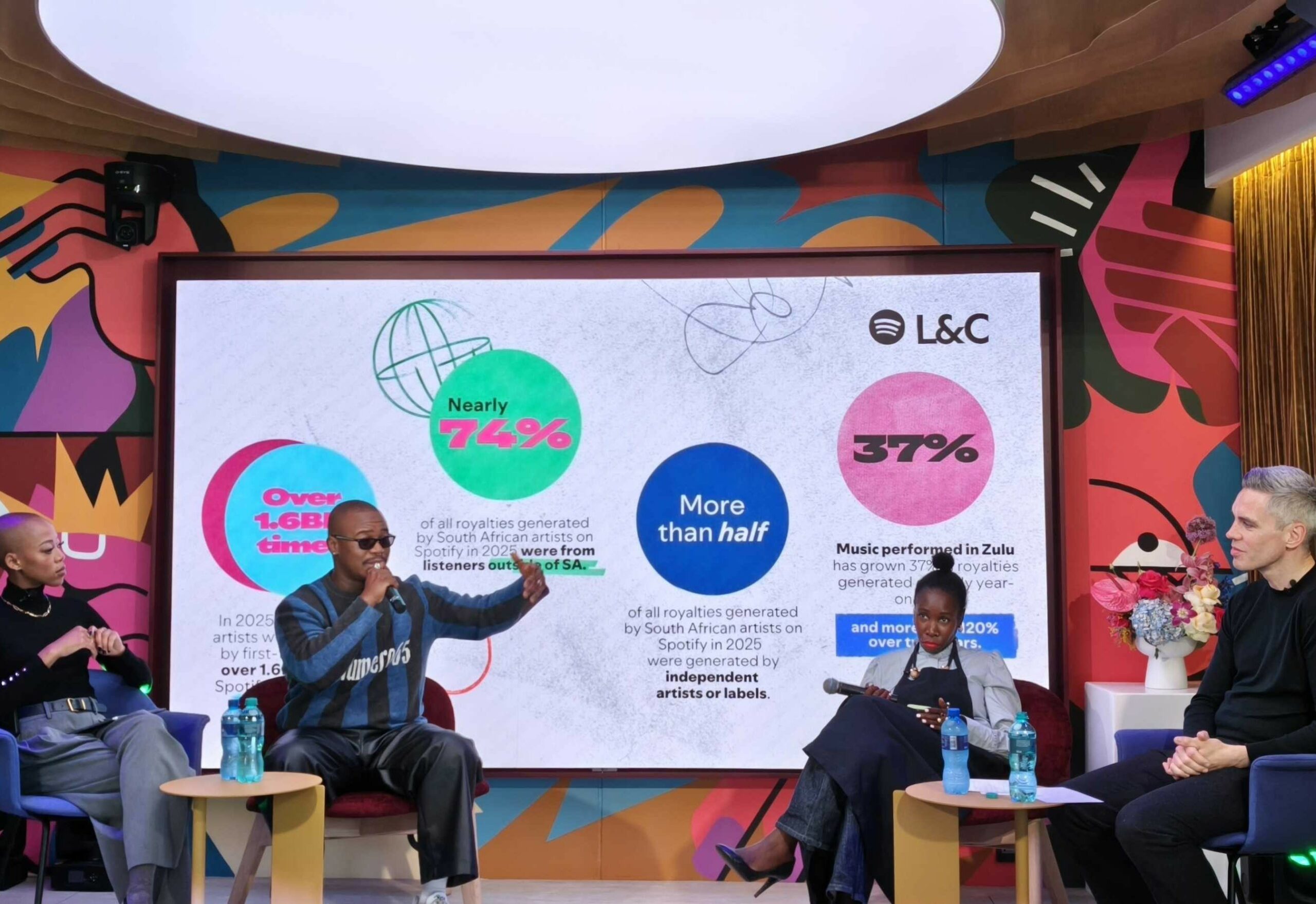
- More than half of all royalties generated by South African artists on Spotify in 2025 were generated by independent artists or labels.
2. Global reach and discovery
- Nearly 74% of all royalties generated by South African artists on Spotify in 2025 were from listeners outside of South Africa.
- In 2025, South African artists were discovered by first-time listeners over 1.6-billion times on Spotify, an increase of 40% since 2024.
- Nearly 3,550 South African artists were added to editorial playlists on Spotify in 2025.
3. Local resonance and cultural trends
- South African artists were responsible for over two-thirds (67%) of the tracks that were featured on Spotify South Africa’s Daily Top 50 in 2025.
- The genres that have seen the highest growth in the last five years in South Africa on Spotify alone are cloud rap, pop country, acoustic country, pop rap, and worship.
- Local streams of South African female artists grew 22% year on year, while their international streams grew 20% year on year.
- Music performed in Zulu has grown 37% in royalties generated globally year on year, and over 120% across two years.
* Read the ‘2026 Spotify Loud and Clear report’ here.
* Jason Bannier is a data analyst at World Wide Worx and deputy editor of Gadget.co.za. Follow him on Bluesky at @jas2bann.