
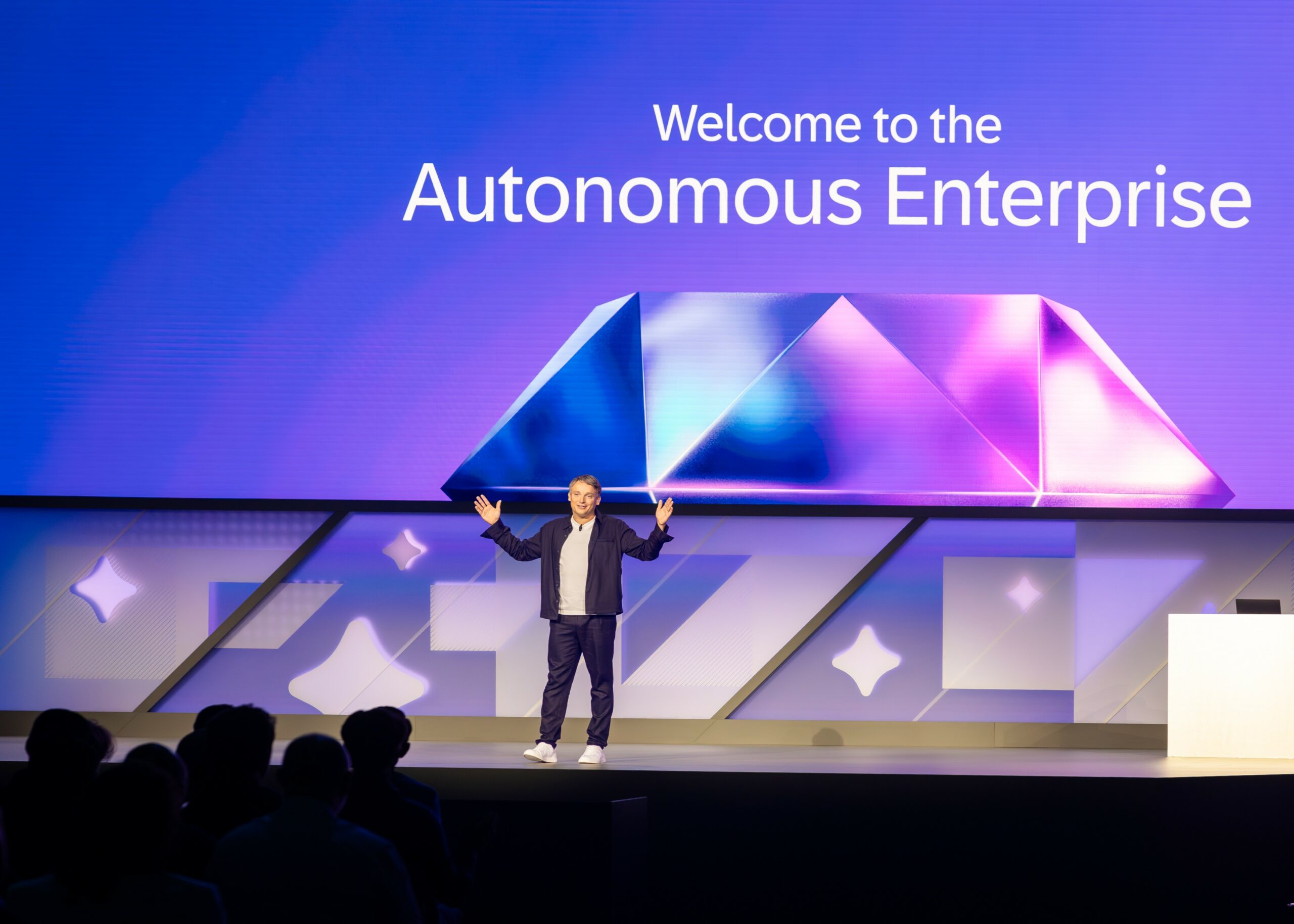


Photo: ARTHUR GOLDSTUCK.
Software
Signpost: Does
software have a future?
At Sapphire 2026 this month, SAP, the world’s largest ERP company, lined up Anthropic, Nvidia and JPMorgan Chase to endorse its vision, writes ARTHUR GOLDSTUCK.

“Will SAP actually be a software company in the future?”
It’s not the kind of question the CEO of a software company would usually ask thousands of customers, partners and analysts. At Sapphire 2026, SAP’s annual conference held this month in Orlando and Madrid, CEO Christian Klein asked his audience if they were scared by the question.
“I’m not scared,” he answered himself. “For me, the time right now is the beginning of something even better.”
The conference saw the launch of SAP’s Business AI Platform, a unified environment for building and governing AI agents across enterprise operations, grounded in real business context.
The strategy is to enhance critical business workflows, so that humans and AI work together to meet the accelerating demands of global business.
“According to a recent Stanford AI survey, almost every company is now using AI, but many see only little value,” said Klein. “Why do we face such huge challenges with AI in business? At the top of this iceberg, visible to everyone, is that large language models are getting better and better at tasks like generating text or images or in specific domains like writing software.
“All of these use cases are related to publicly available content the modules are trained on. But if you go below the waterline, beyond the level of sales demos, and into the real business world, you’re going to find out that none of these models are trained on your business data and processes.
“These AI agents also don’t naturally adhere to governance requirements, like your security compliance framework, your data privacy requirements, or to your company’s identity and authorisation rules. All AI agents … have faced these challenges until now.”
The solution, he suggested, was that a company’s enterprise resource planning system, or ERP, should be recognised as the brain of every business. Since SAP is world leader in ERP software, one might argue, naturally the CEO would say that.
But Klein made a good case for it: “For over 15 years we have been developing an ERP with incredibly deep process and data domain know-how. On top of that, all your governance requirements and customer-specific extensions are stored in the ERP. The ERP is the trusted system of execution running your company.”
Powerful external validation came from Anthropic, the company behind the Claude family of AI models, and that is competing neck and neck with Open AI to become the most valuable AI platform company in the world. At Sapphire, SAP shared video testimony from Anthropic co-founder and president the Daniela Amodei in which she declared: “The world’s largest enterprises run on SAP. That’s exactly where trusted AI belongs.”
That significance of this alignment revolves around the core value proposition of the Business AI Platform: trustworthiness.
JPMorgan Chase CFO Jeremy Barnum, who joined Klein on stage in Orlando, said his bank was already running agents in production on SAP, operating within defined compliance boundaries.
“The agents that we’ve built are not inventing their own business rules,” he said. “Those rules rather come directly from SAP Embedded Control Framework, and every AI-driven intervention is logged and fully traceable.”
One organisation’s production deployment does not establish a category. But the compliance architecture it describes is precisely what most organisations attempting enterprise AI have not yet achieved.
Jensen Huang, CEO of $5-trillion AI chipmaker Nvidia, also appeared in a pre-recorded video segment, making it clear that AI agents would not replace ERP. The most ringing endorsement? Nvidia itself used SAP as its ERP brain: “What SAP and Nvidia are building together is one of the most important platforms in enterprise AI. Nvidia’s supply chain is incredibly complex. Millions of parts, hundreds of partners and factories, all connected through SAP. But what’s changing is not just how enterprise systems are managed, it’s how work actually gets done.
“We’re moving from hand-coded software to AI that can understand, reason, and act. AI no longer simply answers questions. It works for you. And enterprise systems are where work happens. Finance, supply chains, procurement, and every workflow in between.
“SAP is the foundation of enterprise. And now they’re building the agents that sit on top of it, trained on proprietary data with the skills to act. Soon, every company will have a workforce of agents. These specialised agents will not replace enterprise software. They will make enterprise software more powerful than ever.”
* Arthur Goldstuck is CEO of World Wide Worx, editor-in-chief of Gadget.co.za, and author of “The Hitchhiker’s Guide to AI – The African Edge”.