


Hardware
MWC 2026: Tecno unveils thinnest smartphone concept
A 4.9mm handset that magnetically connects to cameras and batteries captured delegates’ attention in Barcelona this week, writes JASON BANNIER.

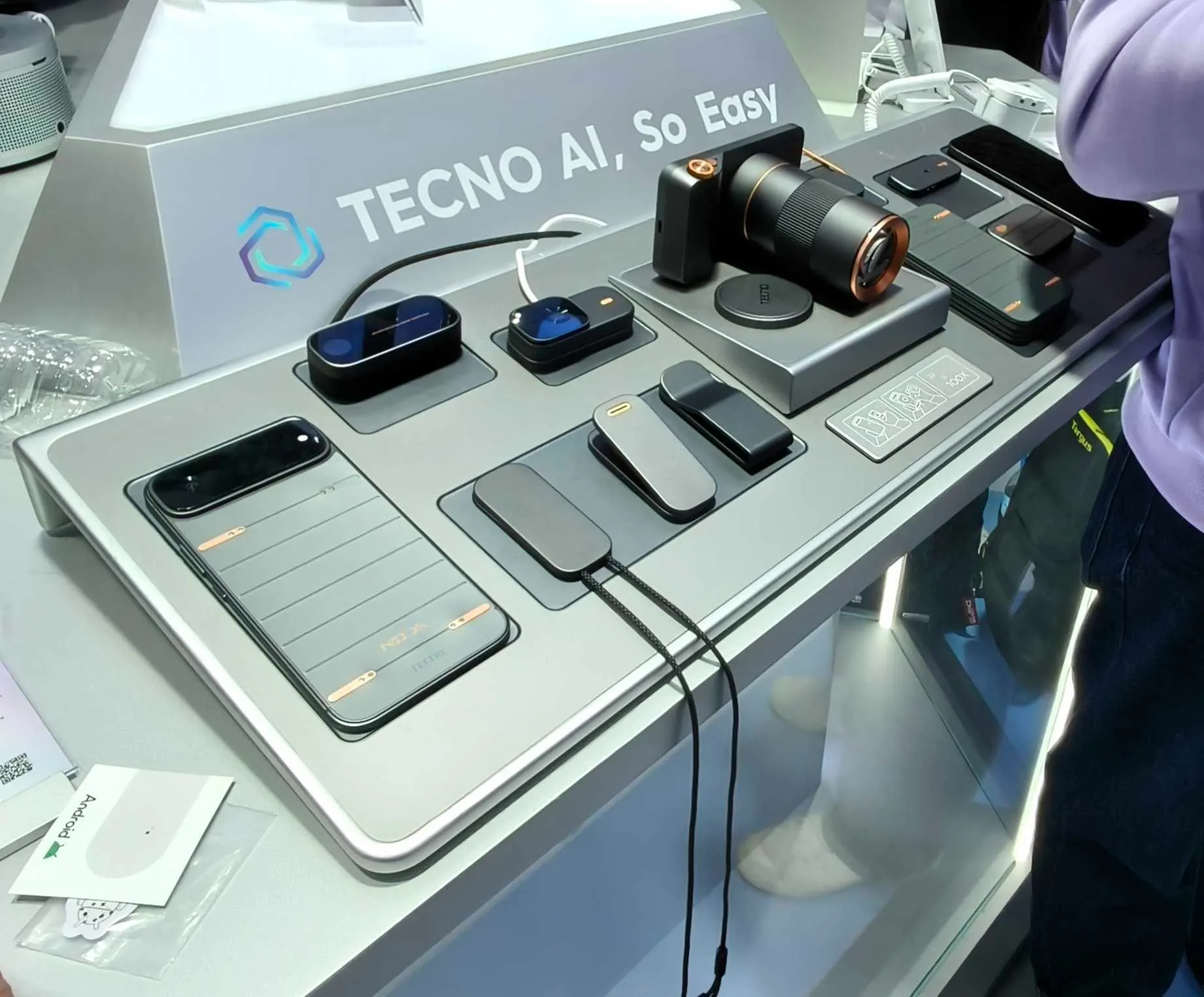
Tecno has revealed what the Chinese company describes as the world’s thinnest modular smartphone ecosystem concept. The system is built around a 4.9mm-thin handset that anchors a magnetic expansion architecture, supported by around 10 attachable modules designed to extend functionality.
The device captured the attention of delegates at Mobile World Congress 2026 in Barcelona this week, and underscored Tecno’s push to rethink how hardware can be scaled up.
Built on what the company calls Modular Magnetic Interconnection Technology, the approach allows physical reconfiguration through magnetic attachment and intelligent connectivity, moving away from fixed, factory-defined hardware configurations.
Built for flexibility
The design responds to rising AI-computing demands and space constraints in modern smartphones by enabling on-demand expansion. Rather than relying on permanently larger devices, users attach ultra-thin modules for specific tasks and remove them when no longer needed.
Two interpretations define the hardware. The ATOM edition follows what Tecno describes as “Rational Order with Personal Expression”, combining a silver-aluminium body with red accents. The MODA edition adopts a more expressive, tech-forward aesthetic. Both present modularity as a long-term design direction.

Earlier modular smartphone efforts struggled to achieve mainstream adoption, often compromising practicality or adding complexity. Tecno’s strategy centres on maintaining an ultra-thin profile while adding capability through external magnetic layers, positioning expansion as an overlay rather than a structural redesign.
“We believe the ultimate goal of technology is not to create a static masterpiece, but to offer an extension of human freedom,” says Leo Li, Tecno product head of Modular Magnetic Interconnection Technology. “By pioneering this modular architecture, we are breaking the constraints of fixed hardware and returning the power of choice to the user. This is more than a leap in connectivity; it is an experiment in mobile liberation, where the device is no longer defined by its factory form, but by the user’s intent in every moment.”
Power, imaging and expansion
The ecosystem includes around 10 modules tailored to specific use cases.
A Power Bank module increases available battery capacity while maintaining a slim profile. An Action Camera module enables alternative shooting angles and workflows without permanently enlarging the handset. A Telephoto Lens module functions as a standalone imaging system, using the smartphone display as a viewfinder and supporting low-latency previews with rapid capture.

The hardware combines a glass rear panel with laminated anti-glare treatment and a polished metal frame, balancing a matte finish with structural rigidity. Eight discrete alignment zones on the back guide module placement while preserving a clean exterior.
Attachment relies on a precision magnetic array supported by pogo-pin connectors for stable power transfer with controlled heat output. Data moves automatically between Wi-Fi, Bluetooth and millimetre-wave communication to maintain bandwidth and low-latency performance, with pairing handled in the background.
The platform is designed to support future modules spanning AI processing, storage and lifestyle accessories. By locking in a consistent physical and connectivity standard, Tecno signals that modular expansion is intended as an ongoing strategy rather than a single concept experiment, creating a framework for continued hardware innovation and new product categories as the ecosystem develops.