


GadgetWings
Hydrogen airships take on helicopters
French startup HyLight has raised €13-million to expand its fleet of autonomous airships inspecting power lines, pipelines and railways across Europe, writes GINA CASE.

Helicopters have long been the gold standard now patrolling power lines, gas pipelines and railway networks, looking for damage that could lead to power failures, leaks and transport disruptions. Now a French startup is replacing some of those flights with hydrogen-powered airships that can remain airborne for up to ten hours.
HyLight, founded in 2022, has raised €13-million to expand its operations across Europe, where its autonomous aircraft are already inspecting infrastructure for major energy and transport operators.
The funding, announced on Monday (12 October 2026), comes after the company’s HyLighter aircraft completed more than 750 flight hours and inspected thousands of kilometres of infrastructure in France and other European countries.
Its customers include electricity network operator Enedis, gas infrastructure companies NaTran and Téréga, railway infrastructure manager SNCF Réseau, and construction and infrastructure group VINCI.
HyLight plans to increase the number of aircraft it can operate simultaneously from four to 15 during 2027, while expanding the artificial intelligence systems used to analyse the information collected during flights.
“Most power lines are still inspected by helicopter, just as they were fifty years ago,” said Martin Bocken, co-founder and CEO of HyLight. “Our HyLighters already do the same job, with greater precision and less risk. This funding takes us from four aircraft to a fleet.”
A different kind of aircraft
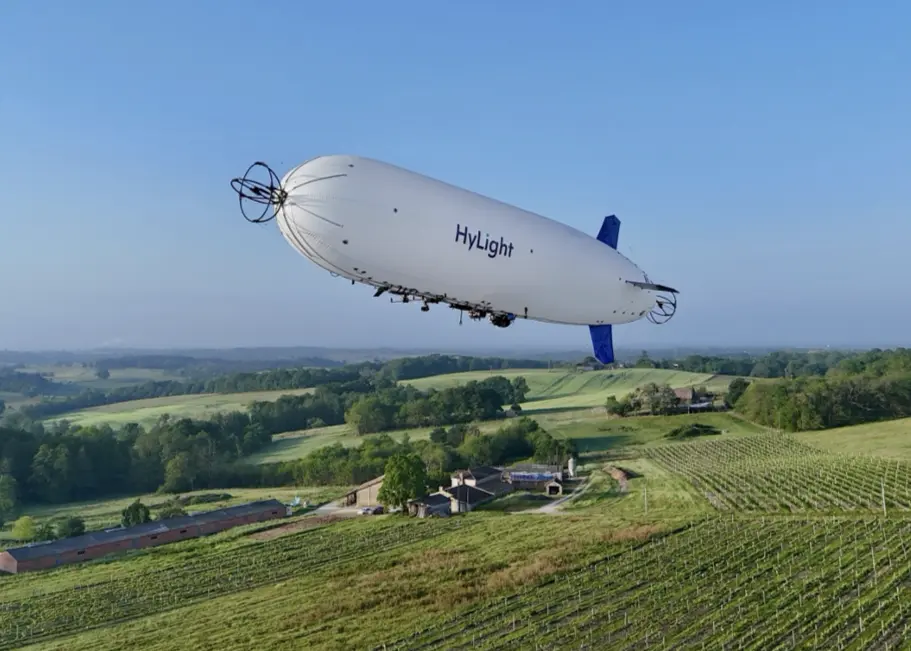
The HyLighter is a 12-metre-long unmanned airship that combines the manoeuvrability of a drone with the endurance of a traditional airship.
Hydrogen provides both lift and electrical power, allowing the aircraft to operate without direct carbon emissions during flight. Its relatively low operating noise also makes it suitable for inspections near populated areas.
The aircraft can remain airborne for up to ten hours, with a target operating range of 350 kilometres.
This gives it a potential advantage over conventional inspection drones, which generally need to land more frequently to recharge or replace their batteries.
The HyLighter can carry up to 10kg of specialised sensors, including high-resolution cameras, laser-scanning equipment known as LiDAR, and instruments that detect methane leaks.
At an altitude of 25 metres, its cameras can capture images at a resolution of one millimetre per pixel, while its LiDAR system records more than 1,000 measurement points per square metre.
These capabilities allow operators to examine the condition of electrical equipment, identify vegetation growing dangerously close to power lines, and detect potential problems along gas pipelines and railway corridors.
The aircraft has received authorisation from French and European aviation authorities for operations beyond visual line of sight, meaning it can conduct inspections beyond the immediate view of a ground-based pilot.
HyLight says its aircraft have operated in rural, suburban and urban environments, including flights over the Palace of Versailles. The technology has also been demonstrated at prominent Paris venues, including the Champs-Élysées and Grand Palais.
AI finds the faults
Collecting detailed aerial images is only one part of the inspection process. Infrastructure operators also need to identify problems across hundreds of kilometres of networks and determine where maintenance teams should be deployed.
HyLight has developed AI-based analysis software that processes the information gathered during flights and automatically identifies and locates more than 50 types of equipment defects and vegetation-related risks on electricity networks.
Instead of requiring engineers to examine thousands of aerial photographs individually, the software produces geographically referenced findings that can be used to plan repairs and preventative maintenance.
For electricity operators, that could mean identifying damaged components before they cause outages, or locating trees and branches that threaten overhead lines.
For gas network operators, methane detection equipment can help locate leaks that might otherwise go unnoticed during conventional inspections.
HyLight is also developing what it describes as a continuously updated digital twin of the infrastructure it monitors.
A digital twin is a virtual representation of a physical asset or network. By combining detailed scans from successive inspections, operators can track changes in infrastructure condition over time.
The company believes the information gathered by its aircraft could eventually support applications beyond infrastructure maintenance, including insurance assessments, agricultural monitoring and public land management.
Scaling up across Europe
The latest investment round was led by Rubio Impact Ventures, DRW and Teampact Ventures, with participation from existing investors Y Combinator and Ring Capital.
HyLight has already opened a new production facility in France and is bringing more of its component manufacturing in-house.
The company plans to recruit 50 additional employees across engineering, AI, data analysis, flight operations, regulatory affairs and business development.
Germany and the Netherlands are priority markets for its next phase of European expansion.
HyLight is based at Air Base 217 in Brétigny-sur-Orge, near Paris. Its founding team of Bocken, Josef Rokusek and Thomas Laporte has an average age of 27.
For infrastructure operators, the potential attraction is the ability to carry out more frequent inspections over long distances, with detailed data that can support faster maintenance decisions.
The environmental benefits could also be substantial. HyLight estimates that conventional helicopter inspections can generate up to one metric ton of carbon dioxide equivalent per flight hour. Its hydrogen-powered aircraft produce no direct emissions during operation, although the overall environmental impact depends partly on how the hydrogen is produced.
Helmer Schukken, managing partner at Rubio Impact Ventures, said the technology offered an opportunity to improve the safety and reliability of critical infrastructure while reducing inspection costs.
“HyLight offers a clean and scalable alternative that does the same work reliably, even over densely populated areas, and has the potential to deliver unrivaled cost savings,” said Schukken.
“That means faults are caught earlier, before they become leaks or outages, and the infrastructure we rely on becomes both more dependable and a good deal cleaner.”
For more information, visit HyLight.