


Business Tech
SA takes third in G20
startup growth
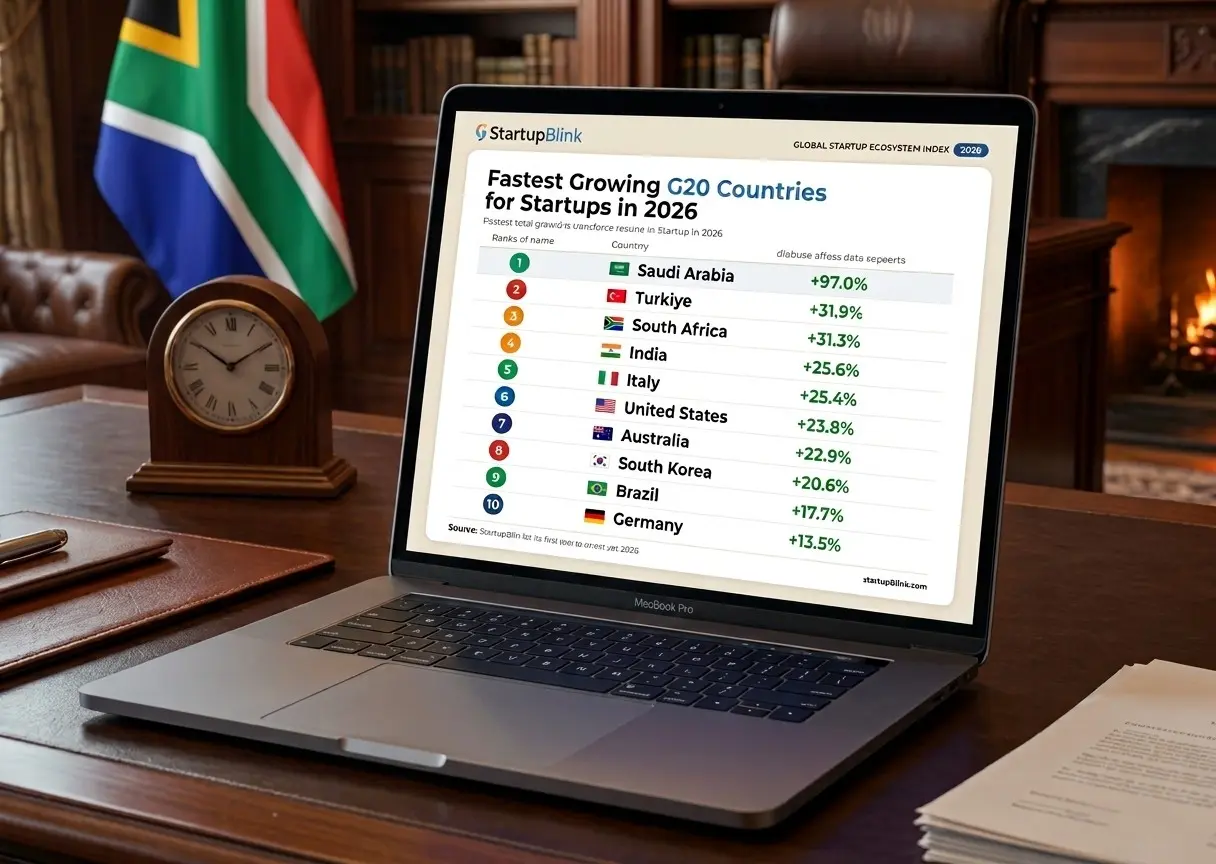
South Africa’s startup ecosystem grew 31.3% in StartupBlink’s 2026 index, trailing only Saudi Arabia and Türkiye among G20 countries.

South Africa has emerged as the third-fastest-growing startup ecosystem among the 19 country members of the G20, according to the Global Startup Ecosystem Index 2026.
Its 31.3% increase was narrowly behind Türkiye at 31.9%, while Saudi Arabia turned the comparison into a different sport with growth of 97%. The accompanying analysis says 16 of the 19 G20 countries recorded positive growth, averaging 18%. Russia, China and Mexico were the three exceptions.
The headline needs its qualifier. The ranking refers to annual growth in the index score, not South Africa’s overall global position. The country remains 52nd worldwide for the third consecutive year, although it has held first place in Africa since StartupBlink launched the index. Its growth rate was the highest in Southern Africa and fifth-highest on the continent.
StartupBlink ranks 1,556 cities and 100 countries using an algorithm fed by hundreds of thousands of data points. The score combines measures of startup activity, the impact and success of that activity, and the conditions supporting startup growth. The annual growth figure compares this year’s total score with last year’s, and StartupBlink cautions that changes in its algorithm also have some influence.
In other words, the 31.3% figure does not say that local venture funding, startup numbers or employment rose by exactly that amount. It says South Africa improved sharply across the mix of indicators used by the index. That is still a substantial gain, especially beside the 10.3% average growth calculated across the global city ecosystems in the report.
South Africa’s national score rose without pushing it above 52nd place because other countries were also advancing rapidly. The report gives the local ecosystem a value of US$14.3-billion, with one unicorn and four cities in the global top 1,000. TymeBank, valued at about US$1.5-billion in 2024, is identified as the country’s first fintech unicorn.

The strongest part of the South African showing is found in its cities. Cape Town reclaimed the national lead after growth of 39%, rising 24 places to 114th globally. Johannesburg remained at 122nd after growth of 8.8%, leaving only an 8% score gap between the two cities. StartupBlink regards that as unusually low centralisation for a national ecosystem led by two sizeable hubs.
Cape Town’s rise took it to third place among African cities and produced the largest ranking improvement in the continent’s top 10. Johannesburg dropped to second in South Africa and fifth in Africa, although fintech remained its strongest sector, ranked fourth on the continent.
The secondary cities supplied the fastest local increases. Pretoria grew 64.8% and climbed 52 places to 377th worldwide. Durban rose 43 places to 601st after growth of 47%. Three of South Africa’s four ranked cities improved their positions, giving the national ecosystem a wider base than the familiar Cape Town-Johannesburg contest suggests.
The spread has practical value. A startup economy concentrated in one city depends heavily on that city’s funding networks, universities, corporate buyers and skills pool. South Africa now has internationally ranked centres in Gauteng, the Western Cape and KwaZulu-Natal. The report also ranks the country 12th globally in clean energy, while Johannesburg’s strongest industry is fintech, ranked fourth in Africa.
Cape Town receives most of the detailed attention in the report. StartupBlink cites Naked Insurance’s R700-million Series B2 round as the largest African insurtech investment recorded to date. It also highlights payments infrastructure company Stitch, which raised US$55-million in a Series B round and acquired ExiPay and Efficacy Payments. OpenAI’s AI Innovation Forum in Cape Town, held with 22 On Sloane ahead of the Africa Tech Festival, adds another piece of international visibility.

There is a brake on the celebration. South Africa ranks 61st in StartupBlink’s separate Innovators Business Environment Index, below its 52nd place for startup ecosystem performance. The report interprets that gap as evidence that broader business conditions still restrict startup development, although the South Africa profile does not break those constraints down further. The gap leaves policymakers with a less comfortable reading of the ranking: founders are improving the ecosystem faster than the country is improving the conditions around them.
The contrast with Saudi Arabia is instructive. Saudi Arabia rose ten places to 28th globally, leads the Gulf Cooperation Council and ranks in the top 10 of the business environment index. South Africa’s 31.3% growth came with no change in its global rank. One country is converting state investment and regulatory reform into a rapid climb; the other is producing strong startup outcomes despite a business environment that ranks lower than its ecosystem.
That makes third place in the G20 useful, but insufficient as a victory lap. It confirms that South African founders, investors and ecosystem builders are producing stronger outcomes than the national ranking alone suggests. It also exposes the distance between entrepreneurial performance and the conditions in which entrepreneurs must operate.
Anele Mkuzo, founder and managing director of the African Entrepreneurship Initiative, puts the opportunity in local terms: “Across our country, and the African continent at large, innovation is not scarce—opportunity is. When we invest in South African entrepreneurs, we are not only building businesses, but shaping a resilient economy, equitable futures, and transformative ideas with global impact.”