
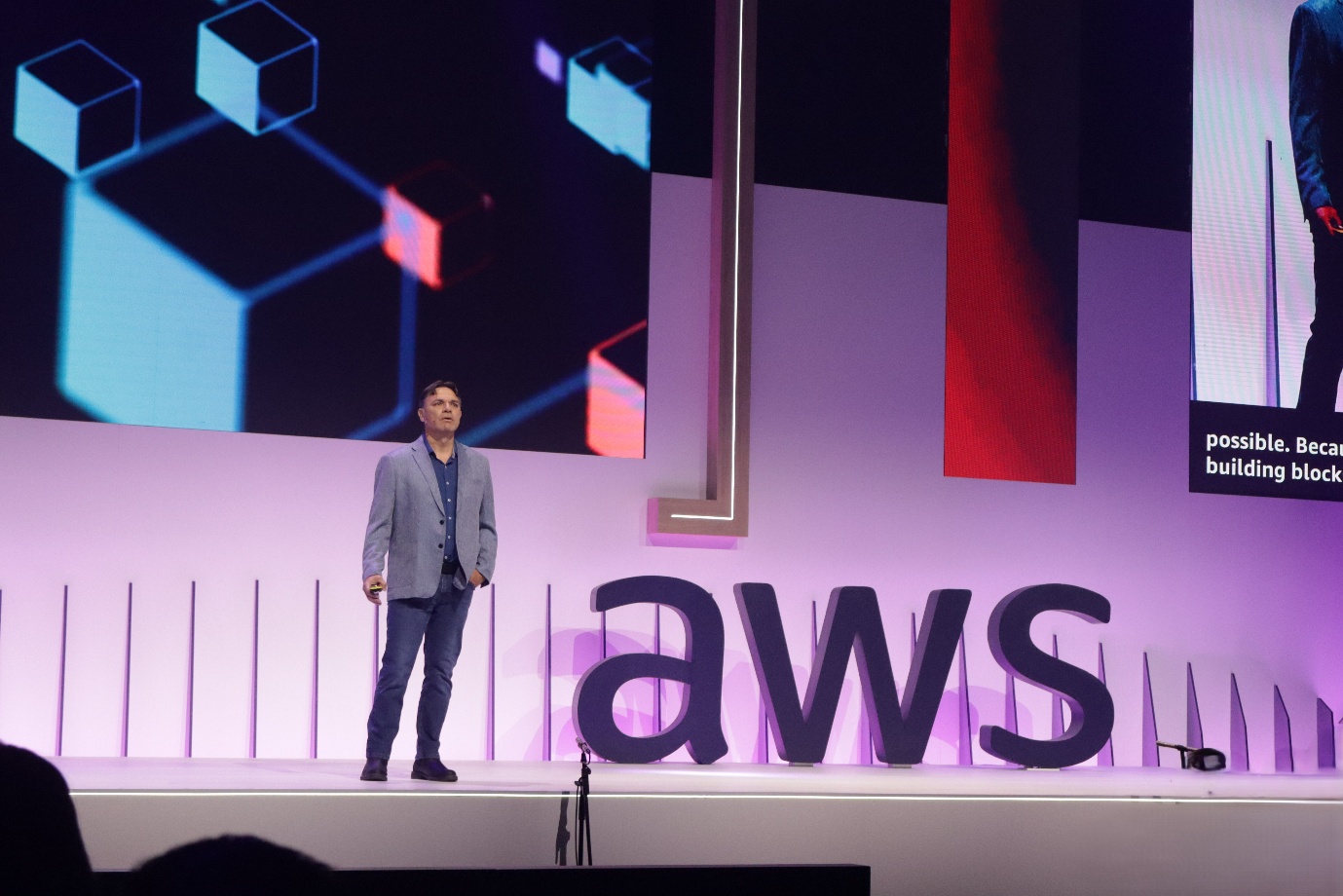


Photo: JASON BANNIER.
Software
AWS Summit: Bedrock powers next wave of
GenAI apps
At the Johannesburg event, the tech giant showcased the evolution of services from simple model access to customisable, enterprise-ready AI, writes JASON BANNIER.

The next wave of generative AI (GenAI) is defined by reasoning. Training and inference form the backbone of this shift, providing the infrastructure for scale, reliability, and new classes of applications.
“This is why we built Amazon Bedrock as the easiest way to build and scale GenAI applications on AWS,” said Willem Visser, Amazon Web Services (AWS) VP for the EC2 cloud platform, in his keynote address at the AWS Summit in Johannesburg last week.
Bedrock is a managed service that provides access to a range of high-performing foundation models (FMs) from providers such as AI21 Labs, Anthropic, Cohere, Stability AI, and Amazon’s own models. It is designed to simplify the development of GenAI applications by enabling developers to build and scale using these models through a single API. In effect, Bedrock serves as a central hub, giving businesses the tools to create GenAI applications without the complexity of managing their own infrastructure.
Model choice
Visser, a South African now based at Amazon HQ in Seattle, said the first step in building a GenAI application that works well today and in the future is model choice. The field of FMs is advancing rapidly, with more capable, cost-effective, and faster models being released each week.
“There’s no single model that’s best for every business,” said Visser. “We offer a broad choice of fully managed FMs across a variety of leading providers to help you access the best model. Without the need to manage and scale your infrastructure, you’re free to build and experiment with the latest models without compromising on security or on performance, including Amazon Nova, our own family of FMs specifically designed to offer new options across quality, speed and cost.”
Customisation
AWS recently announced the ability to customise Nova models on SageMaker AI, a service that helps data scientists and developers build, train, and deploy machine learning models. Visser said this choice enables you to pick a model that’s best suited for your specific use cases.
“Incorporating your own data is one of the most important steps for getting value out of AI, and one of the most common ways to do this is retrieval-augmented generation (RAG).
“But a challenge many developers have encountered while building GenAI apps with RAG is that it was originally optimised for unstructured data. Today, Bedrock supports fully managed end-to-end RAG across data types, delivering more relevant, accurate and explainable responses to your users.”
Trust and security
Visser said trust remains central to enterprise adoption of GenAI. Bedrock guardrails provide organisations with the ability to block harmful or unwanted inputs and outputs, ensuring applications align with company policies and brand values.
Beyond filtering, AWS has introduced automated reasoning checks within guardrails, designed to reduce factual errors and limit the risk of hallucinations in AI-generated responses. This safeguard, said Visser, gives businesses greater confidence in deploying GenAI at scale.
Affordability
Cost remains another challenge in GenAI adoption. Visser said techniques such as model distillation, which allows smaller models to learn from larger ones, improve performance while lowering costs. According to AWS, distilled models in Bedrock are up to five times faster and 75% cheaper than their larger counterparts.
Bedrock’s intelligent prompt grounding enables one to designate multiple models for an application. Bedrock then determines which model will best serve each request and routes requests through the appropriate model.
“Prompt grounding can reduce costs by up to 50% without compromising on accuracy.”
These measures, said Visser, are designed to make GenAI powerful and economically viable for enterprises.
Bedrock in action – GenAI Zone
At the Summit’s GenAI Zone, AWS demonstrated how Bedrock extends far beyond basic image generation or text transcription. Daniel Schormann, Amazon Connect specialist solutions architect, showed Gadget at the GenAI Augmented Contact Centre exhibit how the service can be applied to extract insights, automate processes, and integrate seamlessly with business systems.
“What we want to do is take that call recording, get a transcript, and then extract insights from it,” he told Gadget. “You can interact directly with the transcription and get insights out of it by asking a question.”
He said the transcription was just the first step. Once the raw text is passed into Bedrock with engineered prompts, the system can deliver much more than a summary. Bedrock enables outputs to be tailored for specific needs, including structured JSON objects (a standard way of structuring data so it can be easily read and processed by software) that can be stored, queried, and linked with other applications.
“If I give it a very specific JSON object, I know exactly what I’m working with,” said Schormann. “I can store that in a DynamoDB table (a cloud database service from AWS for storing and retrieving data at scale), I can process it, I can link it up with other sources of information, and that’s where the additional power comes in.”
This, he said, is where Bedrock shows its strength: turning manual, resource-heavy tasks into automated ones. A quality assurance check that once required staff to listen to a 20-minute call can now be completed automatically, with results routed directly to training workflows for agents.

“Traditionally, you would need someone to spend hours reviewing calls, which is expensive. Whereas this costs a fraction of a dollar to run, and it allows those people to do more valuable tasks.”
Schormann said the value lies not only in efficiency but also in scalability, making GenAI an attractive commercial tool.
“If you can make your agents more efficient, you can make your processes more efficient, and you can automate. You’re suddenly taking a $500 call and making it $200, saving three-fifths of the entire cost. If you multiply that by millions, it’s an incredibly large saving.”
* Jason Bannier is a data analyst at World Wide Worx and deputy editor of Gadget.co.za. Follow him on Bluesky at @jas2bann.