



GadgetWings
Open letter to Lufthansa: I’ve had enough
In an open letter to Lufthansa’s chiefs, ARTHUR GOLDSTUCK despairs of the failures of the airline’s in-flight offering.

Open letter to Carsten Spohr, CEO of Lufthansa Group, and Jens Ritter, CEO of Lufthansa Airlines
Dear Sirs
Your long-haul economy experience has reached a level where it actively damages trust in the Lufthansa brand. These comments are based on several years of travelling in the Economy cabin on Lufthansa flights from Johannesburg to Europe and back. And I’ve had enough.
This is not a case of cosmetic decline or minor inconvenience. It is a systemic failure in the everyday tools your passengers are required to use. I chose to write this review as an open letter to you, because I believe a premium airline cannot justify fundamentals being so compromised.
The first failure begins even before takeoff: with the earphones handed out before departure. They are not merely basic; they are barely functional. Dialogue often emerges as a vague murmur beneath cabin noise. It is completely destroyed when background music is intended to create a mood.
But this is mood with a vengeance. Volume adjustments swing sharply from almost inaudible to uncomfortably loud and even shrill. The single-jack plugged into a dual-prong adaptor – how ancient is this system? – makes for a connection that is so delicate, the slightest movement introduces crackle or channel drop-out.
I now travel with my own earphones that plug into the dual adaptor and allow me to hear the movie and the music with a semblance of enjoyment. But what occasional flyer thinks of that?
For an airline of Lufthansa’s scale, this is indefensible. Long-haul travellers are entitled to equipment that allows them to hear the very content your system offers.

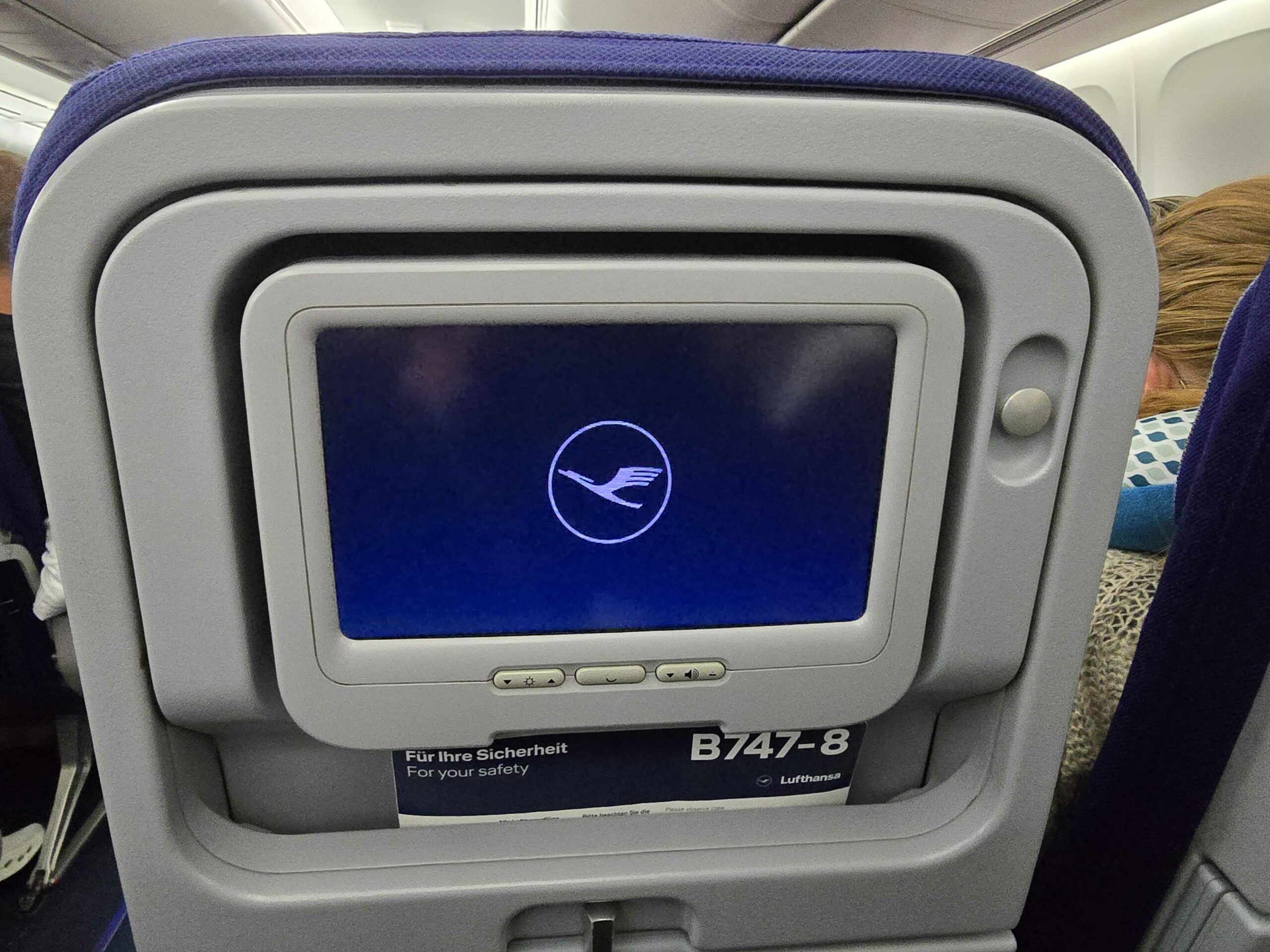
The inflight entertainment screen looks adequate, but using it is a different matter entirely. A touchscreen that refuses to respond to normal touch is no longer a touchscreen. Light taps are ignored. Firmer taps are ignored. Only repeated, heavy pressure eventually registers, and even then the command arrives with noticeable delay.
It should never feel as if you are punching an appliance rather than interacting with an interface. And it shouldn’t result in the person in the seat in front of you wanting to turn round and punch you.
Once it finally responds, the navigation reveals an equally troubling layer of dysfunction:
- Menus require multiple forceful taps to open.
- Scrolling alternates between painfully slow movement and sudden, imprecise jumps.
- Sub-menus behave as though they are operating through molasses, consistently seconds behind the passenger’s wishes.
The back button is the clearest sign of a system long past its intended lifespan.
- The first press: nothing. It remains greyed.
- The second: it turns orange but that is it.
- The third: a delayed, exaggerated leap back several screens.
This forces passengers to repeat the same cumbersome steps again and again. Meanwhile, the person seated ahead must endure the physical tapping transmitted through the seatback. No one wants that interaction, yet the system makes it inevitable.

Even simple actions like pausing or resuming a film feel unreliable. Each tap is a negotiation.
The Wi-Fi continues the experience. “Free messaging” in theory sounds competitive. In practice, with bandwidth hovering at 100–150 kbps, it struggles with even the simplest exchanges. Messages stall in delivery. Basic status updates time out. Anything beyond plain text is aspirational. The service may be free monetarily, but it imposes a cost in wasted minutes and frustration. Passengers should not have to fight for the digital equivalent of a drip-feed connection in 2025. Unless you are trying to induce nostalgia for 1995.
Against this backdrop, your public commitments stand out sharply.
Mr Ritter, you have announced Lufthansa’s €70-million investment in the Future Onboard Experience (FOX), promising “greater comfort,” “more individuality,” and “extraordinary Lufthansa Signature Moments,” with FOX beginning to roll out from spring 2026.
Mr Spohr, your push for “Premium, Premium, Premium” reflects an ambition to rebuild confidence in the brand through quality.
These are welcome goals. But they are not reflected in the experience delivered today.
If you truly want to understand the scale of the problem, then it requires more than brief walkthroughs or controlled demonstrations. It requires immersion.
I challenge both of you to take one of your own long-haul overnight flights in economy. And please: not in a curated environment. Nor with pre-notified crew. Nor with upgraded equipment or special arrangements.
Sit in a standard seat. Use the standard earphones. Navigate the existing touchscreen. Rely on the free Wi-Fi tier. Try watching a movie, rewinding, pausing or dipping into the flight map while watching. Try scrolling through the menu at two in the morning. Try sending a message live, and waiting for a response that was sent so long ago, the sender has already gone to sleep.
Do that, and the gap between your promises and your passengers’ reality will become unmistakable.
If Lufthansa intends to deliver the future onboard experience you have described, then the present must not be left to deteriorate further. Your passengers encounter these failures today. They deserve to see the first signs of your commitment now, not only when the new system arrives in 2026.
* Arthur Goldstuck is founder of World Wide Worx, editor-in-chief of Gadget.co.za and author of “The Hitchhiker’s Guide to AI: The African Edge”.