



Product of the Day
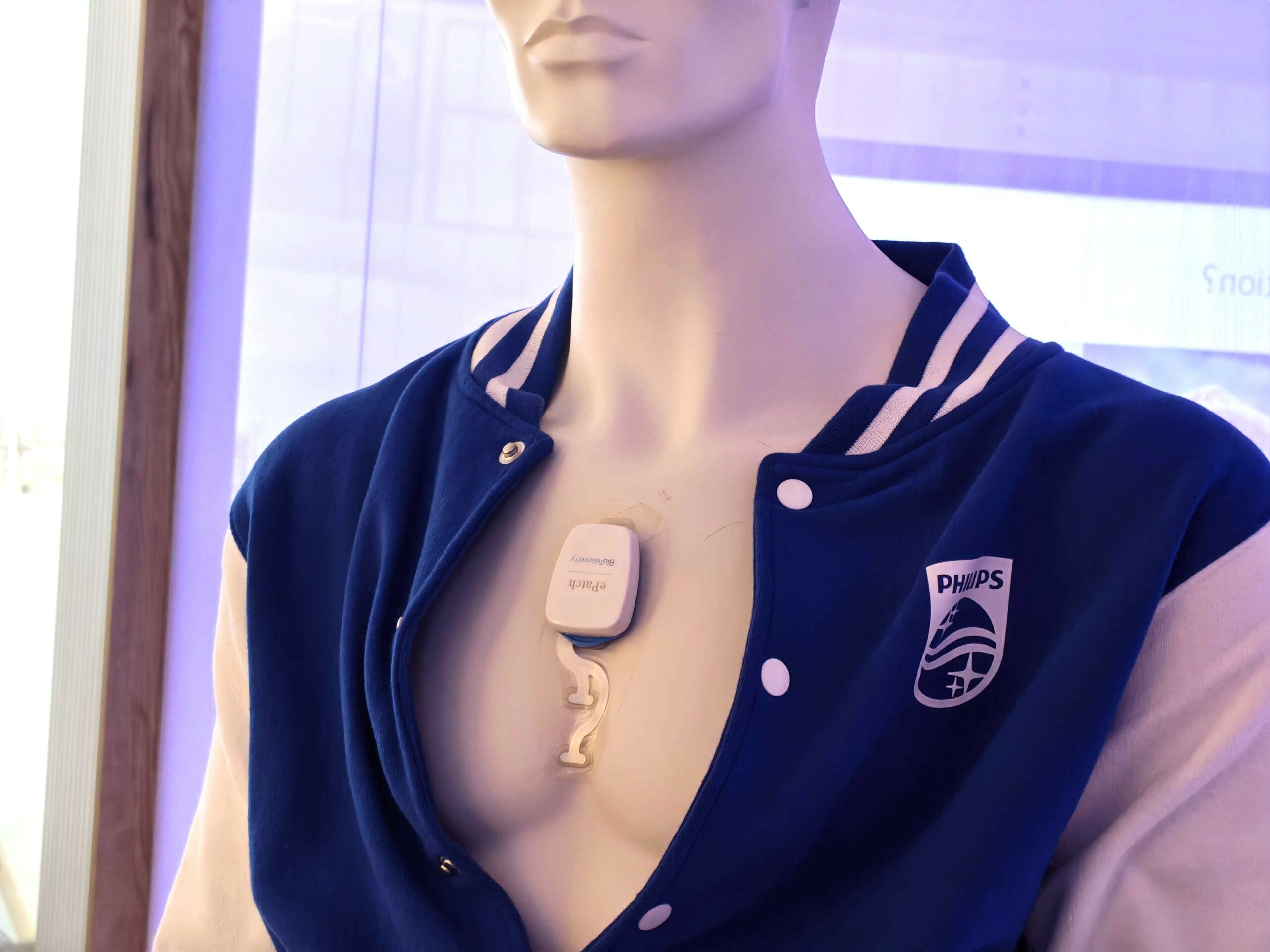
The ePatch tracks
hidden heartbeats
A wearable device developed by Philips uses AI to help doctors spot irregular heart rhythms that short hospital tests may miss, writes JASON BANNIER.

Philips has developed a small wearable device that can be stuck onto a patient’s chest to monitor heart activity for up to two weeks, while the patient continues with normal daily routines.
The ePatch acts as a wearable electrocardiograph (ECG) monitor, recording the heart’s electrical activity while the patient works, sleeps, exercises or showers. Once monitoring has been completed, the ECG data is uploaded to Philips Cardiologs, an AI-powered analysis platform that helps clinicians assess heart rhythm data.
The product is designed to address a common diagnostic problem: many irregular heart rhythms come and go, making them easy to miss during a short hospital ECG. A traditional Holter monitor, a portable device with wires that records heart activity for one or two days, extends the monitoring period but may still miss rhythm problems that appear only occasionally.
“Patients first need a clear diagnosis before being sent for specialist heart procedures in a hospital intervention lab,” said Remmelt de Geus, ePatch and ECG platform business developer for Benelux and Nordics, during Gadget’s visit to the Philips Customer Experience Centre in the Netherlands.
“We look for irregular heart rhythms, and one of the most common is atrial fibrillation.”
Atrial fibrillation (AFib) occurs when the upper chambers of the heart do not contract properly. This can cause blood to stand still in the heart, raising the risk of clotting. If a clot travels to the brain, the result can be a stroke.
“We want to catch that and prevent people from having a stroke,” said De Geus. “With atrial fibrillation, 99% of the time we can either give them beta blockers or we can do a small ablation, which is a small electrical burning of cells in the heart to prevent this.”
The difficulty lies in catching the problem at the right moment.
“With a tumour, the tumour is there and we can always catch it during a CT scan. But with a heart rhythm disease, you need to catch it in the moment.”
Traditional ECG tests in hospital use 12 leads, with stickers placed across the body to measure electrical signals from different angles. This allows clinicians to map the heart’s electrical activity and check whether a part of the heart is not working as expected.
Longer monitoring can help, but the equipment can affect how patients behave while being monitored. De Geus said this matters because some rhythm problems may be triggered by normal daily activity.
“People feel a lot like a patient with this,” he said, referring to traditional Holter equipment. “They’re going to sit down, they’re going to take it calmer, they won’t go to work, maybe they will work from home. But with these arrhythmias, normal day-to-day life is important, because sometimes certain triggers or events are needed for the arrhythmia to occur.”

The ePatch is intended to make the monitoring period less disruptive. The patch sticks to the chest and records heart activity for longer than a conventional Holter study.
“Compared to a normal 24- or 48-hour Holter, a seven-day ePatch study will diagnose 3,5 times more arrhythmia than a normal study. We have a way higher chance to catch something.”
Longer recording creates another problem: data volume. Several days of continuous ECG recording can produce far more information than clinicians can review manually in a practical time frame.
“That is not possible for our healthcare system and our physicians to look at. There is too much data.”
This is where Cardiologs, Philips’ AI analysis platform, is used. The system scans the ECG recording, reviews every heartbeat, and highlights rhythm strips that require clinical review. A cardiologist or Holter technician can then examine the flagged sections and confirm the diagnosis.
According to Philips, the AI-supported workflow can reduce review time for Holter technicians by 42%. De Geus said hospitals in the Netherlands have used the platform to increase Holter study volumes from 2,000 to 4,000 a year with the same staff complement.
The ePatch can also reduce hospital visits. The product can be sent to a patient at home with instructions for self-application. Once monitoring has been completed, the sensor can be returned to the hospital for analysis.
This removes the need for a patient to visit a hospital to have the Holter fitted and then return the device afterwards. The patient can complete the monitoring period before clinicians review the results and decide on the next step.
Another use case is post-stroke care. After a stroke, doctors may need to know whether atrial fibrillation is present, because that can influence the risk of another stroke and shape the treatment plan.
De Geus said the Philips reading and reporting service allows departments such as neurology to send ECG data for analysis, even when they do not review the ECG data themselves. The result can help clinicians confirm whether atrial fibrillation is present and use that finding to guide treatment decisions.
The ePatch sensor is reusable, while the adhesive patch placed on the skin is a consumable. The device costs about €500, with the consumable costing about €10. Philips also offers a pay-per-study model, where the company owns the device and the clinic pays for each study, at about €50 per study.
The device is supplied through clinics and hospitals, which provide the ePatch to patients as part of a clinical pathway. De Geus said direct consumer availability would raise ethical and clinical concerns, because rhythm monitoring may identify findings that require medical interpretation.
“You also need to know what to do with the results,” he said. “You want physician oversight that can give the recommendation.”
The ePatch differs from smartwatch-based heart monitoring. De Geus told Gadget that, while smartwatches can indicate possible atrial fibrillation, a diagnosable ECG requires more than a single sensor point.
Philips is exploring broader use of ECG data. The Cardiologs model processes more than a million studies a year and undergoes re-approval every two years. The company has received approval in Japan to use ePatch data to diagnose sleep apnoea.
“Normally people have to do a sleep study. We can look at the heart and confidently diagnose sleep apnoea from those things.”
For now, the ePatch’s main role is more focused: helping clinicians find irregular heart rhythms that may otherwise be missed. By combining longer wearable monitoring with AI-supported analysis, Philips is aiming to turn days of heartbeat data into a shorter, more practical route to diagnosis.
* Jason Bannier is a data analyst at World Wide Worx and deputy editor of Gadget.co.za. Follow him on Bluesky at @jas2bann.