


Artificial Intelligence
SA reaches agentic
AI inflection point
Businesses are moving towards a new measure of human value, Salesforce declared at its Agentforce conference last week, writes JASON BANNIER.

South Africa has reached a moment in the adoption of agentic AI that Salesforce compares to the rise of the internet in 1999. According to the global customer relationship management software company, businesses that delay adoption risk falling behind as AI agents begin changing work, customer engagement and how value is created.
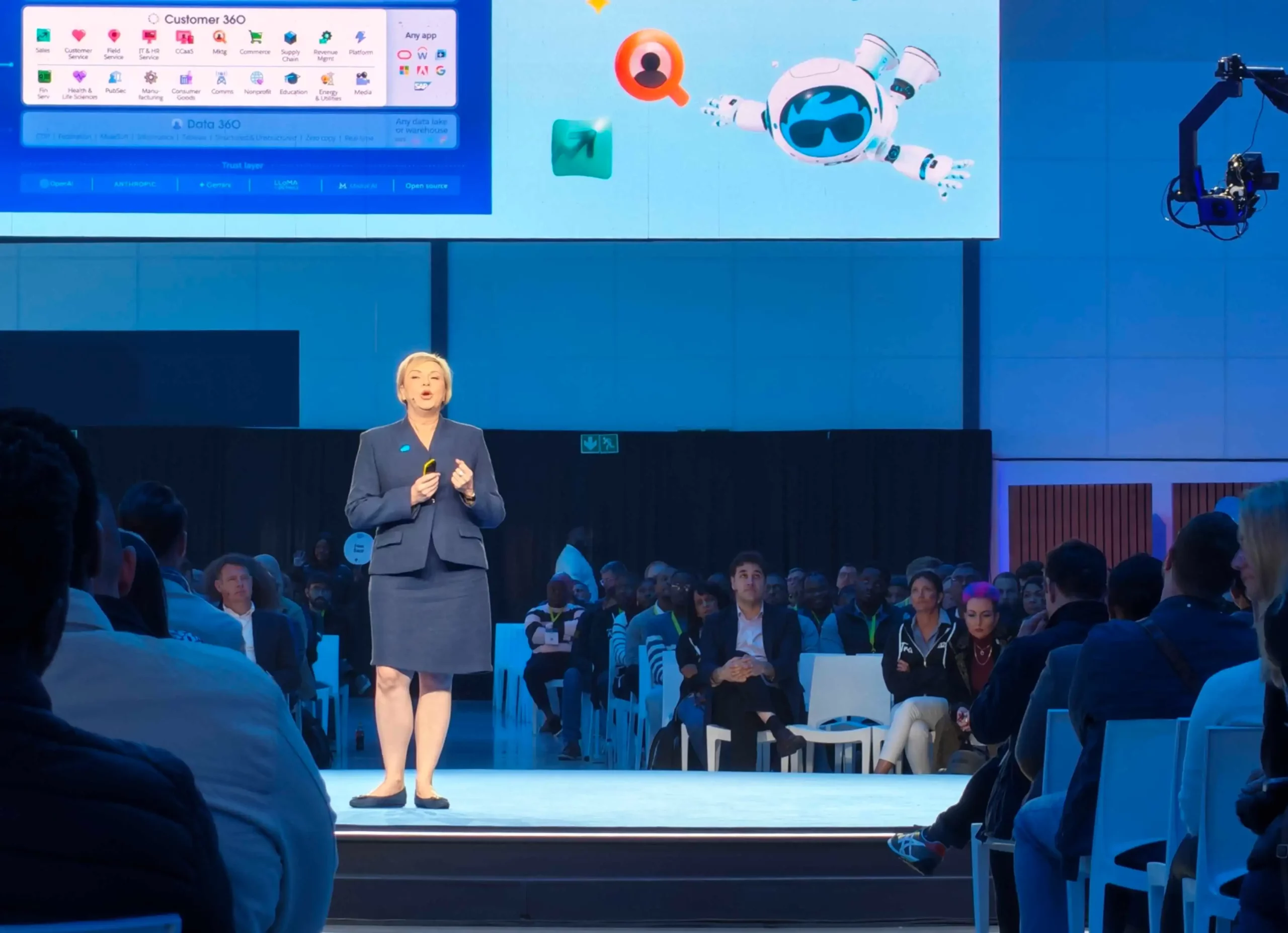
“We are at a point of inflection and our mission as a business is now not only about the great products, but it’s also a piece of education,” said Linda Saunders, Salesforce country manager and senior director for solution engineering in Africa, during a briefing at the Agentforce conference in Johannesburg last week. “We need to give people the confidence around the technology and how that mitigates a lot of the risks that they are carrying out there in the world.
“Our mission right now is to leave nobody behind. As a company, as a country, as a community, there is an incredible opportunity here to empower humans with agentic solutions. We do have the privilege of working in an organisation that lets us, as a business, redesign our work, our jobs, and fail forward with how we use this technology.”
Salesforce uses its own AI tools internally, including Slackbot, an AI assistant built into the Slack workplace collaboration platform. The tool has evolved beyond analysing structured business data and can provide insights from workplace conversations and other unstructured information.
As an example, Saunders said managers can use Slackbot to gauge team sentiment and identify potential stress or pressure points. These insights, she said, are proving valuable both within Salesforce and among customers, helping organisations draw useful information from everyday interactions and communication.
Nearly two years have passed since Salesforce shifted the company’s entire core strategy to agentic AI and launched the Agentforce platform, as revealed during 2024’s Dreamforce conference in San Francisco.
“When we shifted to agentic, we increased our footprint,” Saunders told Gadget. “In a personal capacity, I think about how to lift and shift as much as I can to agentic solutions. And I’ve never been busier.”

Agentic AI has fundamentally changed how Saunders works, shifting her focus away from administrative tasks and towards higher-value activities such as customer engagement, education and strategic decision making.
“I find value in the freedom [agentic AI] gives me to re-engineer my job, to have the ability to pivot to things that are valuable.”
Access to real-time information and AI-generated insights gives organisations a broader awareness of what is happening across the business, she told Gadget. As a result, conversations can shift away from collecting and analysing data towards identifying trends, exploring opportunities and deciding how to respond to changing circumstances.
“On top of that, having AI surface insights according to what you’ve asked or your priority list, I think, is super powerful.”
However, with great power comes great responsibility. As agentic AI accelerates work, businesses will need to rethink what progress means. Faster execution alone does not answer the bigger question of where human judgement, purpose and value fit when autonomous systems begin completing more of the work.
Saunders cautioned that if organisations continue to measure human output through legacy lenses, they risk missing the true potential of the agentic era.
“Ethically, from an employee-organisational perspective, if we continue to think about our organisations as pin factories – where if we’ve made 100 pins, then that’s done – you will stagnate. Because this technology is not about doing something one-and-done.”
This changes the way businesses can think about progress in an agentic environment.
“There is an evolution of continual improvement that is unlocked with this technology in a very interesting way, because it’s not sorry for itself to self-reflect a little like we are. We don’t like to think: ‘Okay, now I have to go back and figure out how I could do this better’. We like to celebrate the win and then go to the next thing. That’s going to change a little bit in terms of how we think about that.”
According to Saunders, any organisation serious about becoming an agentic enterprise must be willing to let the workforce reshape what “value” looks like on both a corporate and individual level. For Salesforce, that shift has changed what the company looks for when evaluating its own use of AI.
“For us, token consumption is interesting,” Saunders told Gadget. “What’s useful is the value that the token consumption creates.”
The challenge for businesses lies in defining what that value means. Beyond productivity gains, Saunders said organisations must consider how work changes, how careers evolve, and how employees adapt to new ways of working alongside autonomous systems.
She described the transition as a learning process that extends beyond technology and into organisational culture. Questions around ethics, flexibility, career development and workplace expectations are becoming increasingly important as businesses integrate agentic AI into day-to-day operations.
Addressing those questions, Saunders said organisations cannot solve the challenges of the agentic era in isolation and need to learn from a broader network of customers, partners and technology providers.
“We’re not an island here. We’re deeply connected to the rest of our business. We’re also looking outside of the bounds of Africa to solve problems. There are problems that exist outside of the world that African countries solve too. It’s not a one-way street, but it is definitely a global network of great minds, passion and technology coming together.”
* Jason Bannier is a data analyst at World Wide Worx and deputy editor of Gadget.co.za. Follow him on Bluesky at @jas2bann.