


Business Tech
Signpost: Accounting becomes
a by-product of business
An eight-person team at a South African fintech is testing how far AI can replace business processes, writes ARTHUR GOLDSTUCK.

A South African fintech with a team of just eight people has attracted more than 15,000 entrepreneurs to its accounting platform, and is now using AI to challenge the way small businesses manage their finances.
The company, called stub, has built its business around a basic truth about accounting software: the people who need it most are often the least in love with it. In response, stub has partnered with entrepreneurial payments provider Yoco to help make accounting happen automatically as businesses go about their daily transactions.
“Existing accounting software was built for accountants and not for entrepreneurs who start and run businesses,” founder and CEO Tayla Dandridge told Gadget.
Dandridge started her career at Absa, building digital financial products, before identifying an opportunity to provide small and micro businesses with tools for managing cash flow. Three years after launching stub, she found that the opportunity extends well beyond conventional bookkeeping.
The company began by competing with the staple accounting systems of small businesses: notepads and Excel spreadsheets. Increasingly, it is now competing with established software providers like Xero and Zoho Books.
Its advantage, Dandridge believes, comes from designing around what entrepreneurs need to accomplish during an ordinary working day.
“We spend a lot of time with our customers understanding less about what they want and more around what they need,” she said.
In truth, accounting software has an image problem. As Dandridge put it, someone once compared buying it to visiting the dentist. Entrepreneurs generally start businesses because they want to sell a product or service, and bookkeeping becomes an obligation that consumes time better spent earning money.
Dandridge wants to change that relationship by making accounting a by-product of running the business.
“We believe that accounting is really just understanding what’s going on in your business.”
The strategy depends on integration with the services entrepreneurs already use. Stub provides the technology behind iKhokha’s accounting offering, and its first direct banking integration was with Capitec, allowing bank transactions to feed into the platform automatically.
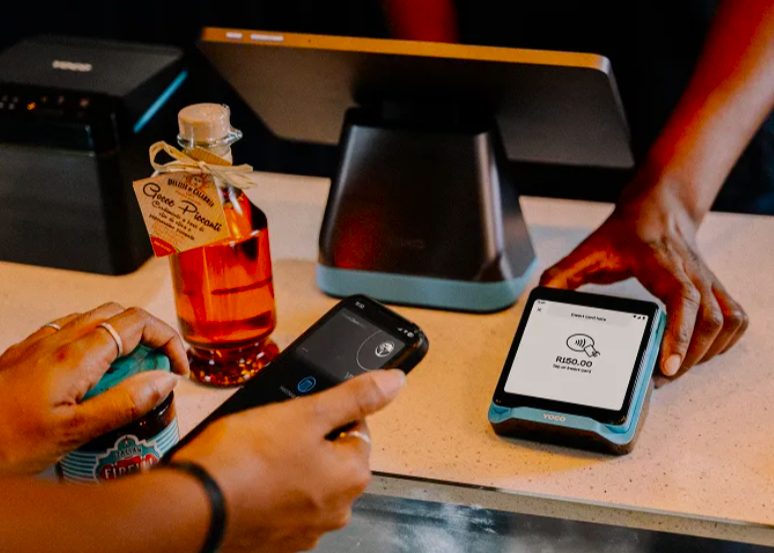
The Yoco partnership extends that approach to one of South Africa’s largest payments platforms, used by more than 200,000 independent businesses.
A merchant accepting a Yoco payment can have the transaction transferred directly into stub, where it is categorised and reconciled. The integration also incorporates other transactions, including those involving Yoco’s lending products and staff tips. The accounting records are updated as transactions occur, reducing the need to assemble information manually.
The fact that it works with companies that compete with each other, like Yoco and iKhokha, is one of the keys to its potential appeal.
“When you’re building accounting software, you almost have to be agnostic because your entrepreneurs are using multiple tools,” said Dandridge.
For now, its commercial model is straightforward. Anyone can start with a free version, which provides basic invoicing and expense tracking. A Pro subscription, costing R239 a month, adds connected payment and banking services, along with financial reporting.
A further package aimed at established entrepreneurs recently launched, incorporating income tax and payroll functionality. That will take stub deeper into territory occupied by established accounting software.
It also raises a pricing question. Subscription businesses have traditionally prospered by selling access to increasingly extensive collections of features. AI offers the prospect of completing tasks through ordinary language instructions, potentially reducing the customer’s need to understand the software itself.
Stub is already using AI internally to test how much work a small team can accomplish without expanding its headcount. For stub’s customers, the immediate application of AI is automatic reconciliation and the allocation of transactions to the correct accounts. Dandridge expects further automation in income tax and payroll, eventually allowing entrepreneurs to instruct the platform to perform financial tasks on their behalf.
Of course, the easier it becomes to build applications and automate processes, the easier it may become for new competitors to enter the market.
Stub’s response is to concentrate on local integrations and the detailed requirements of South African entrepreneurs. Those relationships are harder to reproduce than a software interface.
The company also answers the question that confronts every business adopting AI: how much can be handed to machines before the business loses the ability to judge their work?
Says Dandrige: “If you don’t know what good looks like, you don’t know when it’s wrong.”
* Arthur Goldstuck is CEO of World Wide Worx, editor-in-chief of Gadget.co.za, and author of “The Hitchhiker’s Guide to AI – The African Edge”.