


GadgetWings
Travel tech: SARS revisits apps – and paper
A new high-tech travel declaration for anyone flying in and out of South Africa has proven baffling, both in action and in purpose, writes ARTHUR GOLDSTUCK.

The South African Revenue Service (SARS) has discovered the convenience of the travel app. Unfortunately, it also appears to have rediscovered paper.
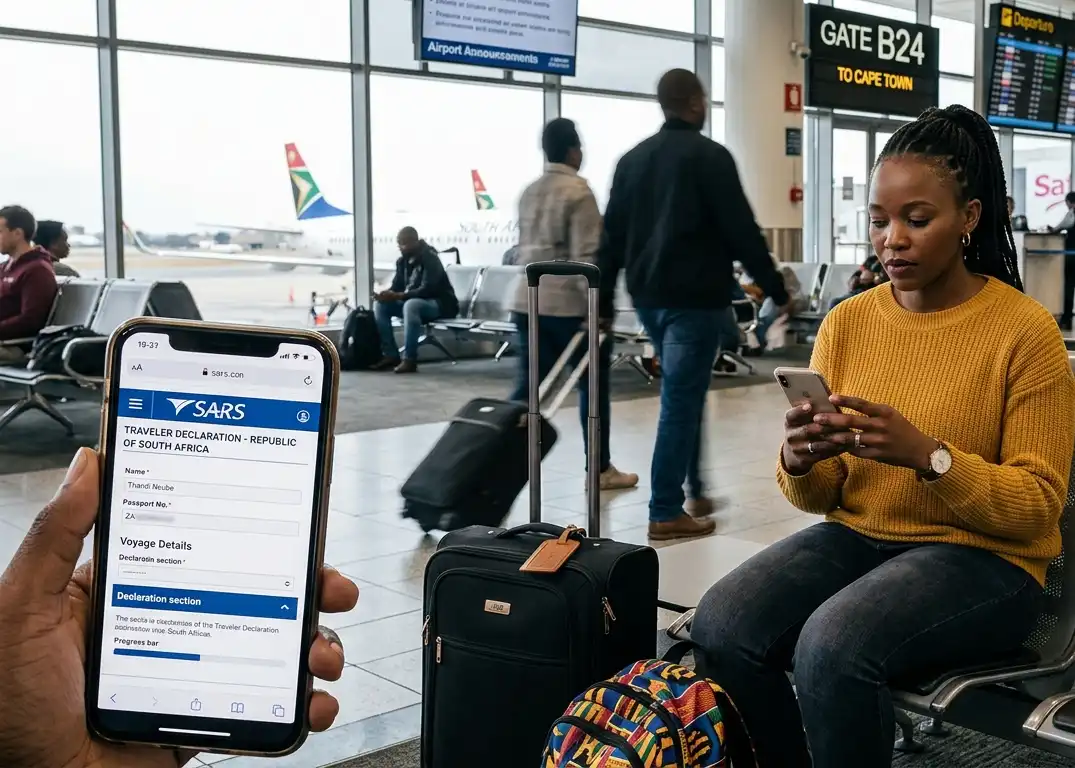
Since 1 July 2026, everyone entering or leaving South Africa has been required to submit a traveller declaration online. It applies whether one travels by air, road, rail or sea, and includes children. Only international passengers who remain inside a transit area are excluded.
For most travellers, it adds another tickbox item to the departure checklist. Check passport, check weather, check in for flight, check boarding pass, check passport, check boarding gate… and now check the SARS app, and tell the Receiver of Revenue where you are going, why, and what you are taking with you. What next? A doctor’s certificate?
The declaration must be submitted within the 24 hours leading up to departure. On a journey back to South Africa with a connecting flight, it must be completed within 24 hours of the final flight into the country.
It can be done through the South African Traveller Management System, known as SATMS, using its mobile app or the SARS website, the SARS MobiApp or a QR code. The form asks for passport, contact and travel details, information about companions and whether goods or currency need to be declared.
The app then tells the traveller what to do at the airport or border post. Some are told they can proceed. Others are instructed to report to a SARS kiosk or Customs counter.
Just like that, the digital revolution runs out of electricity.
Travellers have found the process hit and miss. Some receive their instruction and pass through seamlessly. Others are sent to a SARS counter, where they may be given a physical form to complete.
In other words, an online system built to replace paperwork sometimes leads back to paperwork.
SARS says paper declarations should be used only when its systems are down, or a traveller has a reasonable excuse for being unable to submit online. Not everyone appears to have received that memo.
Which all raises a basic question: what has been modernised?
SARS is no stranger to apps. It has offered mobile eFiling for more than a decade. It began testing the online declaration system in 2022, and there are good reasons for moving it online.
SARS says the system will improve information sharing between government agencies, strengthen the monitoring of cross-border activity and eventually support a trusted-traveller programme with a faster green lane.
In theory, that sounds more useful than handing every passenger a form and hoping someone reads it. According to SARS, those forms increased the workload of officials, created risks and gave travellers a poor experience.
The old Traveller Card, known as the TC-01, asked many of the same questions as the app. What happened to all those cards? Were they kept in files that nobody ever opened again? Did they end up in a landfill?
The online system should solve that problem because digital information can be searched, compared and analysed. But: making everyone submit a declaration creates a huge amount of data; most people will select the equivalent of “nothing to declare”.
Seriously now: will a traveller who plans to smuggle goods or move money illegally announce it in an app? The people most likely to complete every field accurately are those who posed the least risk in the first place. In short, the declaration becomes a digital ritual with little practical value.
I accept that Customs needs to know what people are bringing in or taking out. I am less convinced that SARS has explained why it needs a detailed record of every journey. How about we apply the government’s own rules here? The Protection of Personal Information Act?
SARS should tell travellers how long it keeps the information, who else in government can see it, how it is protected and whether it may later be used for something unrelated to Customs.
The app could become a useful weapon against smuggling and illegal money flows. Or it could become the e-version of the Traveller Card: completed because the law demands it, collected in vast numbers, and rarely looked at again. That’s the difference between a database and a filing cabinet.
* Arthur Goldstuck is CEO of World Wide Worx, editor-in-chief of Gadget.co.za, editor of GadgetWings, and author of “The Hitchhiker’s Guide to AI – The African Edge”.