



Arts and Entertainment
What shutting Showmax teaches young creatives
While talent is essential, understanding the business is equally critical, writes MZI KAKA, Academy of Sound Engineering lecturer.

The Showmax situation has unsettled South Africa’s film and television industry. When a platform associated with premium local content is pulled back as a standalone service and effectively restructured, it raises difficult questions across the creative economy. But I do not think the lesson is that South African content has lost its value.
Instead, it is the business model around content that is under pressure. Local content still has audiences, cultural relevance, commercial potential, and export value. What is changing is the route between the creator and the audience.
The risk of too few routes to market
South Africa’s screen industry is shaped by a small number of large players that carry enormous weight in commissioning, funding, production, and distribution.
When one major player changes strategy, the effect moves through the entire value chain. It affects production companies, writers, actors, camera crews, editors, sound teams, composers, musicians, and suppliers.
This is why the Showmax development should not be viewed only as a streaming story. It is a value-chain story.
Creatives need to understand the business
For young creatives, the message is uncomfortable. Talent is no longer enough. Writing, shooting, editing, performing, producing, mixing, or directing remains essential, but it is no longer sufficient.
A modern creative professional must understand how entertainment is funded, commissioned, distributed, marketed, and monetised. They need to understand audiences, rights, contracts, platform behaviour, digital distribution, and commercial sustainability.
Decentralising the value chain
Young creatives may need greater control of funding, commissioning, and distribution. Funding does not always have to begin with a large institution. Creatives can pool resources, build collectives, exchange skills, and work with leaner budgets without lowering standards.
Commissioning can also become more creator-led. Creative teams can identify audience gaps and move faster. Larger broadcasters and platforms are often necessarily risk-averse. Smaller creator collectives can be more agile.
YouTube is not a downgrade
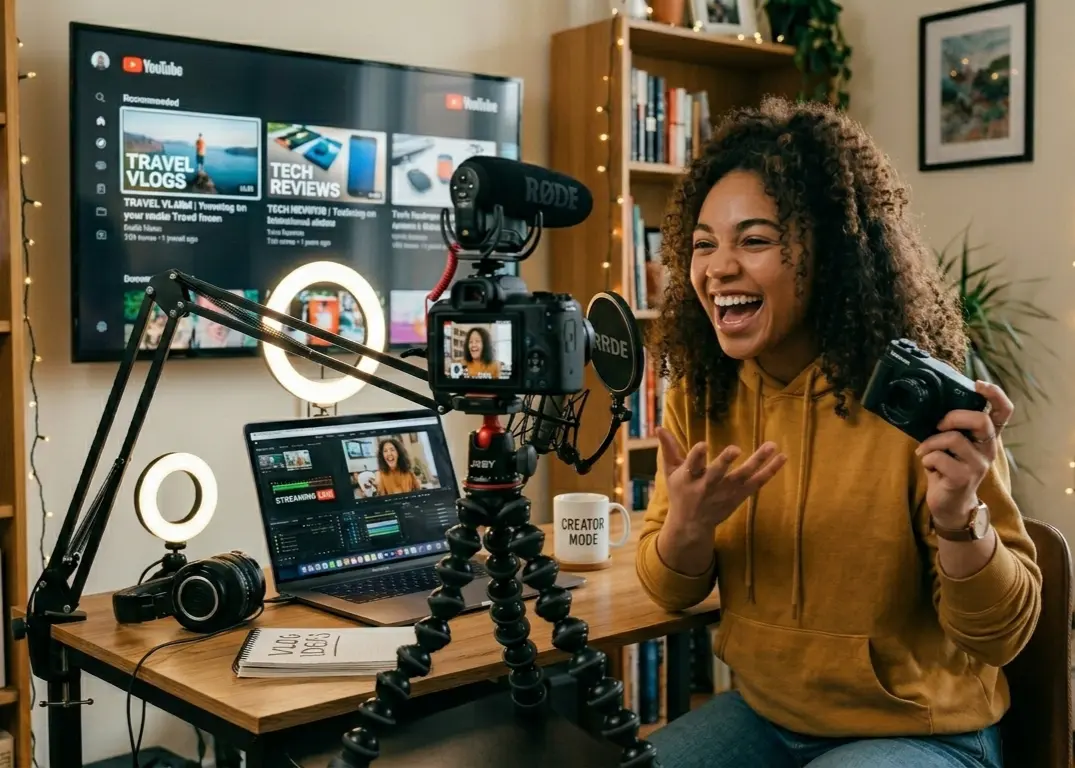
Many people still look at YouTube as less sophisticated than a paywalled platform. Across Africa, open distribution models have become a serious form of creative infrastructure. Nollywood has shown how direct-to-consumer film channels can build audiences at scale. In South Africa, the vodcast scene has proved that a creator-led platform can grow into a functioning media business.

Not every film or series must live on YouTube forever. But open platforms can serve as an audience route, proof of concept, bargaining power, and sometimes a complete business model.
Chris Q. Radebe’s Shut Up, Men Are Talking is a useful example. It found an audience on YouTube, built demand, and showed how open infrastructure can test the market before larger players enter.
Multi-skilled does not mean unfocused
Young creatives now need a broader understanding of the entertainment ecosystem. Broadcasting, live production, digital content, post-production, sound, rights, audience development, and business strategy are increasingly connected. A student may begin in one discipline, but their career will almost certainly touch several others.
That is why collaboration is so important. At Academy of Sound Engineering, students are introduced to the business of entertainment from the start, while also working in environments where technical skill, creative thinking, and industry relationships intersect. The point is not to produce shallow generalists, but professionals who understand how their specialisation fits into the wider entertainment economy.
The opportunity inside the pressure
It creates uncertainty, and uncertainty has real consequences for people’s livelihoods. But it should also sharpen our thinking.
If young creatives depend only on traditional commissioning structures, they remain exposed to decisions made far above them. If they build skills, networks, and routes to the audience, they begin to create leverage.
South African creatives have always had to do more with less. That resilience should become a strategy. The next generation must be creative, technical, collaborative, and commercially literate.
Content is still the product. But in the modern entertainment economy, ownership of the audience and control of distribution may matter even more.