



GadgetWings
Drone pilots take on Mozambique’s disasters
The story of drones in disaster management in Mozambique tell the tale of two floods, writes EL KHILI LHOUCINE of the African Development Bank.

In February 2000, Mozambique experienced its worst floods in fifty years. More than 700 people died, 650,000 were displaced, and 4.5-million — a quarter of the population — were affected. The iconic image that circled the globe was of a woman who gave birth in a tree above the floodwaters. Mozambique had no way to see what was happening and or reach those who needed rescuing.
Nearly two decades later, Cyclone Idai followed, killing more than 1,300 people and destroying over $773-million in buildings, roads and crops. The same question returned with devastating force: what if we could see what is happening — in real time, from the air, with precision?
In February 2026, floods hit southern Mozambique again, destroying 30,000 homes and affecting up to 800,000 people. But the response was different this time – when the Government called for emergency intervention, a team of trained Mozambican drone pilots was ready. Within hours, drones were airborne — mapping the disaster, monitoring water levels, feeding real-time intelligence to national authorities. The technology the country had lacked for twenty-five years was finally, operationally, in Mozambican hands.
The Partnership
In 2023, the Government of Mozambique requested the African Development Bank Group’s support in drone-based flood management. The Bank secured $967,000 from the Republic of Korea’s KOAFEC Trust Fund. In April 2025, the Bank, the Ministry of Communication and Digital Transformation of Mozambique (MCTD), and Busan Technopark (BTP) signed a tripartite agreement in Maputo.
Korea brought two decades of drone expertise from Pusan National University. Mozambique brought sovereign ownership and institutional commitment. The African Development Bank brought fiduciary rigour and the convening authority to hold the partnership together. The project was built on three integrated components: equipment, trained pilots, and actual deployment in disaster zones — because equipment without people is hardware, and training without deployment is theory.
The Technology
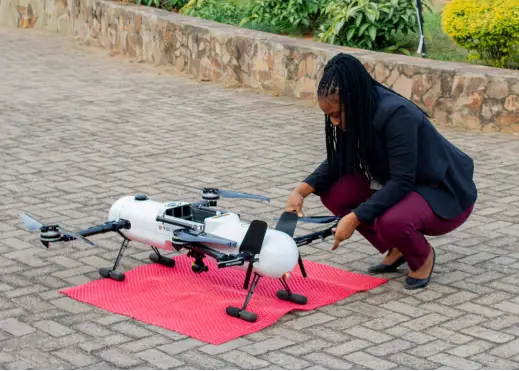
The drone fleet is a purpose-built aerial intelligence system: two fixed-wing drones for search-and-rescue and aerial mapping, unmanned surface vehicles that measure river depth and water quality, and a portable ground control station integrating all data in real time.
Together they deliver five capabilities that close the information gap: aerial mapping of flood extent with centimetre precision; real-time flood monitoring feeding GIS simulations; damage assessment guiding food aid and shelter allocation; search and rescue — locating survivors in floodwaters in full darkness and transmitting their exact coordinates to rescue teams; and water quality monitoring via surface vehicles, enabling early warning of disease outbreaks before they begin.
When the February 2026 emergency struck, all five were operational. The drones found the people. The data guided the response.
The People
The most important outcome of this project is not the drone fleet. It is the thirty certified Mozambican drone pilots and ten certified instructors who now form the backbone of a permanent national disaster management capability.
Training ran from October 2025 to April 2026, across four groups, combining theory, simulation, practical flight and maintenance. Ten participants completed an advanced instructor module — qualifying them to train future cohorts independently.
Each instructor can certify ten new pilots per group. Within three years, Mozambique can grow its drone workforce from 30 to 300, using national personnel and national infrastructure, at a fraction of the original cost.
On 10 July 2026, Prime Minister Maria Benvinda Levi presided over the National Drone Pilot Graduation Ceremony in Maputo — a signal that this capability is a national strategic priority.
AfDB’s Role and the Road Ahead
The African Development Bank invested in this project because its mandate — anchored in President Dr Sidi Ould Tah’s Four Cardinal Points — is to build climate-resilient infrastructure, unlock capital, and harness Africa’s demographic transformation.
This project does all three: it protects physical infrastructure, multiplies a $967,000 investment into decades of impact, and places cutting-edge technology in the hands of young Mozambican professionals. The model is replicable.
A concept note for a Centre of Excellence for Drone Technologies has been submitted to KOAFEC, positioning Mozambique as Africa’s continental reference for drone innovation and a regional training hub.
The drones are still flying. The instructors are already training the next cohort. The data is feeding early warning systems that protect communities long unprotected. That is what development means. That is what the African Development Bank, Korea and Mozambique built — together.
El Khili Lhoucine is a Business Relationship Manager for Corporate IT Services (TCIS) at the African Development Bank