


Fintech
Putting the tech
in Capitec
The group is pairing AI support systems with smart terminals, upcoming Home Affairs services, and environment-testing sensors, writes JASON BANNIER.

Capitec Bank is using a blend of technologies to reshape how customers are helped in person, from the first touchpoint in a branch to the handling of more complex issues such as suspected fraud. This includes an AI copilot for consultants, smarter queuing and self service systems, data-reactive screens, Home Affairs ID and passport services, and sensors that can monitor branch environments.
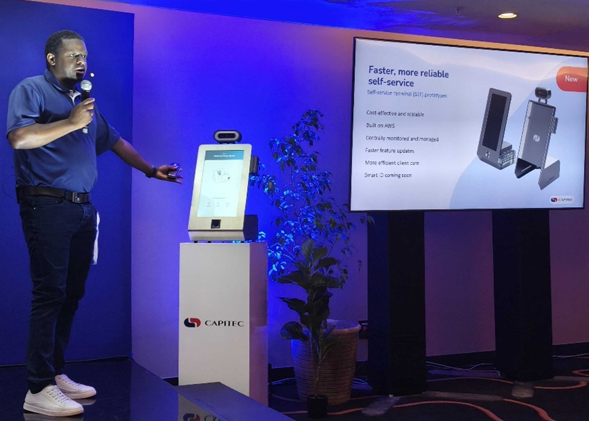
Capitec’s name was formed by combining “technology” and “capital”, and that technology focus was unpacked at the inaugural Capitec Innovation Exchange press conference in Sandton last week.
The bank confirmed that an upcoming partnership with the Department of Home Affairs will allow Smart ID and passport applications to be processed at select branches using dedicated Home Affairs terminals.
On the operational side, Capitec is testing new internet of things (IoT) devices in branches to track conditions in near real time. The sensors monitor water use, power consumption, and CO2 levels, giving the bank clearer insight into how each branch environment is performing.
Capitec says the data will support more efficient branch management and help create healthier spaces for staff and customers. Further IoT use cases are expected as the pilots expand.
Smarter support for branch consultants
“The AI assistant Neo is used in different parts of the business, not just to fight financial crime but also to empower our actual service consultants in over 840 branches,” said Blessing Mgaga, Capitec divisional executive for retail client experience delivery, during the conference.
“What we’ve introduced is also a copilot way of enabling our service consultants to be empowered with Neo to do certain transactions on behalf of the clients in the moment of need with a level of accuracy and speed that really shows efficiency.”
Capitec service consultants can access Neo within the banking system to ask questions during client interactions. In sensitive cases, such as when a client raises concerns about possible fraud on an account, consultants can use Neo to draw on multiple data sources and guide the conversation.
“Neo actually can help the service consultant navigate conversations to a place where it starts actively and automatically loading certain cases in the backend with Salesforce and allowing our investigations teams to start realising that we need to act on this and service the client in a much more meaningful way,” said Mgaga.
The predictive nature of the tool can support both consultant and customer by suggesting likely next steps in the moment, surfacing relevant context from multiple sources, and helping steer the interaction towards a clear outcome, especially when time sensitive decisions are needed.
“This is just one of the use cases we’re starting to work on, and I’m excited about the future of where this takes us. We’ll see more and more value as we go on, and I think clients will be better off for it.”
Queuing and self service upgrades
Neo works behind the scenes, so it is not technology most customers will interact with directly. In branches, the experience is shaped by in person service points such as self service terminals, queuing kiosks, and on-site screens that guide customers through the process.
Mgaga said the bank is upgrading the queuing and media solution systems which will launch soon in a few branches. One of the goals, he said, is in some cases to empower customers to complete tasks themselves without direct assistance from a service consultant.
Capitec tracks how customers move through a branch, including the time from arrival to being helped at a consultant desk. By analysing this flow, Capitec can pull practical insights on what clients need most and where service can be improved on a day-to-day basis. These measurements, he said, help the bank plan staffing levels for different days and understand where new branches are needed, so that in person service matches demand in each area.
Capitec’s queuing terminal does more than issue tickets, said Mgaga. By capturing what customers select when they arrive, it provides data that can shape what information is shown on a nearby screen, helping visitors while they wait. The result is branch-specific content that reflects the most common needs in that location and can be updated quickly when priorities shift.
Mgaga said this is meant, in some cases, to encourage customers to use self service options where possible, empowering them to handle simpler needs on their own and easing pressure on consultants.
The queuing device and media system are powered by a small Raspberry Pi computer that Capitec assembles in house for its branch needs. Using the low cost, custom built hardware has cut the total cost of ownership at that touchpoint by more than 50%, according to the bank.
This has improved efficiency and freed up savings that support the bank’s aim to keep services affordable. The approach reflects Capitec’s wider focus on re-engineering branch technology to better understand and respond to what customers need in the moment.
“Since launch, we can now safely say 60% of all interactions that take less than 60 seconds to accomplish are being done on the self service terminal. It’s not just a service point, it’s also an education point.”
Capitec provided the following key innovation highlights from the event:
- Fraud Prevention: State-of-the-art, AI-driven security systems prevented over R300-million in client fraud this year, blocking 80,000 mule accounts and 200,000 scammer payments. Client-control features put the client in charge:
- Feature lock prevents fraud if a phone is compromised by locking features that clients rarely use.
- Digital fingerprint creates a unique phone identity using the contact list, immediately flagging app access from an unauthorised device.
- Location permissions have proven helpful in kidnapping cases and are actively used by 13-million of Capitec’s 14-million app clients.
- Payment innovation: Driven by over 200% growth in trading merchants, more than R1-billion was funded to small businesses this year. Capitec Pay has pioneered the most secure online payments (24-million monthly transactions) and became the first in South Africa to secure international e-commerce payments to global platforms like Shein and Netflix.
- Capitec Connect: Since March 2025, 1.1-million active SIMs have been rewarded with 449 terabytes of free data.
- Global Reach: Cross-border payments are available in 8 African countries and have recently expanded to Pakistan and Bangladesh. The bank has eliminated international transaction fees on card payments since 1 October, saving clients R55-million while simplifying international transfers to a flat R175 fee for over 50 countries.
*Jason Bannier is a data analyst at World Wide Worx and deputy editor of Gadget.co.za. Follow him on Bluesky at @jas2bann.