


EdTech
Creative education must return to ‘first principles’
Foundational skills like critical thinking and creative craft remain essential in the age of AI, writes DR SHELDON ROCHA LEAL, academic registrar at the Academy of Sound Engineering.

The debate around AI in education often starts in the wrong place. We ask whether students should be allowed to use it, whether institutions should ban it, or whether accreditation bodies are moving quickly enough to respond.
Has learning actually taken place? That is the test. AI can produce a polished document or a research outline in seconds, but speed and appearance are not evidence of understanding. A finished-looking output tells us what the tool can do. It tells us very little about what the student has learnt and understood from the work.
We have been here before. The typewriter changed how students produced work; Google changed how they searched. AI is another step in that evolution. Pretending it does not exist is pointless because students are already using it. The real question is whether they have enough knowledge to judge what it gives them.
Understanding the maths
One of the big misunderstandings about AI is that people treat it like magic. It is a calculation. It takes what has been fed into it and produces an approximation.
In creative fields, the work is not only about structure or surface. It is about judgment, context, lived experience, and emotional intent. A student who understands music can listen to an AI-generated composition and hear where it fails. They can hear what is generic, unresolved, or disconnected. A student without that foundation may accept the output simply because it looks complete.
The same applies to written work. A student can submit something polished, but if they cannot explain the argument, defend the sources, or show how the ideas connect, the document tells us very little about their learning. In those cases, we need to ask different questions. What did you discover? How did you get there? What do you now understand?
Meaningful use
Used properly, AI can help. It can guide early thinking, provide structure, and remove some of the administrative burden from creative work. But it cannot replace the hard part of education, which is learning how to think through a field with enough depth to make informed decisions.
This matters especially in South Africa. Much of our creative history, music knowledge, mythology, and cultural experience is not well documented online. When AI is asked about South African music or local creative traditions, the answers are often superficial because the depth of that knowledge still sits with people, communities, practitioners, and memory.
If the knowledge is not documented, AI can only guess from what it has. If education abandons foundations for tools, we weaken what students need most. In music, sound, and production, students still need to understand scales, notation, acoustics, sound behaviour, performance, language, and creative process. Without those foundations, AI cannot elevate their work. It can only make weak work look more finished.
More than content
Education is not just content transfer. It is also socialisation, collaboration, debate, feedback, networking, and learning how to operate within a field. Assessment should ask whether the student can think, adapt, explain, and apply knowledge in context.
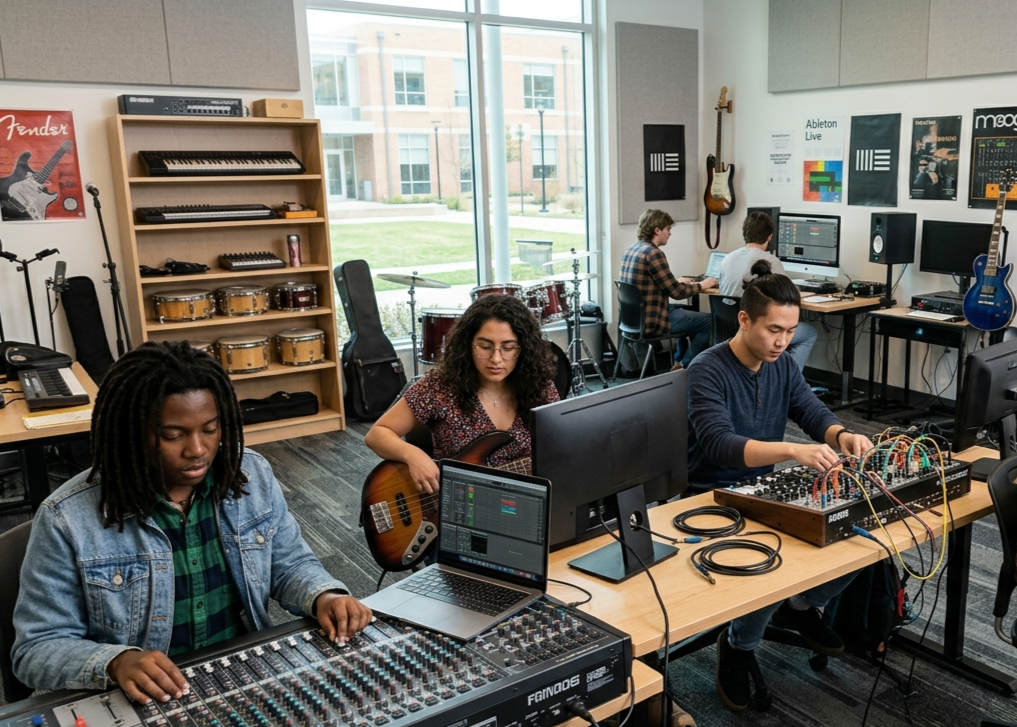
At Academy of Sound Engineering, our responsibility is to protect that balance. We cannot abandon the concepts that govern our industry or prevent students from encountering the innovations that shape it.
As a smaller private institution, we can respond with agility. But agility should not mean chasing every tool at the expense of the principles that make learning durable. AI will become part of creative education. What matters now is whether institutions use it to deepen learning or allow it to disguise the absence of learning.
If a student can use the tool, explain the process, challenge the output, and improve it through craft, learning has happened. If they cannot, the machine did not make them creative. It merely coloured in the numbers.