

Connectivity
Signpost: Meet the mobile
network that runs itself
Networks that were once little more than pipes are waking up as they prepare for the AI token economy, writes ARTHUR GOLDSTUCK.

The mobile phone in your pocket is about to get a lot smarter. That is only partly because AI apps will become the new default for search, travel and shopping. But something bigger is coming: the network itself is waking up.
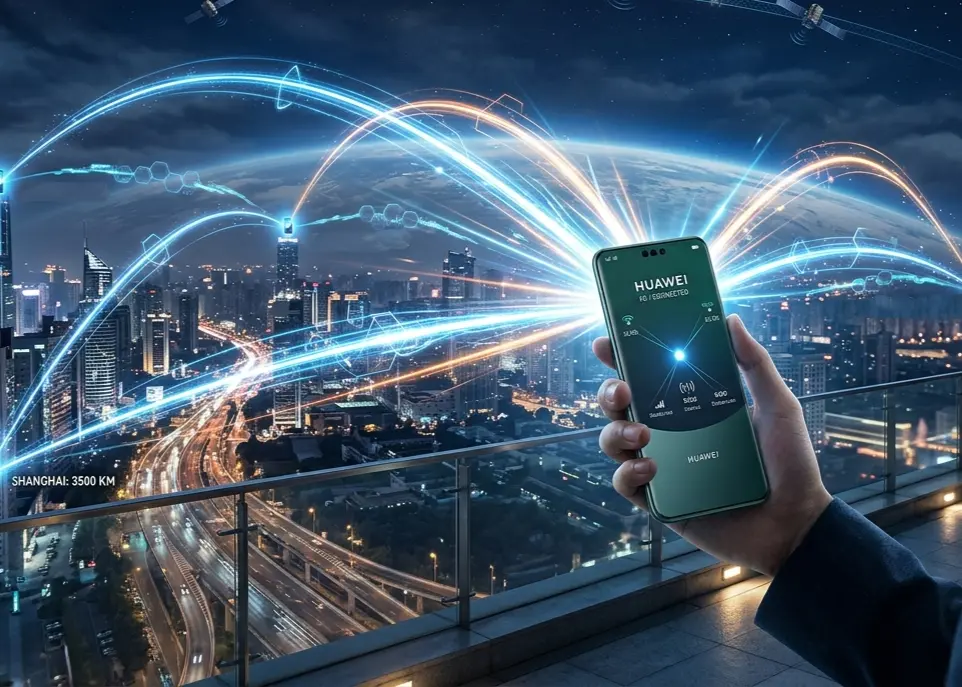
At Mobile World Congress Shanghai 2026, held in the futuristic Chinese city this week, Huawei’s rotating chairman David Wang described a future where mobile networks move on from moving data. For the four decades that the mobile telecoms has been in existence as a distinct sector, the network was treated as little more than a pipe, and the industry focused on one thing: speed. Now, that will be only one of a number of facilitators of what comes next.

“With each generation, we have pushed the limits of spectral efficiency and performance,” Wang said. “Network architecture has gradually flattened, with new application scenarios and services emerging left and right. This has consistently expanded the boundaries of communications, helping carriers translate network capabilities into commercial value.”
The pressure is on, in particular, to deliver the complex network architecture demanded by the explosion of AI applications. According to Huawei, “leading carriers around the world are moving fast to explore commercial high-uplink services through various capabilities to guarantee peak speeds, latency, and universal speeds in the uplink.”
The boom in AI agents in particular is expected to drive rapid growth in token services, which represent the currency of the AI economy. Tokens can be described as the atoms of AI: every query and response consumes tokens, and complex processes use up exponentially more tokens.
Wang Chao, chief marketing officer of WhaleCloud, told the Mobile AI Monetisation Summit, part of MWC, that global token usage had jumped from 114-trillion a day in 2024 to 400-trillion in 2026. China’s growth has been as dramatic. According to the National Data Bureau, China’s token market has grown from 0.1-trillion daily “token calls” to 140-trillion a day in March 2026, making it the world’s largest token user.
Volume is both the strength and weakness of tokens. As usage rises, so do costs, and operators have an imperative to build in greater network efficiency to support the token economy more effectively.
Jiangang Tong, China Telecom’s director of core network technology research, told the Summit that telcos must provide high reliability and high quality connectivity to power the AI era.
“We hope that we can build up this infrastructure and embrace the new era of AI,” he said.
Richard Liu, Huawei’s president of ICT marketing and solution sales, said at the Summit that Huawei’s AI architecture would cut token use demanded of specific agentic activity by half.

“In the token monetisation era, high uplink is a key capability of carriers’ network infrastructure,” he said.
At its MWC stand, Huawei showcased this capability in a live trial with China Mobile Hubei, run on a computing cluster called the Ascend A3 SuperPoD. Ascend is Huawei’s home-grown answer to Nvidia’s AI chips, born out of necessity after the company was cut off from US chip supplies. The SuperPoD wires thousands of Ascend chips together to compete on scale.
The trial was a spectacular success: it showed AI response speeds increasing by up to 93% and token throughput by as much as 372% on the kind of long, multi-turn conversations that chew through the most tokens.
Huawei competitor ZTE echoed both the token theme and the trial at its stand, demonstrating a system that packs 128 AI processors into a single cabinet and scales up to 16,000 processors.

The telecom industry is now racing toward what it calls Level-4 autonomous networks, the fourth rung on a five-step ladder that measures how much control AI has over network operations, and a threshold where AI begins to run the network itself.
Wang said: “Huawei hopes to continue leading the innovative application of AI-native technologies to autonomous networks, and has been working to develop domain-specific intelligence to lay the groundwork for level-4 autonomous networks.
“This year, Huawei will work with carriers to implement domain-specific intelligence across domains, including wireless network and transmission network, in key regions. The resulting synergy that will be achieved across the maintenance, optimisation, energy efficiency, and experience aspects of networks will help carriers enhance both network quality and efficiency.
“It will also enable them to deliver differentiated products for a range of scenarios like high-speed rail, event venues, and campuses, thereby driving new network momentum.”
* Arthur Goldstuck is CEO of World Wide Worx, editor-in-chief of Gadget.co.za, and author of “The Hitchhiker’s Guide to AI – The African Edge”.