



People 'n' Issues
Cisco builds bridge between quantum islands
A new switching prototype points to a future where quantum machines work together, writes ARTHUR GOLDSTUCK.

Cisco is trying to solve a problem that has kept quantum computing stuck in isolation: how to connect machines that speak entirely different “languages” without breaking the message in transit.
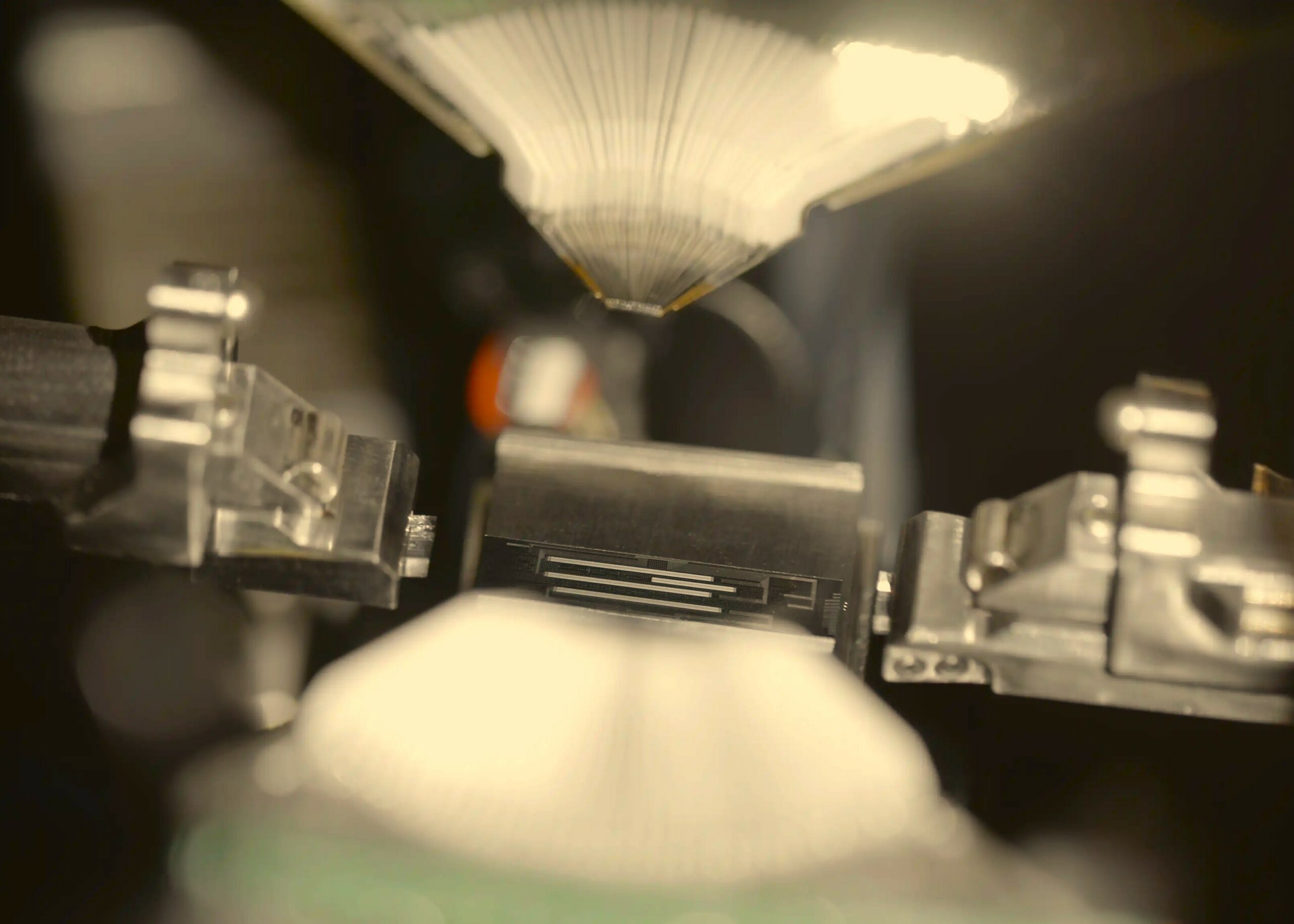
Last week, the company revealed a Universal Quantum Switch, a research prototype that tackles the challenge head-on. While it sounds like a niche engineering milestone, it harks back to when the internet was a collection of disconnected networks before it became something far bigger.
The premise is straightforward. Quantum computers encode information in different ways and translating between those formats has typically destroyed the data. Cisco’s switch is designed to accept that information in one form, convert it, and pass it on in another, without losing its quantum state.
The company describes the core capability in precise terms:
- The Cisco Universal Quantum Switch is designed to route quantum information between systems while preserving it, with a Cisco-patented conversion engine that translates between all encoding and entanglement modalities at input and output.
- In proof-of-concept experiments, the switch preserved quantum information with an average of less than or equal to 4% degradation in encoding and entanglement fidelity. The complete findings are expected to be published in an upcoming research paper on ArXiv.
In classical computing, a small loss of fidelity is tolerable. In quantum systems, it can render results meaningless. Keeping degradation at or below 4% in early tests suggests the approach is valid.
“Reaching this milestone is a pivotal moment for our quantum program and a testament to the transformative potential of quantum networking,” says Vijoy Pandey, SVP and GM of Outshift, Cisco’s emerging technologies and incubation group. “We’ve long recognised that connecting quantum systems is the key to achieving true scalability, and now we’ve taken a critical step toward making that vision a reality. While this is a significant achievement, it’s just the beginning. The road ahead is long, yet the impact of what we are building – and what is still to come – will be nothing short of profound.”
From silos to systems
Quantum computing still remains experimental and constrained by scale. Current machines operate with hundreds of qubits, while many real-world applications in fields like healthcare, financial services and aerospace are expected to require millions. That gap, says Cisco, is why it is focusing on networking, since connecting many quantum systems may prove more practical than trying to build a single machine large enough to do it all.
The switch is meant to act as the intermediary that makes that possible. It takes in quantum information, translates it into a format suitable for routing, and delivers it in whatever format the receiving system needs.
Cisco says the quantum switch is designed to support all major quantum encoding modalities used to carry information, namely:
- Polarisation (the orientation of light waves)
- Time-Bin (the timing of light pulses)
- Frequency-Bin (the color or frequency of light)
- Path (the physical or spatial path)
To date, Cisco has validated the system using polarization encoding. Support for time-bin and frequency-bin is built into the design, with further testing still to come.
Performance under pressure
Early experiments suggest the idea is more than theoretical. Cisco highlights three performance markers:
- Quantum information preserved through conversion: Average of less than or equal to 4% degradation in quantum state fidelity and entanglement, maintaining the coherence that quantum networks require to function.
- Switching at the speed quantum networks demand: Nano-second electro-optic switching, reconfiguring connections in as little as 1 nanosecond
- Energy efficient: Consumes less than 1 watt of power
Speed and stability are central to quantum systems, where information can decay rapidly. Energy efficiency becomes important when considering how such switches would scale across a network.
There is also a practical advantage that could prove decisive. The switch operates at room temperature and runs over standard telecom fibre. That removes the need for specialised cooling and new infrastructure, both of which have slowed quantum deployments.
Cisco has outlined its approach in terms of a set of design principles:
- Unique in its nature: Current switch technology is limited to one encoding type. The Cisco Universal Quantum Switch is designed to support all major modalities, with a built-in conversion capability that is Cisco-patented and available in no other product on the market today.
- Room-temperature operation: Unlike many quantum hardware components that require cryogenic cooling, Cisco’s Universal Quantum Switch operates at room temperature. This eliminates the need for specialized cooling infrastructure, reducing both deployment complexity and cost.
- Works with existing infrastructure: It operates at standard telecom frequencies over the same fiber that carries internet traffic today, requiring no specialized equipment.
- Connects systems that could not previously communicate: Organizations are no longer locked into a single vendor ecosystem. It enables quantum devices from different manufacturers to interoperate, protecting existing investments and enabling best-of-breed quantum environments.
- Designed for the full stack: The Cisco Universal Quantum Switch is built as part of Cisco’s evolving end-to-end architecture for a distributed quantum network, spanning hardware, software, and application layers.
Building the next network
Cisco’s history is rooted in building the infrastructure that connects everything else. The Universal Quantum Switch fits neatly into that strategy, extending it into a field that is still taking shape.
The company is not positioning the switch as a standalone product, but as part of a broader stack that includes an entanglement chip and a network-aware quantum compiler. Together, they point to a model in which quantum computing is distributed across multiple systems rather than concentrated in a single machine.
That model is still some distance from commercial reality. The switch itself remains a research prototype, and the wider ecosystem of quantum networking is in its infancy. Nevertheless, Cisco is laying the groundwork for a future of quantum that lies in the network.
* Arthur Goldstuck is CEO of World Wide Worx, editor-in-chief of Gadget.co.za, and author of “The Hitchhiker’s Guide to AI – The African Edge”.