


EdTech
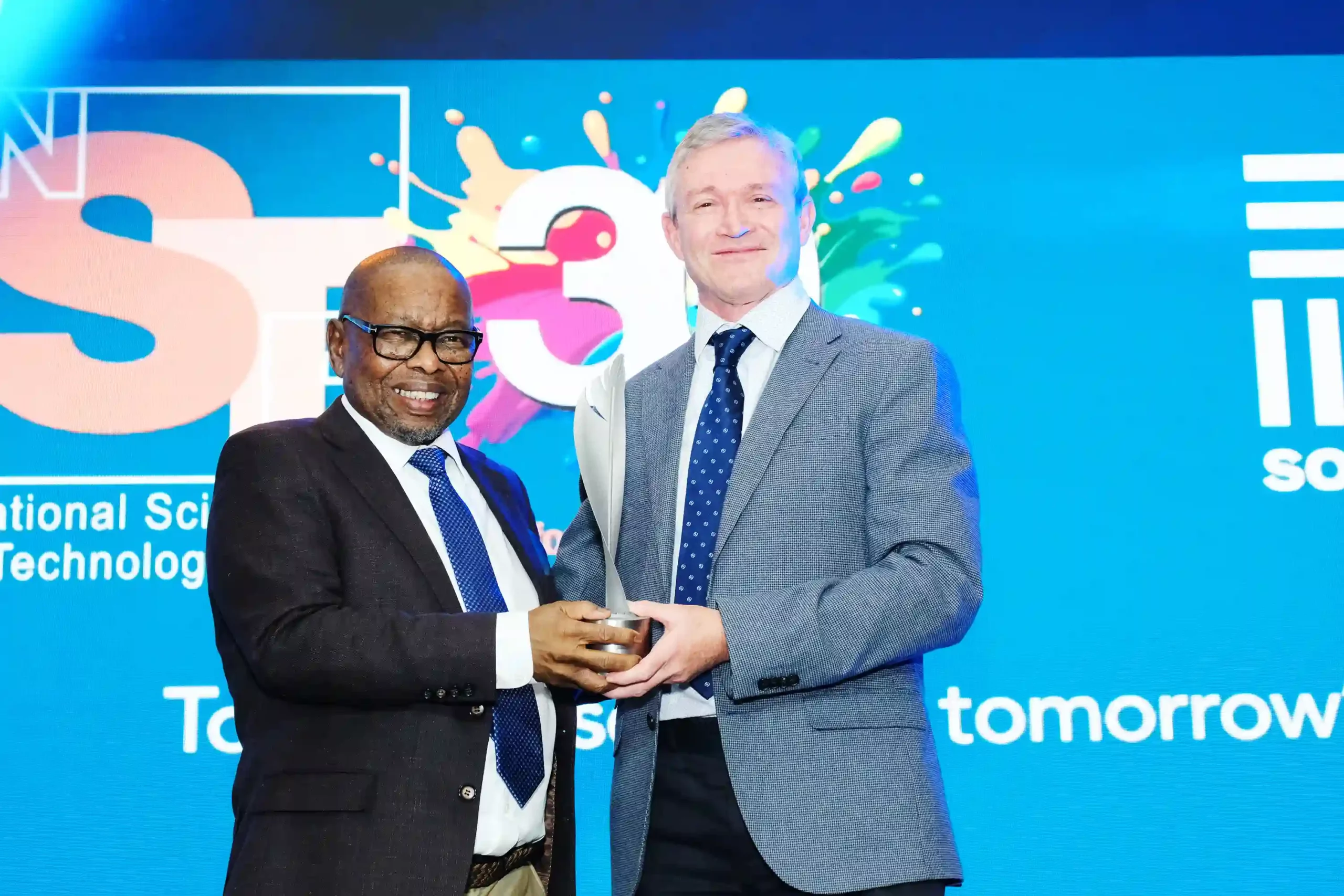
Wits U prof shines on World Quantum Day
He probably knows more about the properties of light than any other human being, and Andrew Forbes is now getting wider recognition for his work, writes ARTHUR GOLDSTUCK.

I call him the man who bends light to his will.
That sounds like science fiction. In a way, it is. Professor Andrew Forbes works in a field that still feels like it belongs to tomorrow, even while it is being built in laboratories today. But there is nothing fanciful about what he does.
Forbes is a distinguished professor at the University of the Witwatersrand, director of the South African Quantum Technology Initiative, and one of South Africa’s leading physicists in quantum photonics and structured light. He studies how light can be controlled at a fundamental level so that it can carry, secure and process information.
That is one reason South Africa still has a place in the global quantum conversation.
As the world marks World Quantum Day on 14 April, the National Science and Technology Forum has chosen to honour Forbes as winner of the 2025 Special Annual Theme Award for Quantum Science and Technology in the NSTF-South32 Awards, often called South Africa’s Science Oscars.
“All awards are of course retrospective; they look to the past, but the past is the stepping-stone into the future,” he says. “Our future is quantum. We want to see a quantum economy for SA. We want to see a trained, quantum-literate workforce.”
Forbes’ work in quantum photonics deals with light and information in ways that feed directly into secure communication, advanced imaging, precision measurement and computing power that will leave current systems looking severely limited.
His work on structured light is especially striking. Most of us think of light as the thing that allows us to see what is in front of us. Forbes works with light as something that can be shaped, encoded and directed to carry unusually large amounts of information. That opens the way to more powerful communication systems, more refined sensing and imaging, and a very different level of control over how information moves.
“We’re making quantum systems resilient for the real world. And we’re doing it right here, in Africa.”
Quantum research is often discussed as though it belongs by default to Europe, the United States and China, with Africa expected to follow later if funding allows. Forbes has spent years pushing against that hierarchy, with institutions, students, collaborations and scientific output. He has helped put South African quantum science in the room with the world’s best.
At Wits, he leads frontier research, supervises postgraduate students and works with international collaborators. Through the South African Quantum Technology Initiative, he coordinates national efforts in research, innovation and skills development. The administrative side of science rarely gets the romance. Yet it is where the future becomes durable.
Forbes’s influence also extends to developing talent in the field. Isaac Nape, now becoming a significant name in quantum information processing in his own right, is one example of what it means to build a research tradition instead of a lone career.
The honours have followed for Forbes. They include the South African Institute of Physics Gold Medal, the World Academy of Science Physics Prize, and his appointment as Editor-in-Chief of APL Photonics. In 2015, he became the inaugural winner of the first NSTF Special Annual Theme Award, then marking the International Year of Light and Light-based Technologies. A decade later, he returns under a different banner, with quantum taking the place once occupied by photonics at the edge of scientific ambition.
World Quantum Day itself has an elegant logic. It falls on 14 April, or 4.14, in reference to Planck’s constant, one of the central values in quantum physics. That symbolic date is a reminder that the strange world of quantum science rests on hard mathematics and disciplined experimentation. It is also a reminder that what sounds abstract can become infrastructure.
Forbes wants South Africa in the field, not reading about it later.
* Arthur Goldstuck is CEO of World Wide Worx, editor-in-chief of Gadget.co.za, and author of “The Hitchhiker’s Guide to AI – The African Edge”.