


Software
Qlik drives SA effort to close AI strategy gap
A wall of stickers at the Qlik AI Reality Tour showed organisations eager to adopt AI but unprepared in strategy, skills, and data quality, writes JASON BANNIER.

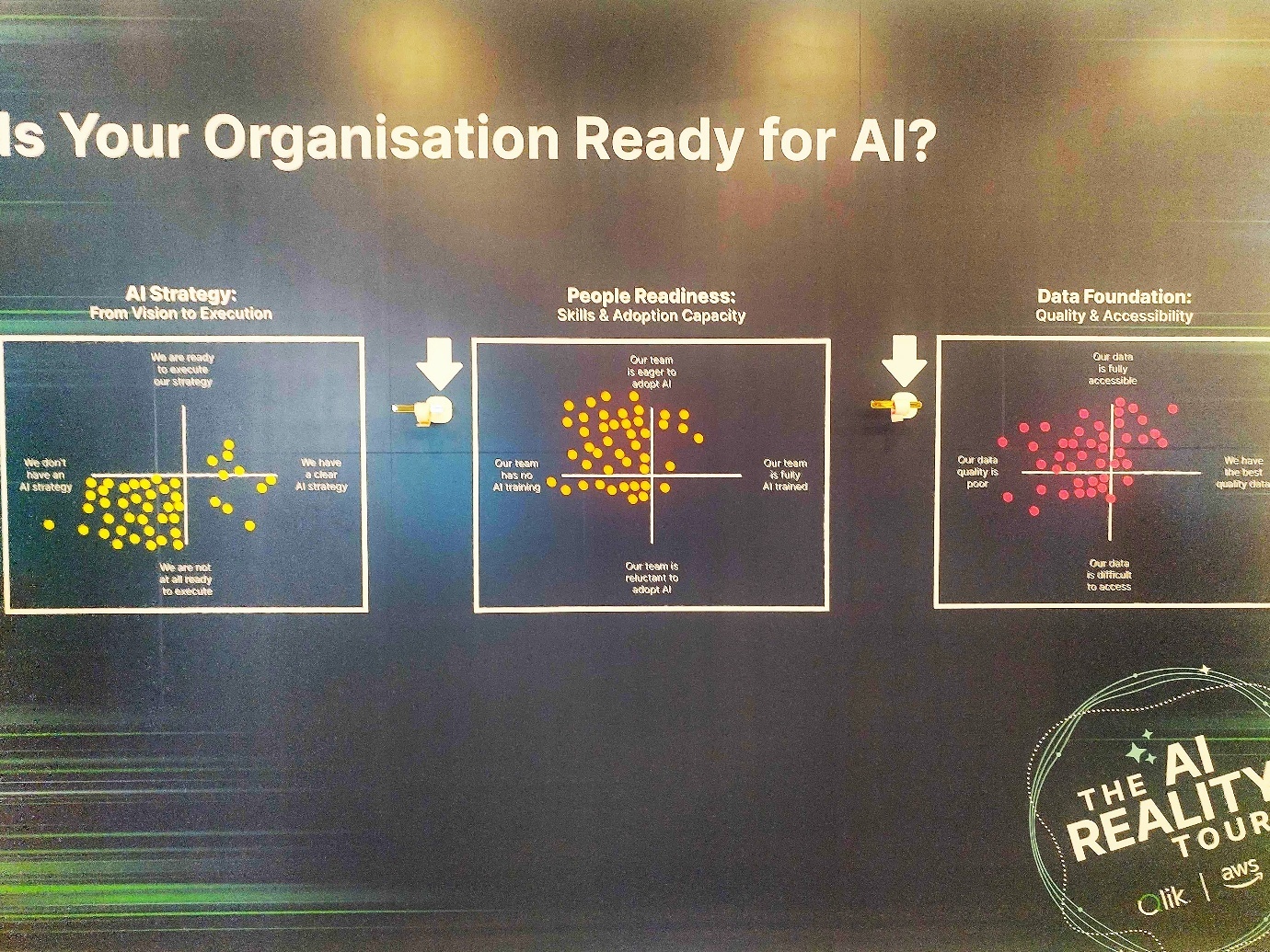
A wall of colourful stickers told a striking story about the state of AI in South African companies at the Qlik AI Reality Tour in Johannesburg this month. Through interactive readiness matrices, participants revealed where their organisations stand on strategy, people, and data. The picture that emerged was far from complete.
Most attendees said their companies did not have an AI strategy and were not ready to execute. On people readiness, they reported that teams lacked AI training but were eager to adopt the technology. For data foundations, attendees indicated that while their data was fully accessible, its quality was poor.
Artificial intelligence adoption in SA will succeed only if companies strengthen their data foundations and invest in people readiness. This theme was central to the event, designed to help organisations turn AI strategies into measurable outcomes while showcasing the data analytics and business intelligence company’s latest innovations.
“It was very interesting seeing the board, and the one thing that jumped out to me was the honesty,” Tejas Mehta, SVP and GM of Qlik for Middle East and Africa, told Gadget at the event.
“It’s really taking the self-reflection, taking a step back and saying: ‘this is really where I think my company falls’. When looking at overall adoption, it comes back down to: ‘does your AI and data strategy map back to your corporate strategy?’
“One of the most important aspects is aligning the data strategy with the corporate strategy. Without shared key performance indicators (KPIs) or the right skills in place, teams will not succeed.”
A recent Qlik study finds 92% of SA organisations deemed AI as either “absolutely essential” or “very important” to their success over the next 12 months, making it clear that AI is becoming a cornerstone of corporate strategy in the region.
Local respondents reported a strong pipeline of AI initiatives, with the average business managing anywhere between one and 50 AI projects in the planning and scoping stages, and between 36% and 48% of projects already in development or testing phases. Furthermore, an encouraging average of 23 projects per organisation are already live and operational.
Despite this, and an eagerness to adopt AI, the research reveals that an average of 17 AI projects per company have been paused or cancelled. The challenges identified include a lack of skills to support implementations post roll out (30%), insufficient resources to develop and work on the projects (25%), budget challenges (21%), and miscommunication around the project objectives (21%).
“When customers look at adopting AI, the use cases generally fall into one of three categories: modernisation, operational efficiency, and customer experience,” Mehta told Gadget. “The starting point is usually customer experience, because that’s the one you can see the easiest.”
He cited the example of telecoms providers that are no longer segmenting customers only by spend but by combining information from multiple sources, such as dropped call rates and service issues, to prioritise retention.
“When this customer calls, we need to fast-track them through the call centre, because we don’t want to lose this customer.”
Doing AI right in SA
Asked what AI done right looks like in SA, Mehta said it starts with data quality and governance.
“If you don’t have the right governance of the data, in terms of who can change it and whether it is categorised properly, you’re not going to get the right outcome and drive the insights that you’re looking for.”
He warned that many companies rush to get AI projects into production without securing their foundations. He said “garbage in, garbage out” remains true in the age of AI.
He advised companies to start with smaller use cases instead of tackling the most complex problems.
“The reality is you should start with the easiest problem. Building a minimal viable product, testing it, and getting it into production – that’s the most critical.”
People readiness and decision-making
While technology is important, Mehta said people and processes often present the biggest hurdles. Skills shortages, misaligned KPIs, and lack of collaboration can stall even the best-laid plans.
“There’s a realisation and an understanding that you do need to upskill, especially if you’re going to try to do something in a different way. You have to have folks that can look at in a different way.”
Mehta warned of “analysis paralysis”, where organisations stare at dashboards without acting. He said this can lead to manipulation and inaction, but skilled people who make decisions can break that cycle.
Qlik innovations
The 2025 AI Reality Tour showcased how Qlik enables execution at scale through three key innovations:
- One platform for data and AI: Qlik combines data integration, analytics, and AI within a single cloud-native platform to reduce handoffs and reliance on multiple tools.
- Open Lakehouse approach: Qlik Open Lakehouse supports real-time ingestion, Iceberg optimisation, and cross-engine access, with the aim of improving performance and lowering infrastructure costs.
- Embedded AI capabilities: Qlik integrates features such as discovery agents, forecasting, writeback, and data preparation directly into workflows to support operational use of AI.
“South Africa is at a pivotal moment in its AI journey,” said Mehta. “Businesses here clearly recognise the potential of AI, but many are still grappling with how to scale projects beyond pilots and proofs of concept.
“The AI Reality Tour is about bridging that gap – showing organisations what successful execution looks like and equipping them with the strategies and tools they need to move from experimentation to impact.”
*Jason Bannier is a data analyst at World Wide Worx and writer for Gadget.co.za. Follow him on Bluesky here.