


Photo: ARTHUR GOLDSTUCK.
Software
OpenAI, Oracle, hand AI
keys to the business
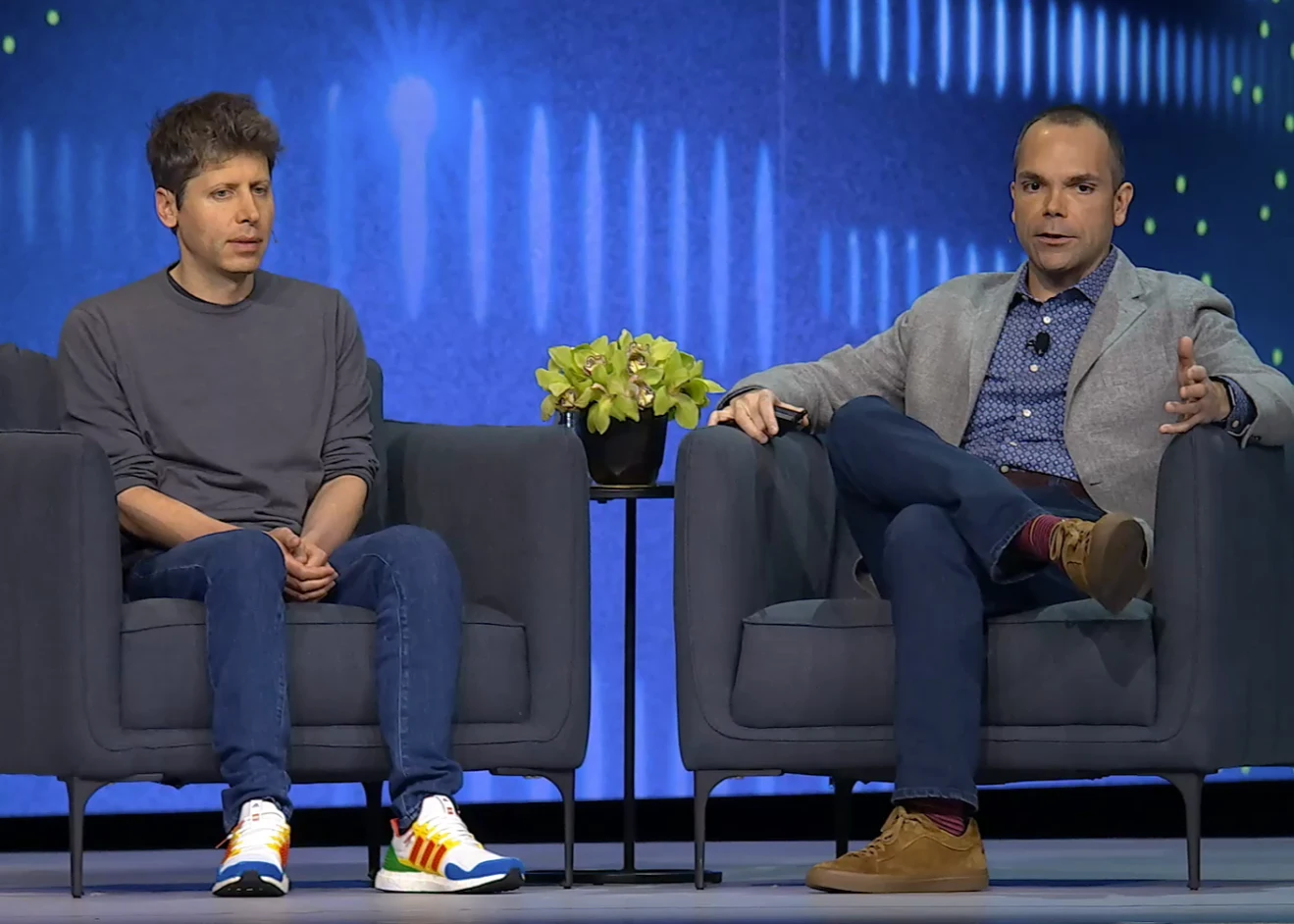
OpenAI CEO Sam Altman joined Oracle CEO Clay Magouyrk on stage at Oracle AI World to reveal how AI would transform business computing, writes ARTHUR GOLDSTUCK from Las Vegas.

Oracle has unveiled a sweeping partnership with OpenAI to bring ChatGPT and its underlying artificial intelligence (AI) models directly into business operations. The collaboration will allow employees to create their own software and deploy AI agents to carry out complex tasks.
The partnership introduces four products: Oracle AI Workspace, AI Security Mesh, App Composer and an AI bundle for small businesses. OpenAI CEO Sam Altman joined Oracle CEO Clay Magouyrk on stage during a keynote address at Oracle AI World in Las Vegas this week to discuss the accelerating capabilities of AI, including the revelation that more than 70% of Oracle’s software is now written by AI.
The collaboration extends from everyday business applications to cybersecurity and the specialised computer chips needed to run advanced AI systems. It brings together OpenAI’s ChatGPT and Codex coding technology with Oracle’s vast enterprise software portfolio, databases and cloud infrastructure.
Altman said the acceleration in AI capabilities was beginning to change the nature of technological invention itself.
“Many things here, but one of them that I can’t resist talking about is how much AI is now helping us discover new science, invent new technology, actually do this work of innovating and creating better things.
“We have seen tremendous examples with maths problems. We’re seeing that in lots of science. We’re seeing that in some of the most valuable technological problems we have.”
His appearance was a highlight of Magouyrk’s keynote, titled “Now that AI works, what are we going to do with it?” It gave the audience an unexpected perspective on the pace of technological change from the man leading the company most closely associated with the AI boom.
“The rate of change has been one of the biggest surprises to me this year,” said Altman. “We’ve talked about how fast it’s been going for four years. We launched ChatGPT almost four years ago, and four years ago our models couldn’t solve grade-school maths, and now they’re knocking down the hardest unproven maths problems we know of.
“But the last, say, six months have felt like a very accelerated version, even on that time frame.”
Altman said the introduction of GPT-6 in August had produced OpenAI’s strongest adoption yet for a new model, with users finding new applications for its capabilities across industries and scientific disciplines.
“GPT-6 was one of those moments where I think the models took a step forward all at once, both in terms of their ability to discover new knowledge, to do very hard things, but also for people’s ability to work with the models and get substantial pieces of work done at a rate that they never could before.”
Some of the most remarkable evidence of this transformation came from Oracle itself. Magouyrk disclosed that the company had rolled out ChatGPT Desktop to its entire workforce, with AI now responsible for the bulk of its software development.
“The vast majority of code, more than 70% of our software these days, is written by AI, and that’s only accelerating,” he said. “But in addition to that, the number of people I go and talk to who could not imagine themselves being a developer just a few years ago are out creating entirely new applications.”
That experience has influenced the development of Oracle App Composer, one of the major products announced under the partnership. It allows employees to use Codex to create applications through ordinary language, with Oracle providing the security and infrastructure to deploy them throughout an organisation.
A marketing manager could create a campaign management application, or a logistics employee could develop software to resolve recurring delivery problems. Oracle would manage deployment and permissions, allowing employees with limited programming experience to distribute their applications securely.
“We had so many people building these new applications, and we needed a secure, controlled way to deploy them,” said Magouyrk.
Altman said the spread of software creation throughout organisations had been among the surprises of OpenAI’s expansion into enterprise computing.
“They may not describe it as programming. In fact, I kind of think they wouldn’t. But the fact that now when they need something, they make an app to just do it.”
The partnership extends those capabilities into established business systems, where AI agents need access to corporate data and authorisation to carry out transactions.
Oracle AI Workspace, developed in close collaboration with OpenAI, connects Oracle’s business applications with external services like Microsoft 365 and Slack. Employees will be able to initiate workflows across multiple systems through a single interface.
Oracle demonstrated how an agent could respond to a supplier delay by identifying replacement products and checking warehouse availability. It then proposed order changes through Oracle’s Fusion applications, with human approvals controlling execution.
Cybersecurity is a major focus of the partnership. Oracle AI Security Mesh combines OpenAI’s specialised cybersecurity models with Oracle’s testing and management infrastructure to discover vulnerabilities and help companies repair them.
Altman delivered a clear message about the scale of the problem: “If I could recommend only one thing to a company right now, even more than become super productive with Codex, it would be to really understand the security threat landscape from AI and mitigate against that.”
However, Magouyrk made a distinction between the discovery of vulnerabilities and their origins: “AI is not creating the problem. AI is not creating these bugs. AI is helping us discover all of the security issues that we have developed over the past 50 years.
“I’m glad that we’re able to now discover them with AI rather than waiting for some unknown hacker to let us know about them.”
Altman agreed that companies needed to find and repair vulnerabilities, but warned that conventional approaches might prove inadequate.
“I think the only way through this is to go find all these issues and fix them. In fact, I think we’ll need new ways to fix them. It’s maybe too hard to patch every bug one by one across the entire supply chain that we’re all dependent on.”
AI Security Mesh is intended to automate much of that work, using specialist agents to identify potential attack paths, validate weaknesses and recommend repairs.
Smaller businesses are also being targeted through the partnership. A new Oracle AI SMB Bundle combines ChatGPT Business, Codex, Oracle AI Workspace and App Composer with Oracle Cloud Infrastructure and NetSuite QuickStart for financial management.
Oracle says the package will be free to start and include $12,000 in annual cloud credits, subject to its terms and conditions.
The overall partnership gives OpenAI access to Oracle’s established enterprise market, while Oracle gains direct access to the AI technology that is changing how business software is developed and operated.
Altman believes the implications will extend far beyond enterprise computing, as AI begins contributing directly to scientific discovery and technological invention.
“We have seen in a small number of years AI move from a chatbot to coding agents to the ability to directly convert AI into innovation, like AI compute into innovation. Whether that’s make a chip or cure disease, it means we’re all going to get much better stuff, higher-quality services, lower-cost services.
“And I think what this is going to enable … even though we now intellectually accept that it’s happening, we have not emotionally felt it yet.”
* Arthur Goldstuck is CEO of World Wide Worx, editor-in-chief of Gadget.co.za, and author of “The Hitchhiker’s Guide to AI – The African Edge”.