
Product of the Day
Canon EOS C50 debuts with 7K full-frame power
The compact camera features open gate recording, hybrid video and stills capability, and streamlined cloud connectivity.

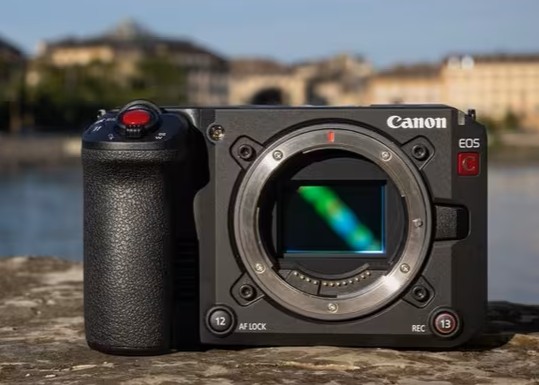
Canon has launched a full-frame RF-mount hybrid Cinema EOS camera, called the EOS C50. It is designed for professional videographers and production teams.
As the smallest camera in the Cinema EOS range, the EOS C50 can integrate into different types of filming environments, including fast-paced shoots and large-scale productions.
At the centre of the EOS C50’s design is a new 7K full-frame CMOS sensor, supported by a DIGIC DV 7 processor. This combination enables internal RAW video recording at up to 7K 60P, high frame rate recording at up to 4K 120P / 2K 180P, and still images with a resolution of 32MP.
The EOS C50 is the first Canon Cinema EOS camera to provide open gate recording, making use of the full sensor area. The Full Frame 3:2 sensor mode produces a larger image that takes advantage of the entire image circle of full-frame lenses. This recording method allows greater flexibility in post-production, as footage can be reframed for horizontal or vertical formats, and supports the use of anamorphic lenses for a wider cinematic presentation.
For fast-turnaround requirements, the EOS C50’s Simultaneous Crop Recording function allows a full-frame image and a cropped vertical or square version to be recorded at the same time. The cropped area can be adjusted horizontally to optimise framing and saved in different formats for delivery.
High-resolution and hybrid capability
The EOS C50 functions as a hybrid camera, supporting both 7K video and 32MP still photography. The display adapts depending on mode, with the Cinema EOS interface active in video mode and the Canon EOS R menu system in stills mode.
Its Dual Pixel CMOS AF II system provides subject detection and tracking with high precision. Users can set autofocus to prioritise one eye in humans or animals, and adjust autofocus speed and tracking behaviour according to the subject.
Adaptable design
The EOS C50 is built for flexibility with a lightweight, modular design suitable for handheld use or integration with gimbals. Its linear, low-profile body and accessory mounting points support a range of rigging options. The camera can be positioned horizontally or vertically, with the display and menu automatically adjusting for vertical operation.
The detachable handle unit enhances usability with two full-size 3-pin XLR audio inputs, control dials for audio, a REC button, and a zoom rocker, providing features suited to professional audio recording and efficient camera control.
Along with native support for RF lenses, the camera can be used with EF and PL lenses through adapters. The Canon PL-RF Mount Adapter provides secure mounting for PL lenses, while Canon EF-EOS R mount adapters allow compatibility with EF lenses.
Connection options
The EOS C50 is equipped with a variety of connectivity options, including XLR inputs, MIC terminal, Timecode terminal, HDMI OUT (Type-A), and USB (Type-C). It features dual card slots for CFexpress and SD cards, supporting simultaneous recording in multiple formats, resolutions, and proxy configurations.
For live production, the camera supports UVC/UAC streaming at up to 60P/50P via USB. Remote control is available through XC Protocol, compatible with smartphone applications and devices such as Canon’s RC-IP1000 Remote Controller. Media transfer to clients in real time is supported through Wi-Fi or USB using Canon’s Content Transfer Professional (CTP) app.
The EOS C50 supports Camera to Cloud connectivity through Frame.io, developed in collaboration with Adobe. This allows proxy files to be uploaded directly from the camera to the Frame.io platform. The same feature is available on the EOS C400 and EOS C80, supporting smoother production-to-post workflows.
The EOS C50 combines compact size with full-frame imaging and robust connectivity, positioning it as a professional option for both video and still photography. It continues the approach established with the EOS R5 C, focusing on high-quality imaging in a versatile format.
Canon has also announced upcoming free firmware updates for other Cinema EOS models. These include 3:2 Open Gate RAW Recording at 6000×4000 resolution for the EOS C400, View Assist during Playback for the EOS C80, and feature improvements such as enhanced focus peaking across the EOS C400, EOS C80, EOS R5 C, and EOS C70.
Key features of the Canon EOS C50 include:
- High-resolution hybrid capability: 7K 60p internal RAW video recording, 32MP still photos.
- Advanced 7K full-frame CMOS sensor with open gate video recording.
- 7K oversampling for higher resolution 4K movies.
- Dual Base ISO support (ISO 800/6400), with up to 15+ stops of dynamic range.
- Flexible range of professional recording formats, including 12-bit Cinema RAW Light, Canon Log 2, Canon Log 3 and XF-AVC S / XF-HEVC S.
- Versatile, compact design with detachable handle unit and extensive rigging capability
- Native RF mount, compatible with mount adapter attachment for EF/PL lenses.
- Two XLR audio inputs, Timecode terminal, HDMI OUT (Type-A), USB (Type-C), Multi-function shoe.
- Dual slots for CFexpress and SD cards, enabling simultaneous recording of different formats to each card.