



GadgetWings
BYD D1: The passenger review, via Mexico City
Departing from a stay in Mexico after the opening game of World Cup 2026. ARTHUR GOLDSTUCK was startled to learn a lesson in passenger-focused design.

The result of the World Cup opening game between South Africa and Mexico was, thankfully, a dim memory when I opened the Uber app to book a ride to the airport in Mexico City. An option appeared that I had not seen in any other city where I had used the app. It was called Uber Planet.
The description, in Spanish (thank you, Duolingo), explained that a small surcharge per kilometre – 0.37 pesos, which works out to roughly two US cents – would go towards carbon credits for environmental projects. I filed it mentally alongside the carbon-offset programmes airlines have been running for years: they help you feel better about your choices while the choices themselves remain unchanged.
But I was stopped by the price. Uber Planet was the cheapest option on the screen, priced below the standard rides I would have booked without a second thought. Even the standard pricing worked out at less than my rides to the airport in South Africa.

An environmentally branded option costing less than the alternatives made no obvious sense, so I booked it out of curiosity. Of course, I also had in mind the breakfast offset: the scientific term for spending money saved from the ride on an airport meal.
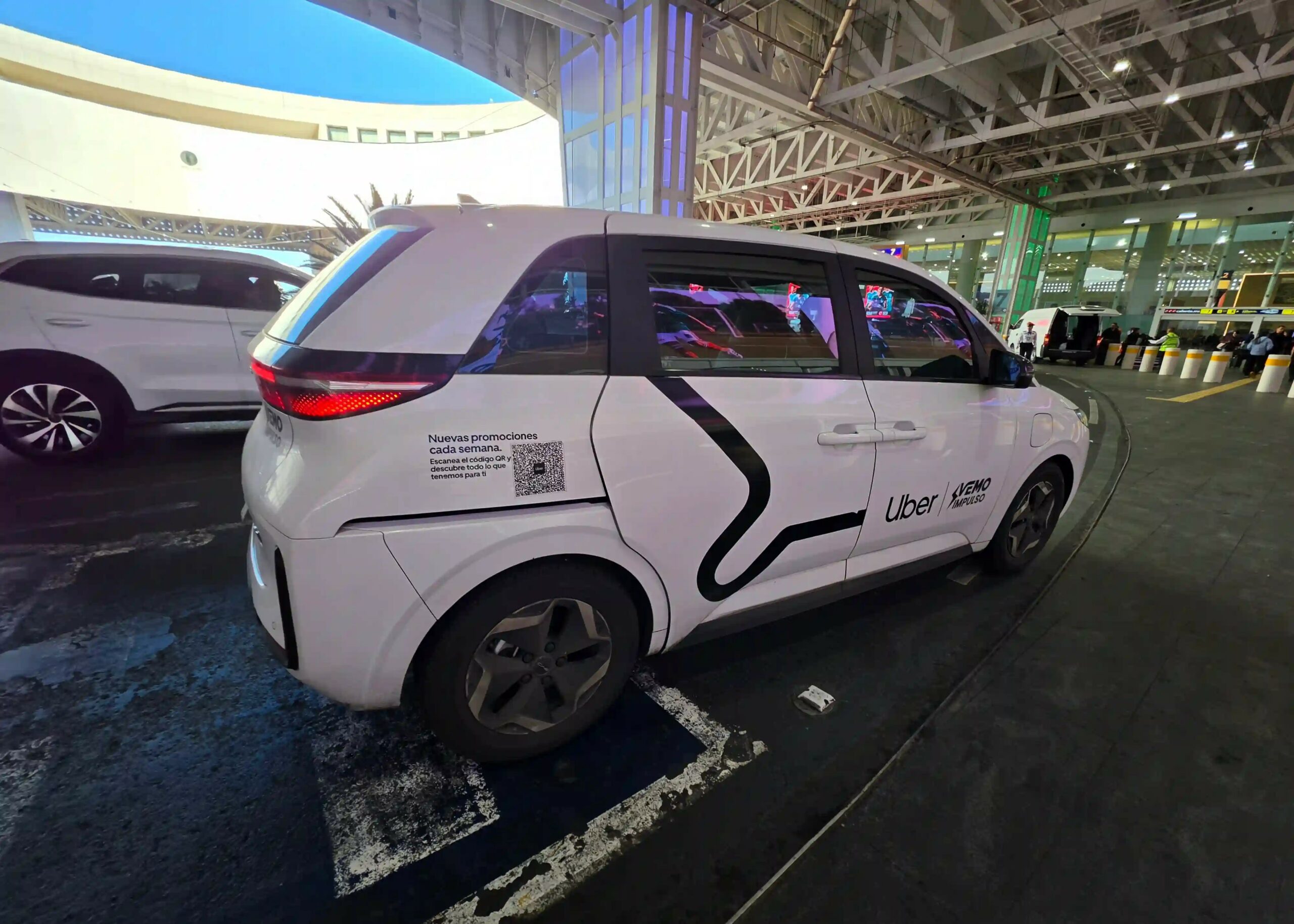
Two minutes later a vehicle rolled up carrying Uber branding on its doors. It looked unfamiliar in a way I couldn’t immediately pin down. I loaded my bag into the boot and checked the badge: BYD D1.
For most travellers those four characters mean nothing. For anyone who follows the Chinese automotive industry’s global push, or the EV industry’s battle to reshape urban mobility, they are worth a second thought. The D1 was unveiled in November 2020 as the world’s first custom-built electric vehicle designed exclusively for ride-hailing. As opposed to being adapted from a consumer model, rather than being retrofitted, it was engineered from scratch around a working shift on a ride-hailing platform.
It was built in partnership with DiDi, the Chinese ride-hailing giant that absorbed Uber’s Chinese operations in 2016 and now runs roughly ten billion trips a year. For South Africans who tried DiDi during its brief local adventure – it launched in Gqeberha in March 2021, expanded to Cape Town and Gauteng, then shut down exactly a year later – it may not have particularly fond associations.

In Mexico, where DiDi entered in 2018 and now holds around 25% of the ride-hailing market, the story has been a little different. The company has committed to bringing 100,000 electric vehicles onto Mexican roads by 2030, in partnership with Chinese manufacturers like BYD, GAC and Deepal.
The D1’s design made its purpose obvious once I got in. The rear passenger door slides rather than swings. It’s a detail that sounds minor until you’ve tried to exit a standard car door alongside a busy airport kerb without collecting a following ride-share customer.
The cabin is built around the passenger in ways the average ride-hailing vehicle is not: legroom generous enough to feel engineered, and a bench seat wide enough for spreading out comfortably. A 10.1-inch touchscreen in the dashboard handles the driver’s platform operations.

Under the floor sits a 53.6 kWh Blade lithium iron phosphate battery – apparently BYD’s own chemistry – giving the D1 a rated range of around 41km, with fast charging from 10% to 80% in roughly 35 minutes. It tops out at 130 km/h, which tells you speed was never the point, and the passenger would probably have cut the 5-star rating if the driver did push the limits.
Mexico became one of the earliest markets for the model outside China. Fleet operator Vemo placed the first significant foreign order in April 2022, initially putting 250 vehicles onto the Uber platform as a pilot, before expanding towards a fleet of one thousand. Vemo claims the deployment reduces emissions by around 20,000 tonnes of CO₂ annually. Uber and BYD subsequently announced a broader global partnership in July 2024, committing to put 100,000 BYD electric vehicles onto Uber’s platform across key markets, starting in Europe and Latin America.

All of which explains why the cheapest ride on the screen happened to be electric. Fleet operators running D1s at scale absorb lower servicing costs, cheaper fuel and longer vehicle lifespans. Those savings feed through to the booking price. It is not a subsidy or a loss leader, but what happens when the economics of EVs stop being a consumer premium and become an operational benefit.
The Uber Planet label is a separate mechanism from all of this. Those 0.37 pesos per kilometre go towards certified carbon credits: reforestation schemes and, among other projects, a wind farm in Oaxaca, verified by bodies that includes the UN Framework Convention on Climate Change.

Uber acknowledged in its own climate reporting that offsets have “weaknesses”, including verification challenges, and that paying someone else to take climate action is a different proposition from reducing emissions at source. Offset specialists have questioned whether Uber’s contributions to the Oaxaca project were financing something that would not have existed without them – which is, after all, the whole point of a carbon credit.
Electric vehicles that cost less to run than petrol alternatives, deployed at fleet scale, produce booking prices that undercut the conventional option. In Mexico City, that is already the reality.
* Arthur Goldstuck attended the opening match of the World Cup between Mexico and South Africa as a guest of Lenovo, official technology partner of FIFA for World Cup 2026.