


GadgetWings
Biometric freedom stalls at the border
After surrendering fingerprints, face and finances to half the world’s consulates, you may still spend hours in airport passport queues, writes ARTHUR GOLDSTUCK.

I stood in the passport hall at Schiphol for an hour, document in hand, occasionally shuffling forward. And it was not the very real fatigue from a sleepless overnight flight that rendered my appearance as slow motion.
The queue looped back on itself so many times I lost sight of the front. Every few minutes we lurched forward by half a metre, then stopped again. A woman behind me checked her watch so often I began timing the gaps between her sighs.
On the same flight, a couple I had chatted to during boarding decided to visit the bathroom before heading to passport control. By the time they joined the line, passengers from at least two earlier flights had filled the hall. They spent 90 minutes there. We compared notes later, less to complain than to confirm that the delay had been real and not imagined.
Departure was no quicker. It took another hour to clear passport control on the way out. Leaving felt as regulated as entering. Like, don’t they want us to leave?
Frankfurt has produced similar calculations. If your layover is under two hours and you must clear passport control, you add 60 to 90 minutes in your head and hope you do not need them. And again, that is going both ways.
All of this would make sense if identity were still established by paper documents inspected line by line. It is not.
To obtain a Schengen visa, I have provided fingerprints, facial scans, employment records, bank statements and detailed itineraries. The appointment system works. Biometrics are captured efficiently. Approval follows digital cross-checking that is far more comprehensive than the brief exchange that takes place at the desk on arrival.
And yet, after that scrutiny, you queue.
The passport is machine-readable. The gates can match a face to stored data in seconds. Border systems exchange passenger information before the aircraft touches down. Unless you hold the right passport, however, that digital preparation rarely translates into a shorter wait.
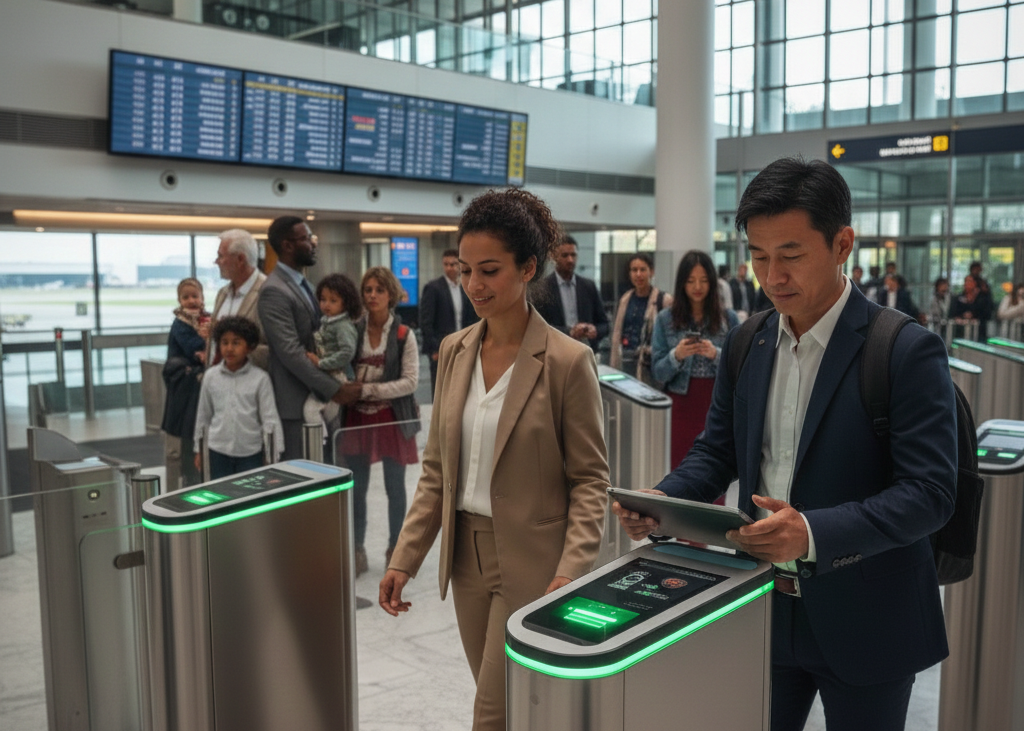
Dubai shows what fuller integration looks like. There, biometric gates match your face against pre-cleared records and open without ceremony. The officer is present, but the system does most of the work. The experience reflects the fact that your data has already been verified.
In major European hubs, the hardware is present but the throughput remains uneven. Gates stand idle while queues stretch. Staffing levels shift according to policy and supervision requirements. Arrival waves are scheduled around aircraft utilisation, not the capacity of the immigration hall. Aircraft movements are timed to the minute, and then human processing ingests the flow and emits the fatigue of queues.
This is not a failure of biometrics, but of alignment.
Airlines confirm you are the person on the ticket. Border authorities decide whether you may enter. Security agencies apply risk filters that are not always visible to the traveller. These systems intersect, but they do not operate as one. A visa proves you have been vetted, but it does not guarantee that the final checkpoint will reflect that vetting in its design or staffing.
Security will always take precedence. No reasonable traveller argues otherwise. The question is what the extensive data collection is meant to achieve if it does not ease the final stage of the journey for those who have already complied.
Pre-clearance before departure could shift much of the assessment upstream. In the USA, for all its entrance delays, passport checks on departure become the responsibility of the airline, which does the job – as logic should dictate – upon boarding.
Scheduling could account for processing capacity as well as runway slots. Immigration halls could be managed with the same rigour applied to baggage systems. None of these ideas require speculative technology. They require coordination between institutions that answer to different incentives. When I gave Schipol a poor rating on Google Maps (I said: “Arrival at Schipol is among the most painful travel experiences in the world. An hour in the passport line was no fun but I was lucky. A couple I know were in line for 90 minutes.”), I received this very prompt and polite response:
“Sorry to hear about your experience and the long waiting time at passport control, that must have been very frustrating. Passport control at Schiphol is handled by the Royal Netherlands Marechaussee. If you would like to share your feedback, please use the contact form on their website, as they are responsible for this process. I hope your next visit will be smoother.”
There you have it. The airport itself and the human flow into the airport are under two completely different jurisdictions. And the queue makes no distinction between a first-time tourist and a traveller who has submitted biometrics repeatedly over years.
After two hours at Schiphol and a similar experience in Frankfurt, the contradiction becomes difficult to ignore. Governments have built detailed digital portraits of travellers in the name of security and efficiency. At the point where efficiency should be visible, the process reverts to managed delay.
Biometric travel has advanced quickly in collection, but it has advanced at a snail’s pace in delivery. Until those two move at the same pace, the promise of frictionless movement will remain something travellers may only hear about from industry conferences while standing in line.