



Artificial Intelligence
Embedded AI engineers are here
Forward deployed engineers work inside customer companies to turn AI plans into working systems, and AWS is betting a billion dollars on their success, writes ARTHUR GOLDSTUCK.

A new category of AI worker is coming into its own: the forward deployed engineer (FDE).
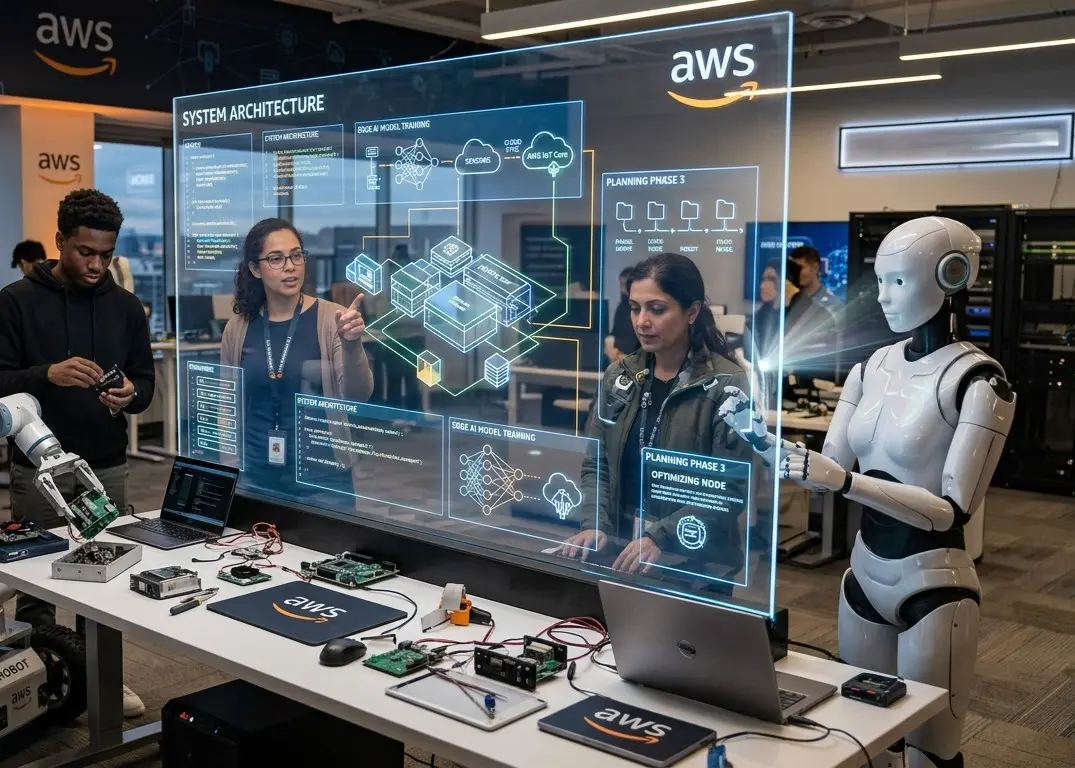
These are engineers who work inside customer companies, building AI systems around their data, software and business processes. They stay through deployment and train the customer’s employees to operate the systems themselves.
Amazon Web Services is investing $1-billion in the model through a new Forward Deployed Engineering organisation. It plans to embed thousands of AI specialists with customers to build agentic systems that can perform tasks and take actions under human supervision.
FDEs occupy ground traditionally divided between software developers and consultants, with the distinction coming from what they deliver. Consultants typically study a problem and recommend a course of action, while an FDE joins the customer’s team and builds the working system with it.
The engineer needs enough technical depth to connect AI models with databases, existing software and security controls. They also have to understand how the customer’s operation works, where its data may be used, and which decisions still require human approval.
The job has become especially relevant to generative AI projects because many companies have discovered that a successful demonstration is a long way from a dependable production system. While a chatbot or agent can be assembled quickly, connecting an AI agent to company records or allowing it to carry out useful work is a far larger engineering task.
AWS says its FDE teams will use AI agents themselves to speed up development, with human engineers guiding and checking their work. It claims this approach can compress deployments from months to days. That claim will depend heavily on the condition of a customer’s data and systems, as well as the complexity of the job.
The company says each engagement will be organised around shared business goals and results, with customer engineers gradually taking over the work. They begin by observing the AWS specialists, then build alongside them, before operating the system themselves.
AWS says customers will retain the deployed systems, architectural documents, operating instructions and knowledge graphs created during the project. A knowledge graph connects information and its relationships in a form that software can query. In this case, it gives AI agents a governed source of company-specific knowledge inside the customer’s AWS account.
This is intended to reduce a familiar risk in large technology projects: critical knowledge leaving with the outside specialists. AWS says domain expertise will be captured in the customer’s code and systems, while internal staff will be trained to continue development.
The approach also provides AWS with a way to get deeper into customers’ operations at a point when cloud providers are competing to host their AI workloads. An embedded engineering team can help a customer cross the gap between a pilot and a live system. Once deployed, that system is likely to consume AWS computing, storage, database and AI services.
The FDE programme combines technical assistance with a powerful route to cloud revenue. AWS promises to leave customers capable of running their own systems, but those systems will be built in the customer’s AWS environment. Customers will have to judge how reusable their new skills and software are outside that environment, and how much the faster deployment is worth over the life of the system.
AWS says security will be built into projects through hardware-based isolation and end-to-end encryption, with customer data remaining under the customer’s governance. Those provisions are aimed particularly at financial services, government and other regulated sectors, where a cool AI prototype has little value if it cannot pass compliance checks.
Partners will also participate, adding industry knowledge and specialist model expertise. AWS says it will invest in training and tools for those partners, although the announcement gives no breakdown of how the $1-billion will be divided between hiring, deployments, partner support and technology.
The company already has FDE teams working with the Allen Institute, Cox Automotive, the NBA, Ricoh, Southwest Airlines and the NFL. The NFL used the model to develop NFL Fantasy AI and NFL IQ, which allow fans and broadcasters to interact with its football data.
NFL chief information officer Gary Brantley said the league wanted new digital products to serve fans throughout the year, including the off-season.
“To create new digital experiences for our fans, the NFL partnered with AWS FDE and got engineers building alongside our team to launch into production in just weeks,” he said. “Together, we created new fan-facing products like NFL Fantasy AI and NFL IQ that allow fans to interact with NFL data like never before.”
AWS is extending work previously done by its Generative AI Innovation Center, whose engineers have participated in thousands of customer projects over the past three years. Among the examples cited by AWS are work with BMW across 23-million connected vehicles, and a Lyft driver-support system that it says resolved issues 87% faster.
Brantley said the NFL saw a response as soon as its services went live: “The engagement from fans and broadcasters was measurable from day one and was made possible by AWS’s delivery model.”